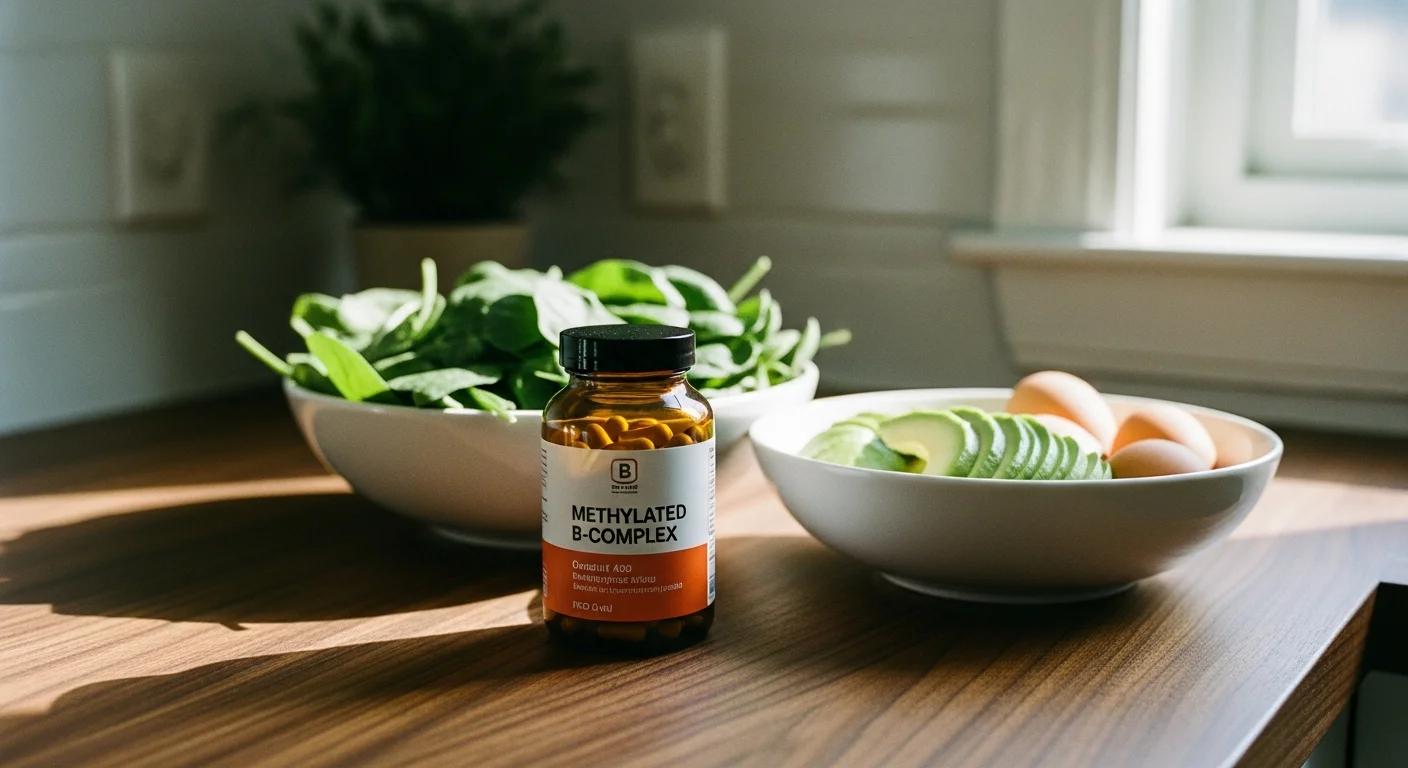

Yes, you can take too much of some B vitamins. Vitamin B6 causes dose-dependent nerve damage, with a United States upper limit of 100 mg a day and a European limit of 12 mg. Folic acid and methylfolate share a 1,000 mcg ceiling, set because high folate can hide a B12 deficiency. Vitamin B12 has no established upper limit.
TL;DR: Yes, you can take too much of some B vitamins. The big one is vitamin B6. Too much B6 over months can damage the nerves in your hands and feet, and the numbness can take a long time to fade. The United States sets the daily ceiling at 100 mg. Europe lowered its ceiling to 12 mg in 2023. Too much folate is a different problem: it can hide a B12 shortage, so your blood test looks normal while nerve damage keeps going. Vitamin B12 has no known ceiling and is safe at high doses. Niacin (B3) causes flushing, and gram-size doses of the slow-release kind can injure the liver. Follow these steps in order: line up every bottle you take, including your multivitamin and any energy drink or protein powder. Add up the B6 in milligrams and the folate in micrograms across all of them. Then ask your doctor to check B12, folate, and homocysteine before you raise any dose.
A 38-year-old CrossFit athlete in Northern Liberties came to see me because the balls of his feet felt like he was walking on crumpled socks at night. We lined up the bottles on his kitchen counter. He was taking a "methylated" B-complex (50 mg of vitamin B6), a magnesium-plus-B6 sleep powder (25 mg), and an afternoon energy drink (20 mg). That 95 mg of daily pyridoxine pushed his blood B6 to four times the upper reference limit. Stopping all three bottles resolved the nerve burning over the next four months without a single prescription drug.
Why doesn't "water-soluble" mean the extra washes out?
The phrase "water-soluble, so any excess washes out" is close to true for most of the B vitamins and wrong for the ones that matter. Water solubility describes how a vitamin travels in the blood and how readily the kidneys clear it. It says nothing about what that vitamin does to tissue during the hours it circulates. It also says nothing about what happens over 3 years of daily dosing.

Vitamin B6 is the counterexample that ends the argument. The Food and Nutrition Board at the National Academies set an upper intake level for B6 in adults because of nerve damage.15 Sensory neuropathy is the specific endpoint the whole limit is built on. A nutrient cannot both wash out harmlessly and be the reason a federal panel wrote a safety ceiling.
The excretion argument also treats each day as a separate event. When the European Food Safety Authority reviewed B6 in 2023, it applied an uncertainty factor of 4 to its reference dose.6 That factor accounts for the inverse relationship between daily dose and time to symptom onset: the lower the daily dose, the longer the exposure runs before nerve symptoms appear. A year without symptoms is weak evidence of safety at that dose, because the clock may simply be short.
Folate is the other exception, and for a different reason. The harm there comes from what a high folate intake conceals.27
How much vitamin B6 is too much?
Vitamin B6 toxicity is the best-established harm in this whole category, and the 2 major regulators are far apart on the number.56
In the United States, the Food and Nutrition Board (National Academy of Medicine) set the tolerable upper intake level for adults at 100 mg per day.15 Trials in patients taking an average of about 200 mg per day for up to 5 years found no neuropathy. The board halved that figure to 100 mg because the long-term data had gaps it did not want to build on. Those limits do not apply to people taking B6 as a prescribed medical treatment under a physician's supervision.
In 2023, the European Food Safety Authority set the upper level for all adults, including pregnancy and lactation, at 12 mg per day.6 That dropped from the 25 mg per day figure European regulators had used since 2000. The panel identified a reference point of 50 mg per day from a case-control study, supported by case reports and pharmacovigilance data, then applied an uncertainty factor of 4. Most human reports describe clinical neuropathy at intakes between 100 and 6,000 mg per day, with latency running from 1 to 72 months.6
Read those 2 findings together and the picture is clear. Regulators differ by roughly 8-fold on where the ceiling belongs, and the recent movement has been downward.
What the nerve injury looks like
A 2023 review in Nutrients pooled 20 studies, and a 2026 Sports Medicine review (van Keulen et al.) studied high-intake athletes.817 Both found that excess vitamin B6 injures the dorsal root ganglia (which lack a blood-brain barrier) and causes sensory nerve damage.81719 At the cell level, high doses of pyridoxine hydrochloride saturate converting enzymes and block active pyridoxal-5'-phosphate (P5P) (Vrolijk et al., 2017; Hadtstein & Vrolijk, 2021).1819 That creates a B6 block inside sensory nerve cells. The long sensory nerves suffer first: numbness, tingling, burning feet and hands, and unsteady footing in the dark.1920 Early small-fiber burning can appear while standard nerve tests (EMG/NCS) still look normal.1920 That pattern looks just like vitamin B12 deficiency.
Human studies (Berger et al., Neurology 1992) show that symptoms can briefly worsen for 2 to 3 weeks after stopping ("coasting") before slow recovery begins over months.81020 Do not swap in high-dose P5P right after stopping pyridoxine assuming it is proven safe.19 Also, because mildly raised B6 did not match nerve severity in 261 neuropathy patients (Stewart et al., 2022), stopping B6 must be paired with a full check of B12/MMA, blood sugar, and thyroid.21 Stopping B6 is the treatment, and stopping it early beats stopping it late.
The uncomfortable case reports
A case report published in Cureus in 2023 describes an older adult with 3 years of progressive peripheral neuropathy and a serum vitamin B6 of 259.9 nmol/L against a reference range of 20 to 125 nmol/L.9 The only source was a daily multivitamin containing 6 mg of B6, well under both regulatory ceilings. A month after stopping it, the dizziness had resolved and the numbness and tingling had partly improved.
A single patient report is the weakest tier of clinical evidence, and it cannot prove that 6 mg per day causes neuropathy on its own. What it does is mark the edge of what is known, and the edge is closer to ordinary doses than most people assume.
What happens when you take too much folate?
The upper intake level for folate in adults is 1,000 mcg (micrograms) per day.27 The limit applies to folic acid and supplemental folate from pills and fortified food, and it excludes the natural folate you eat in whole food. There is no ceiling on the folate in lentils and spinach.
That ceiling was set to keep high folate intake from masking a vitamin B12 deficiency.27
The masking problem, step by step
Vitamin B12 deficiency does 2 separate things to the body at the same time. It makes red blood cells large and causes anemia, and it damages the spinal cord and the peripheral nerves. Those 2 injuries run on different tracks.
Folate corrects the blood count while doing nothing for the nerves.211 A person with an untreated B12 deficiency who takes high-dose folic acid can watch the complete blood count normalize while the nerve injury continues underneath with the warning light switched off. Carried long enough, that damage stops being recoverable. The order of operations is simple: check B12 (and methylmalonic acid when borderline) before raising folate, and correct a low B12 first or alongside folate.
The limit applies to methylfolate too
When the European Food Safety Authority revisited folate in 2023, it retained the 1,000 mcg per day adult limit and stated that the limit applies to the combined intake of folic acid, (6S)-5-methyltetrahydrofolic acid glucosamine salt, and L-5-methyltetrahydrofolic acid calcium salt.7
Methylfolate is the third item on that list. Choosing the active form solves an absorption and conversion step, which is why we prefer it and why our B-complex guide recommends it. It does not buy you a higher ceiling, and it does not exempt you from the masking problem, because 5-MTHF corrects the blood count just as folic acid does.7
The cancer signal, at its true strength
In the Aspirin/Folate Polyp Prevention Study, 1,021 people with prior colorectal adenomas were randomized to 1 mg per day of folic acid or placebo (Cole and colleagues, JAMA, 2007).13 Folic acid did not prevent new adenomas. At a follow-up colonoscopy around 3 years later, the folic acid group had more advanced and more multiple adenomas. Among the 643 men in the trial, 10-year prostate cancer incidence was 9.7% in the folic acid group versus 3.3% on placebo (Figueiredo and colleagues, JNCI, 2009).14
Those numbers deserve care and proportion. Both findings come from a trial in people already selected for adenoma history, and a later meta-analysis of folic acid trials found no overall adenoma effect (OR 1.08). Use caution with long-term supplemental folate at or above 1 mg per day if you have a personal history of colorectal adenomas or prostate cancer. It is not a reason for the general public to fear dietary folate.
Unmetabolized folic acid, which the internet oversells
At high intakes, folic acid turns up in the blood in its unconverted form because the liver's DHFR enzyme converts it slowly. That observation is clear, while its clinical meaning remains unsettled. An early study linked plasma unmetabolized folic acid to lower natural killer cell activity in older women (Troen and colleagues, Journal of Nutrition, 2006).15 Later lab work found that folic acid did not alter natural killer cell activity directly. Reviews of this literature conclude that harms from unmetabolized folic acid remain unproven outside the B12-masking risk.27
What is the methyl trap, and how is it different from "overmethylation"?
The methyl trap, also called the folate trap, is established biochemistry that describes what goes wrong in vitamin B12 deficiency.11
Your cells shuttle folate between several chemical forms. The step that produces 5-methyltetrahydrofolate (5-MTHF, the molecule sold as methylfolate) runs in one direction and does not reverse. The only exit from 5-MTHF back to usable tetrahydrofolate is an enzyme called methionine synthase, which requires vitamin B12 as a cofactor.11
Take away the B12 and the exit closes. Folate piles up as 5-MTHF with nowhere to go, the other folate forms your cells need for DNA synthesis run short, and you end up with a functional folate shortage inside cells (Smulders and colleagues, British Journal of Haematology, 2006).11
Two practical lessons follow. Giving folate to someone who is B12 deficient does not open the trap, because the missing piece is B12. And giving folate makes the trap harder to spot on a routine CBC, since high folate restarts DNA division and normalizes red cell size.
The supplement-community claim of "overmethylation" uses similar words to describe a different idea: that taking methylfolate floods the body with methyl groups and causes anxiety. The methyl trap is about too little B12. That internet claim is about too much methylfolate.
Fishtown Medicine
A 90-minute conversation with Dr. Ash. A written plan you can follow.
How strong is the evidence that high-dose methylfolate causes anxiety?
The evidence is weak. The "overmethylation" framework traces back to clinical anecdotes instead of controlled trials, and the proposed COMT mechanism has not been shown in randomized human studies. Genotype does not rescue the argument either: an MTHFR test result cannot predict whether folate will improve or worsen mood, anxiety, or sleep in a given person.
Controlled trial data point the other way. In 2 randomized, double-blind, placebo-controlled trials of L-methylfolate at 15 mg per day (15,000 mcg/day) added to an SSRI in depression (Papakostas and colleagues, American Journal of Psychiatry, 2012), adverse event rates and study withdrawals matched placebo.12 That dose is 15 to 35 times higher than a standard methylated B complex.
When a patient tells me they feel jittery or wired in the first week on a methylated B complex, we still adjust the plan right away. We start every other day, build up slowly, or switch to hydroxocobalamin plus folinic acid if the feeling persists. We simply skip the "overmethylation" label and focus on the 2 B-vitamin ceilings that are documented: vitamin B6 nerve toxicity and folate masking of B12 deficiency.
Which B vitamins are safe at high doses, and which are not?
Being accurate about the safe B vitamins matters just as much as flagging the risky ones.
| B vitamin | Adult upper limit (United States) | What the limit protects against |
|---|---|---|
| B3, niacin | 35 mg per day | Flushing; liver injury at gram-size doses |
| B6, pyridoxine | 100 mg per day (Europe: 12 mg per day) | Sensory peripheral neuropathy (dorsal root ganglia) |
| B9, folate | 1,000 mcg per day of folic acid or methylfolate from supplements and fortified food | Masking a B12 deficiency while nerve damage continues |
| B12, cobalamin | None established | No limit set, because toxicity potential is low |
| B1, B2, B5, B7 | None established | No dose-related harm identified at intakes reviewed |
Niacin (B3) is the third one to respect
The 35 mg per day upper level for niacin was set on flushing as the critical adverse effect, against a recommended intake of 16 mg per day for men and 14 mg for women.4 The flush brings warmth, redness, and itching within 30 minutes of a dose.
Liver injury is the serious risk with high-dose niacin, and it depends on the formulation.16 Niacin hepatotoxicity is dose-dependent and much more common with sustained-release over-the-counter preparations than with immediate-release niacin. The high-risk pattern is someone taking gram-size doses (1,000 to 3,000 mg/day) of an over-the-counter time-release niacin for cholesterol without checking liver enzymes.16
B12 is the low-risk one
The Food and Nutrition Board declined to set an upper limit for vitamin B12 because its potential for toxicity is very low, and high oral doses (1,000 to 2,000 mcg/day) are safe.3
Low risk is different from universal benefit. Taking large amounts of B12 when your levels and methylmalonic acid are already optimal produces expensive urine and nothing else, which is the first gate in how we choose supplements. On B12 form, we prefer methylcobalamin or hydroxocobalamin over cyanocobalamin, particularly in patients with reduced kidney function.
Thiamin (B1), riboflavin (B2), pantothenic acid (B5), and biotin (B7) have no upper limits either. Biotin carries a lab-testing caveat: high doses interfere with the streptavidin-biotin immunoassays used for thyroid (TSH, Free T4) and troponin blood tests, which is why we hold a B complex for 72 hours before any blood draw. Our B-complex guide covers that rule in detail.
How do people end up taking too much without knowing?
Almost always by stacking across multiple daily products.
A multivitamin, a separate B complex, an energy drink, a pre-workout, a fortified cereal, and a greens powder can each carry B6 and folate. Every label looks modest read on its own, yet your nerve exposure depends on the daily sum across all of them. Enriched grains in the United States have also been fortified with folic acid since 1998, and high-potency bottles advertise 2,000% or 5,000% of the daily value on the front label as if bigger numbers meant better health.
The fix takes 10 minutes at the kitchen counter. Put every bottle, drink can, and powder tub on the table, write down the B6 in milligrams and the folate in micrograms from each panel, and add the columns.
How does Fishtown Medicine decide on a B vitamin dose?
Dr. Ash runs the same 4 gates on every supplement in your cabinet:
- Do you need it? We check serum B12, folate, homocysteine (< 8 umol/L target), MCV (80 to 87 fL target), and methylmalonic acid (MMA < 260 nmol/L). Those markers show whether a B complex belongs in your plan at all.
- Is it safe for you? We total your B6 across every product you take. When supplemental B6 is needed, we keep it at 10 to 25 mg/day as active P5P, and near the 12 mg/day European ceiling for long-term use. We also total your folate and confirm B12 status before raising folate. If your feet or hands feel numb or tingly, we check both B12/MMA and plasma B6 right away.
- Does the dose work? We match the dose to the marker we are moving and recheck in 8 to 12 weeks.
- What does it cost? We pass 100% of our Fullscript discount straight to you at cost. Stopping 3 overlapping bottles in your cabinet saves you money and protects your nerves.
In Philadelphia, we see stacked B6 every week. Between long winters, the after-shift energy drinks that get our restaurant and hospital patients through a double, and the pre-workouts in gyms around Fishtown and Northern Liberties, the daily B6 total we uncover on intake is often 50 to 150 mg higher than the patient knew. Bring the bottles (or snap photos of the labels in your intake) and we will count them together.
Guidance from the Clinic

Actionable Steps
Count what you are already taking before you change anything.
- Put every bottle on the counter. Include your multivitamin, B complex, greens powder, pre-workout, and any energy drink you have more than occasionally. Anything with a Supplement Facts panel counts.
- Add up the B6 in milligrams. Compare your daily total against 100 mg per day (the US ceiling) and 12 mg per day (the 2023 European ceiling). Any long-term total above 12 to 25 mg per day deserves a look with your doctor.
- Add up the folate in micrograms. Folic acid and methylfolate share the same 1,000 mcg per day ceiling from supplements and fortified food. Whole-food folate does not count toward the limit.
- Get B12, MMA, folate, and homocysteine checked before raising folate. Correcting a low B12 first keeps folate from masking a deficiency, and homocysteine shows whether your cellular methylation cycle is keeping up.
- Report numbness or tingling in your feet or hands right away. Sensory symptoms in someone taking high-dose B6 are a reason to stop the supplement and get examined promptly.
Key Takeaways
- Vitamin B6 is the best-documented B vitamin toxicity: the US upper limit is 100 mg per day, the European limit is 12 mg per day (2023), and excess pyridoxine injures the dorsal root ganglia, causing a sensory axonal neuropathy that can mimic B12 deficiency.568
- Folate's 1,000 mcg per day upper limit prevents masking a vitamin B12 deficiency, and European regulators apply that same limit to methylfolate.27
- The methyl trap is established biochemistry about too little B12, which is distinct from the internet claim that methylfolate causes "overmethylation."11
- Randomized trials of L-methylfolate at 15 mg per day (15,000 mcg) showed adverse event rates no different from placebo.12
- Vitamin B12 has no established upper limit and is safe at high oral doses (1,000 to 2,000 mcg/day); niacin's 35 mg per day limit is set on flushing, with liver injury a risk at gram-size doses of sustained-release products.3416
- Stacking is how most people cross a limit: total the B6 in milligrams and the folate in micrograms across every multivitamin, B complex, pre-workout, and energy drink before changing a dose.17
A note on cost: any discount we negotiate on professional-grade supplements passes straight through to you, with no markup. Read how we choose and source supplements.
Related at Fishtown Medicine
- Vitamin B12 Deficiency: Why a Normal Level Can Miss It - how MMA, homocysteine, and active B12 catch cellular deficiency in the 170 to 390 pg/mL gray zone
- B-Complex Clinical Guide - which forms to use, how to dose them, and the 72-hour biotin-before-labs rule
- How We Choose Supplements - the 4 gates: need, safety, dose, then cost
- MTHFR and Methylation - what the gene variant does and does not predict
- Homocysteine and Methylation Testing - the functional markers (< 8 umol/L and MCV 80 to 87 fL) we dose against
- Personalized Supplement Logic - why the dose belongs to your labs and clinical story
Scientific References
- National Institutes of Health, Office of Dietary Supplements. "Vitamin B6: Fact Sheet for Health Professionals." https://ods.od.nih.gov/factsheets/VitaminB6-HealthProfessional/
- National Institutes of Health, Office of Dietary Supplements. "Folate: Fact Sheet for Health Professionals." https://ods.od.nih.gov/factsheets/Folate-HealthProfessional/
- National Institutes of Health, Office of Dietary Supplements. "Vitamin B12: Fact Sheet for Health Professionals." https://ods.od.nih.gov/factsheets/VitaminB12-HealthProfessional/
- National Institutes of Health, Office of Dietary Supplements. "Niacin: Fact Sheet for Health Professionals." https://ods.od.nih.gov/factsheets/Niacin-HealthProfessional/
- Institute of Medicine, Food and Nutrition Board. Dietary Reference Intakes for Thiamin, Riboflavin, Niacin, Vitamin B6, Folate, Vitamin B12, Pantothenic Acid, Biotin, and Choline. National Academies Press, 1998. https://www.nationalacademies.org/read/6015/chapter/9
- EFSA Panel on Nutrition, Novel Foods and Food Allergens. "Scientific opinion on the tolerable upper intake level for vitamin B6." EFSA Journal. 2023. https://efsa.onlinelibrary.wiley.com/doi/10.2903/j.efsa.2023.8006
- EFSA Panel on Nutrition, Novel Foods and Food Allergens. "Scientific opinion on the tolerable upper intake level for folate." EFSA Journal. 2023. https://efsa.onlinelibrary.wiley.com/doi/10.2903/j.efsa.2023.8353
- Muhamad R, Akrivaki A, Papagiannopoulou G, Zavridis P, Zis P. "The Role of Vitamin B6 in Peripheral Neuropathy: A Systematic Review." Nutrients. 2023;15(13):2823. https://doi.org/10.3390/nu15132823
- Paluszny A, Qiu S. "Vitamin B6 Toxicity Secondary to Daily Multivitamin Use: A Case Report." Cureus. 2023. https://pubmed.ncbi.nlm.nih.gov/38098895/
- Hemminger A, Wills BK. "Vitamin B6 Toxicity." StatPearls. NCBI Bookshelf. https://www.ncbi.nlm.nih.gov/books/NBK554500/
- Smulders YM, et al. "Cellular folate vitamer distribution during and after correction of vitamin B12 deficiency: a case for the methylfolate trap." British Journal of Haematology. 2006. https://pubmed.ncbi.nlm.nih.gov/16445837/
- Papakostas GI, et al. "L-methylfolate as adjunctive therapy for SSRI-resistant major depression: results of two randomized, double-blind, parallel-sequential trials." American Journal of Psychiatry. 2012. https://pubmed.ncbi.nlm.nih.gov/23212058/
- Cole BF, Baron JA, Sandler RS, et al. "Folic Acid for the Prevention of Colorectal Adenomas: A Randomized Clinical Trial." JAMA. 2007. https://pubmed.ncbi.nlm.nih.gov/17551129/
- Figueiredo JC, et al. "Folic Acid and Risk of Prostate Cancer: Results From a Randomized Clinical Trial." Journal of the National Cancer Institute. 2009;101(6):432-435. https://pubmed.ncbi.nlm.nih.gov/19276452/
- Troen AM, et al. "Unmetabolized folic acid in plasma is associated with reduced natural killer cell cytotoxicity among postmenopausal women." Journal of Nutrition. 2006. https://pubmed.ncbi.nlm.nih.gov/16365081/
- LiverTox: Clinical and Research Information on Drug-Induced Liver Injury. "Niacin." National Institute of Diabetes and Digestive and Kidney Diseases, NCBI Bookshelf. https://www.ncbi.nlm.nih.gov/books/NBK548176/
- van Keulen TV, Lewis NA, Pedlar CR. "Vitamin B6 in elite athletes: potential implications of high intakes." Sports Medicine. 2026;56(2):241-258.
- Vrolijk MF, Opperhuizen A, Jansen EHJM, Hageman GJ, Bast A, Haenen GRMM. "The vitamin B6 paradox: supplementation with high concentrations of pyridoxine leads to decreased vitamin B6 function." Toxicology in Vitro. 2017;44:206-212.
- Hadtstein F, Vrolijk M. "Vitamin B-6-Induced Neuropathy: Exploring the Mechanisms of Pyridoxine Toxicity." Advances in Nutrition. 2021;12(5):1911-1929.
- Berger AR, Schaumburg HH, Schroeder C, Apfel S, Reynolds R. "Dose response, coasting, and differential fiber vulnerability in human toxic neuropathy: a prospective study of pyridoxine neurotoxicity." Neurology. 1992;42(7):1367-1370.
- Stewart SL, Thomas S, Höke E, et al. "Vitamin B6 levels do not correlate with severity of neuropathy in chronic idiopathic axonal polyneuropathy." Journal of the Peripheral Nervous System. 2022;27(1):66-72.

Frequently Asked Questions
Common Questions
Deep-Dive Questions
Ready when you are
The chat is our AI assistant, answering from our published guides. To talk it through with Dr. Ash himself, start with the intake.