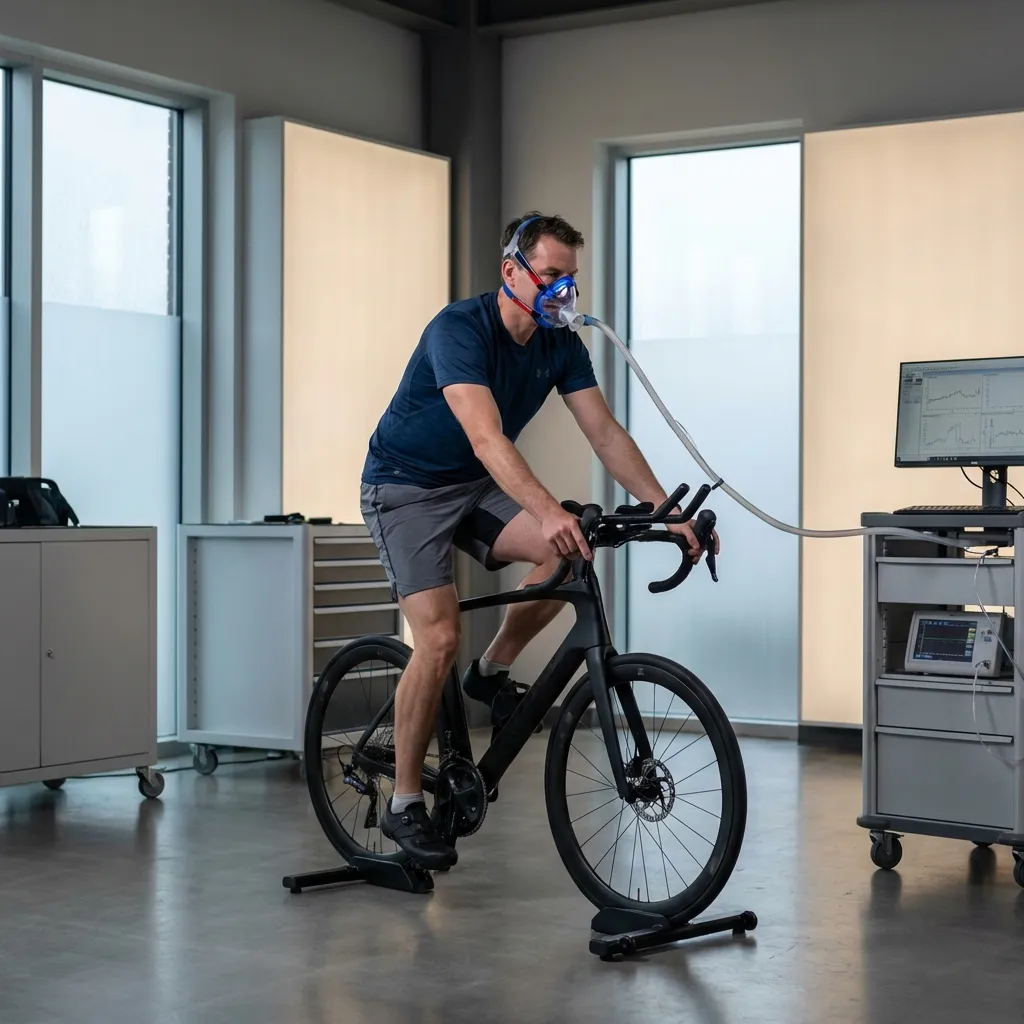

VO2 Max is the maximum oxygen your body can use during intense exercise, and across cohorts of more than 750,000 adults, it is the strongest single predictor of how long you will live. Every +1 MET (+3.5 mL/kg/min) increase lowers all-cause mortality by 12 to 14%, and moving from low fitness to elite fitness cuts death risk by 75 to 80% (~6 extra years of life) with no upper mortality ceiling. Under a 2 to 4 hour weekly schedule, Norwegian 4x4 intervals at 90 to 95% max heart rate raise VO2 Max 4.6-fold faster per minute of training than steady Zone 2 alone by directly expanding cardiac stroke volume (+10 to 14%).
TL;DR:
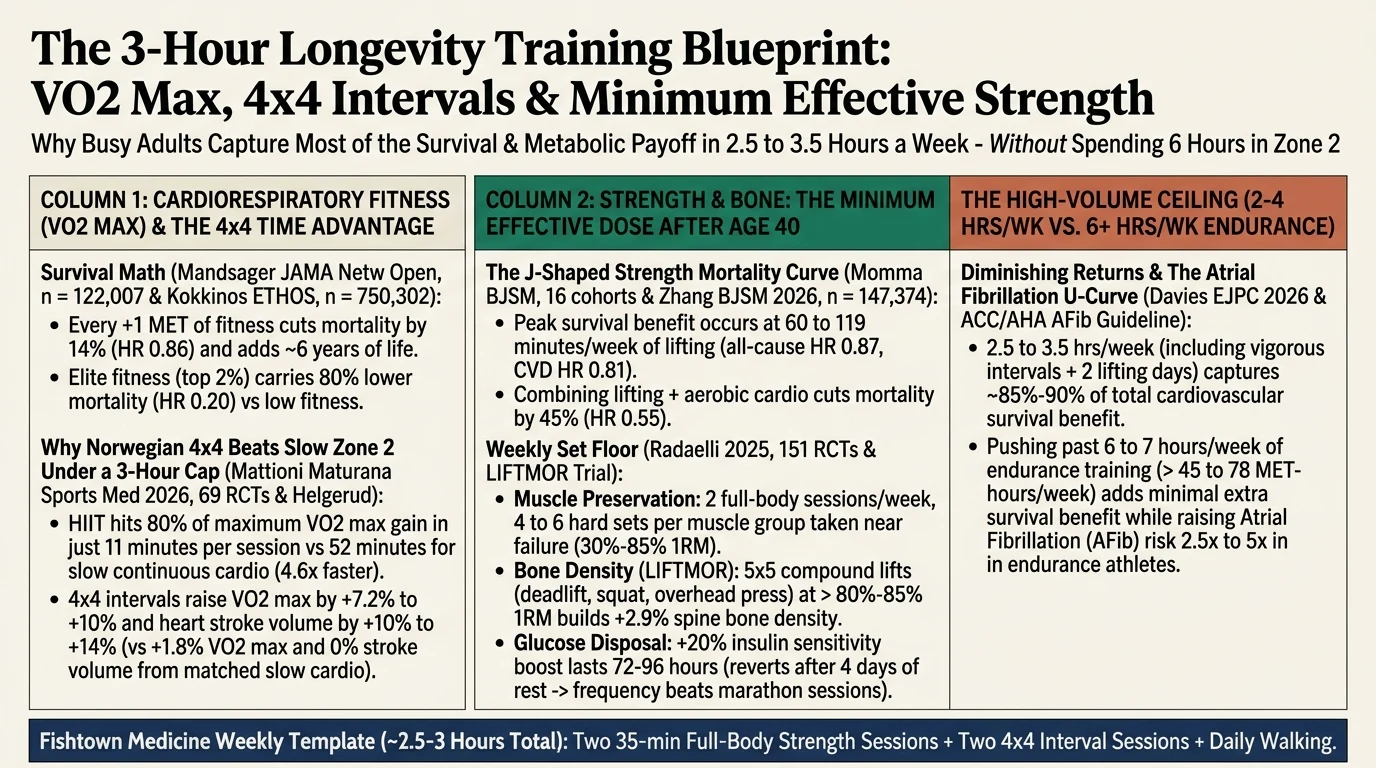
- The strongest survival predictor: In the Cleveland Clinic cohort (n = 122,007) and the VA ETHOS study (n = 750,302), moving from the bottom fitness tier to the top tier cuts all-cause mortality by 75 to 80% (HR 0.20 to 0.24) and adds roughly 6 years of life expectancy, with no upper mortality ceiling.12
- Every +1 MET counts: Each +1 MET (+3.5 mL/kg/min of VO2max) lowers all-cause mortality by 12 to 14%, cardiovascular death by 16%, and cancer death by 14%.23
- Why 4x4 intervals beat steady cardio for VO2max: Across 69 randomized trials (Mattioni Maturana 2026), high-intensity intervals reach 80% of their maximum VO2max gain (+3.45 mL/kg/min) in ~15 minutes of hard work per week (4.6-fold more time-efficient than moderate cardio) because 90 to 95% HRmax bouts expand cardiac stroke volume by +10 to 14% (Helgerud 2007; Bækkerud 2016), whereas steady Zone 2 alone changes stroke volume by 0%.456
- Pair VO2max with strength: Combining aerobic fitness with 2 weekly strength sessions (60 to 120 minutes/week) lowers all-cause mortality by 45% (HR 0.55), while each 5 kg drop in grip strength independently raises death risk by 16% (PURE study).78
- Fitness vs. 6+ hour endurance volume: Having an elite VO2max carries zero survival penalty, whereas logging 6 to 7+ hours per week of vigorous endurance volume over years raises atrial fibrillation (AFib) risk 2.5- to 5-fold.910
Why does VO2 Max belong at the top of your medical chart?
VO2 Max is the single most powerful modifiable predictor of all-cause mortality in medicine, outranking smoking, diabetes, coronary artery disease, and blood pressure.12 It measures the integrated horsepower of your lungs, heart stroke volume, blood vessels, and muscle mitochondria.
If I could know only one number to predict how you will age over the next 30 years, it would not be your cholesterol or even your blood pressure. It would be your VO2 Max (paired with your appendicular lean mass and grip strength).
VO2 Max is the maximum volume of oxygen your body can pull out of the air, pump through your heart, and burn inside your muscle cells during maximal effort, measured in milliliters of oxygen per kilogram of body weight per minute (mL/kg/min) or metabolic equivalents (1 MET = 3.5 mL/kg/min). In Medicine 3.0, we track VO2 Max as a primary health marker because it sets your functional ceiling: since VO2 Max drops by roughly 8 to 10% per decade after age 30, your midlife ceiling decides whether climbing stairs at 80 feels like a warm-up or a maximal effort.11
What do the largest treadmill cohorts prove about VO2 Max?
Across more than 870,000 patients tested on clinical treadmills, cardiorespiratory fitness shows a steep, graded survival benefit with no upper limit where being "too fit" becomes harmful.123
Three landmark studies anchor why we treat VO2 Max with the same rigor as ApoB:
- The Cleveland Clinic Study (Mandsager et al., JAMA Network Open 2018, n = 122,007, 13,637 deaths over 8.4 years):
- Elite vs. Low fitness (80% lower death risk): Adults in the Elite fitness group (>= 97.7th percentile for age and sex - roughly >= 14.3 METs / 50 mL/kg/min in 40-to-49-year-old men and >= 12.6 METs / 44 mL/kg/min in 40-to-49-year-old women) had an 80% lower risk of all-cause mortality (HR 0.20, 95% CI 0.16-0.24) than those in the bottom 25%.1
- Being unfit is deadlier than smoking or diabetes: Moving from Low fitness (< 25th percentile) to Elite carried a 5.04-fold hazard penalty - larger than the risk of smoking (HR 1.41), diabetes (HR 1.40), hypertension (HR 1.21), or established coronary artery disease (HR 1.29).1 Even moving a single rung from Low to Below Average (25th to 49th percentile) cut death risk by ~50% (HR 1.95 drop).1
- No upper ceiling: Even at the very top of the chart, Elite fitness still beat High fitness (75th to 97.6th percentile) by a statistically significant 23% (HR 0.77, p = 0.02), including in adults over age 70 (HR 0.71).1
- The VA ETHOS Cohort (Kokkinos et al., JACC 2022, n = 750,302 ages 30 to 95, 174,807 deaths over 10.2 years):
- Every +1 MET lowers death risk 14% (HR 0.86): The least-fit group (~4.7 METs) carried a 4.09-fold higher mortality risk (HR 4.09) than the extremely fit group (~14.0 METs), who lived an average of 6.0 years longer (79.2 vs 73.2 years).2
- 50% mortality reduction threshold: Half of the total survival risk was eliminated simply by reaching ~11 METs (~38.5 mL/kg/min) at ages 30 to 49, ~9.5 METs at ages 50 to 59, and ~7.3 to 8.0 METs after age 60.2
- Direct Gas-Exchange VO2peak (BALL ST Cohort, Imboden et al., JACC 2018, n = 4,063 healthy adults followed 24.2 years):
- Because treadmill duration can overestimate oxygen uptake by 1 to 2 METs, the BALL ST study measured direct metabolic-cart gas exchange and confirmed that each +1 MET (+3.5 mL/kg/min) lowered all-cause mortality by 11.6%, cardiovascular mortality by 16.1%, and cancer mortality by 14.0%.3
Why do Norwegian 4x4 intervals raise VO2 Max 4.6x faster than steady Zone 2?
Your VO2 Max ceiling is limited primarily by central cardiac stroke volume (how much blood your left ventricle ejects per beat). Moderate Zone 2 cardio builds peripheral muscle mitochondria but barely moves stroke volume, whereas 4-minute intervals at 90 to 95% HRmax stretch and strengthen the heart chamber directly.456
Many busy adults spend 3 hours a week jogging at a comfortable pace and wonder why their VO2 Max never budges. Head-to-head randomized trials explain why:
- The Helgerud 2007 work-matched RCT (Med Sci Sports Exerc, n = 40): Four groups trained 3 days per week for 8 weeks at matched total energy expenditure:
- Long Slow Distance (LSD / Zone 2 at 70% HRmax for 45 minutes): VO2max rose only +1.8% (not statistically significant), and cardiac stroke volume changed by 0%.5
- Lactate Threshold (85% HRmax for 24.25 minutes): VO2max rose only +2.0% (p > 0.05).5
- 15/15 Short Intervals (15 seconds at 90-95% HRmax / 15 seconds active recovery x 47 reps): VO2max rose +5.5% (p < 0.01).5
- Norwegian 4x4 Intervals (4 x 4 minutes at 90-95% HRmax with 3-minute active recoveries at 70% HRmax): VO2max surged +7.2% (p < 0.001) and cardiac stroke volume increased by +10%.5
- Replicated in overweight/obese adults (Bækkerud et al., MSSE 2016, PMID 26440134): Over 6 weeks, 4x4 intervals raised VO2peak by +10.0% and stroke volume by +14.4%, compared with +3.1% VO2peak and no significant stroke-volume change in the 45-minute moderate continuous group.6
- Why 4x4 beats 20-second Tabata or 30-second all-out sprints (Hov et al., Scand J Med Sci Sports 2023, PMID 36314990): When researchers directly compared 4x4 aerobic intervals against 8 x 20s Tabata and 10 x 30s Wingate sprints, 4x4 raised VO2max by +6.5% (+3.16 mL/kg/min) and increased oxygen pulse (+6.7%), whereas 8 x 20s gained only +3.3% and 10 x 30s sprints failed to increase VO2max (+1.1%, p = 0.28) because short sprints end before the heart reaches maximal stroke-volume filling.12
- The 69-RCT meta-analysis (Mattioni Maturana et al., Sports Medicine 2026): Across 69 randomized trials (n = 2,279), high-intensity intervals delivered 80% of their maximal VO2max gain (+3.45 mL/kg/min) in ~11 minutes per session (~5 minutes of high-intensity work, or ~15 minutes/week), compared with ~52 minutes per session (~156 minutes/week) for moderate continuous cardio - a 4.6-fold time-efficiency advantage.4
How to execute the Norwegian 4x4 protocol (once per week)
- Warm-up (8 to 10 minutes): Easy cycling, incline treadmill walking/running, or rowing until you break a light sweat.
- Work Interval (4 minutes at 90 to 95% HRmax): Push at the highest steady output you can hold across all 4 minutes. It takes about 90 to 120 seconds for your heart rate to climb into the 90 to 95% window - do not sprint the first minute and blow up. By minute 3, you should only be able to speak 1 or 2 words at a time.
- Active Recovery (3 minutes at 60 to 70% HRmax): Drop the resistance or pace and keep moving gently to clear lactate.
- Repeat 4 times total, followed by a 5-minute cool-down (~35 minutes door-to-door).
How do you test VO2 Max accurately - and what are our targets by age?
Performance Medicine
Stop guessing at recovery and energy. Get the data behind your performance.
Wearable watches estimate VO2 Max within 10 to 15%, whereas a clinical metabolic cart (CPET) measures expired oxygen and carbon dioxide directly. At Fishtown Medicine, we target at least the 75th percentile ("High") for your age and sex, and ideally the 95th+ percentile ("Elite") to buffer the ~10% per-decade decline of aging.1311
| Age Group | Men: 75th Percentile ("High") | Men: 97.7th Percentile ("Elite") | Women: 75th Percentile ("High") | Women: 97.7th Percentile ("Elite") |
|---|---|---|---|---|
| 30 to 39 years | ~45 to 49 mL/kg/min (13-14 METs) | >= 53 mL/kg/min (>= 15.2 METs) | ~38 to 42 mL/kg/min (11-12 METs) | >= 47 mL/kg/min (>= 13.5 METs) |
| 40 to 49 years | ~42 to 46 mL/kg/min (12-13 METs) | >= 50 mL/kg/min (>= 14.3 METs) | ~35 to 39 mL/kg/min (10-11 METs) | >= 44 mL/kg/min (>= 12.6 METs) |
| 50 to 59 years | ~38 to 42 mL/kg/min (11-12 METs) | >= 46 mL/kg/min (>= 13.1 METs) | ~31 to 35 mL/kg/min (9-10 METs) | >= 40 mL/kg/min (>= 11.4 METs) |
| 60 to 69 years | ~33 to 37 mL/kg/min (9.5-10.5 METs) | >= 41 mL/kg/min (>= 11.6 METs) | ~27 to 30 mL/kg/min (7.8-8.6 METs) | >= 34 mL/kg/min (>= 9.8 METs) |
| 70+ years | ~28 to 31 mL/kg/min (8-9 METs) | >= 35 mL/kg/min (>= 10.0 METs) | ~23 to 26 mL/kg/min (6.5-7.5 METs) | >= 29 mL/kg/min (>= 8.3 METs) |
Guidance from the Clinic

Actionable Steps: Your If -> Then VO2 Max Plan
Use these four If -> Then triggers to measure and build your aerobic ceiling safely:
- If you have only 3 hours per week to train -> anchor your week with one Norwegian 4x4 session: Perform 4 x 4 minutes at 90 to 95% HRmax (with 3-minute easy recoveries) once a week on a stationary bike, incline treadmill, rower, or the Manayunk hills, paired with two 45- to 60-minute Zone 2 sessions and two 30- to 40-minute strength sessions.457
- If you are currently below the 50th percentile for your age -> focus on the first +1 to +2 METs: Every +1 MET (+3.5 mL/kg/min) lowers all-cause mortality by 12 to 14%, and moving out of the bottom 25% cuts death risk in half.123 Start with 4 weeks of consistent Zone 2 and strength before adding 90 to 95% HRmax intervals.
- If you want to protect the muscle sink that burns oxygen -> never skip your 2 weekly strength sessions: In the 2026 BJSM cohort (n = 147,374), adding 60 to 120 minutes/week of resistance training to aerobic exercise produced the lowest all-cause mortality (HR 0.55), and in the PURE study (n = 139,691), each 5 kg drop in grip strength raised cardiovascular death by 17% - a stronger predictor of death than systolic blood pressure.78
- If you are over 40 with cardiovascular risk factors (high ApoB, high Lp(a), or family history) -> screen your heart before starting maximal Zone 5 intervals: We check your baseline bloodwork and, when indicated, coronary imaging (CAC or CCTA) so you can push 90 to 95% HRmax with full confidence.
Start Your Intake with Dr. Ash
Scientific References
- Mandsager K, Harb S, Cremer P, Phelan D, Nissen SE, Jaber W. Association of Cardiorespiratory Fitness With Long-term Mortality Among Adults Undergoing Exercise Treadmill Testing. JAMA Netw Open. 2018;1(6):e183605. PMID: 30646252.
- Kokkinos P, Faselis C, Samuel IBH, et al. Cardiorespiratory Fitness and Mortality Risk Across the Spectra of Age, Race, and Sex. J Am Coll Cardiol. 2022;80(6):598-609. PMID: 35926933.
- Imboden MT, Harber MP, Whaley MH, Finch WH, Bishop DL, Kaminsky LA. Cardiorespiratory Fitness and Mortality in Healthy Men and Women. J Am Coll Cardiol. 2018;72(19):2283-2292. PMID: 30384883.
- Mattioni Maturana F, et al. Dose-Response Relationships of High-Intensity Interval Training Versus Moderate-Intensity Continuous Training on Cardiorespiratory Fitness: A Systematic Review and Meta-Analysis of 69 Randomized Controlled Trials. Sports Med. 2026. DOI: 10.1007/s40279-026-02528-y.
- Helgerud J, Høydal K, Wang E, et al. Aerobic high-intensity intervals improve VO2max more than moderate training. Med Sci Sports Exerc. 2007;39(4):665-671. PMID: 17414804.
- Bækkerud FH, Solberg F, Leinan IM, Wisløff U, Karlsen T, Rognmo Ø. Comparison of Three Popular Exercise Modalities on V̇O2peak in Overweight and Obese. Med Sci Sports Exerc. 2016;48(3):491-498. PMID: 26440134.
- Zhang Y, et al. Dose-response associations of resistance training volume and combined aerobic physical activity with all-cause and cardiovascular mortality in 147,374 adults. Br J Sports Med. 2026. PMID: 42230125.
- Leong DP, Teo KK, Rangarajan S, et al. Prognostic value of grip strength: findings from the Prospective Urban Rural Epidemiology (PURE) study. Lancet. 2015;386(9990):266-273. PMID: 25982160.
- Davies EJ, et al. Long-term endurance exercise volume and risk of atrial fibrillation: a U-shaped dose-response analysis. Eur J Prev Cardiol. 2026. PMID: 42861574.
- Joglar JA, Chung MK, Armbruster AL, et al. 2023 ACC/AHA/ACCP/HRS Guideline for the Diagnosis and Management of Atrial Fibrillation. J Am Coll Cardiol. 2024;83(1):109-279. PMC: PMC11104284.
- Strasser B, Burtscher M. Survival of the fittest: VO2max, a key predictor of longevity. Front Biosci (Landmark Ed). 2018;23(8):1505-1516. PMID: 29293447.
- Hov H, Wang E, Lim YR, et al. Aerobic high-intensity intervals are superior to improve V̇O2max compared with sprint intervals in well-trained men. Scand J Med Sci Sports. 2023;33(2):146-159. PMID: 36314990.
- Mølmen KS, Almquist NW, Skattebo Ø. Effects of Exercise Training on Mitochondrial and Capillary Growth in Human Skeletal Muscle: A Systematic Review and Meta-Regression. Sports Med. 2025;55:115-144. DOI: 10.1007/s40279-024-02120-2.
- Ryan BJ, Schleh MW, Ahn C, et al. Moderate-Intensity Exercise and High-Intensity Interval Training Affect Insulin Sensitivity Similarly in Obese Adults. J Clin Endocrinol Metab. 2020;105(8):e2941-e2959. PMID: 32492705.
- Radaelli R, et al. Dose-Response Effects of Resistance Training Volume and Frequency on Muscular Strength and Hypertrophy in Middle-Aged and Older Adults: A Systematic Review and Network Meta-Analysis of 151 Randomized Controlled Trials. Sports Med. 2025. DOI: 10.1007/s40279-024-02123-z.
- Marques DL, Neiva HP, Marinho DA, Marques MC. Manipulating the Resistance Training Volume and Intensity in Older Adults: A Systematic Review and Meta-Analysis. Sports Med. 2023;53(6):1149-1168. DOI: 10.1007/s40279-022-01769-x.
- Watson SL, Weeks BK, Weis LJ, Harding AT, Horan SA, Beck BR. High-Intensity Resistance and Impact Training Improves Bone Mineral Density and Physical Function in Postmenopausal Women With Osteopenia and Osteoporosis: The LIFTMOR Randomized Controlled Trial. J Bone Miner Res. 2018;33(2):211-220. PMID: 28975661.
Key Takeaways
- Cardiorespiratory fitness lowers mortality with zero upper ceiling: Moving from the lowest fitness tier to below-average cuts all-cause mortality risk by roughly 50%, and elite VO2 max carries the lowest mortality hazard in large cohort studies.
- Pair Zone 2 volume with weekly 4x4 intervals: Roughly 80% easy aerobic work expands mitochondrial capacity, while one weekly session of 4-minute intervals at 85% to 95% max heart rate drives peak stroke volume.
- Combine VO2 max with grip and leg strength: Aerobic capacity and lean muscle strength act independently to preserve function and extend survival into later decades.
- Endurance training protects the heart up to extreme weekly hours: Moderate-to-vigorous cardio lowers atrial fibrillation risk, whereas sustained heavy endurance loads above 6 to 7 hours weekly can nudge AFib risk slightly upward.
Related at Fishtown Medicine
- Zone 2 Training - the mitochondrial foundation and 3-hour weekly longevity split
- Grip Strength - why grip strength beats systolic blood pressure as a survival predictor
- DEXA Body Composition Testing - measuring ALMI lean mass and VAT visceral fat alongside VO2 Max
- Metabolic Efficiency - how your body switches between burning fat and carbohydrate
- Creatine Clinical Guide - the cognitive and muscular RCT evidence for creatine monohydrate
- The Performance Physical - the 4 numbers that predict how you age, VO2 Max among them
- The Philly Fitness Guide - where to do the intervals and the Zone 2 work in this city
- Longevity Medicine in Philadelphia - VO2 max testing alongside ApoB, Lp(a), and DEXA in one plan

Frequently Asked Questions
Common Questions
Deep-Dive Questions
Ready when you are
The chat is our AI assistant, answering from our published guides. To talk it through with Dr. Ash himself, start with the intake.