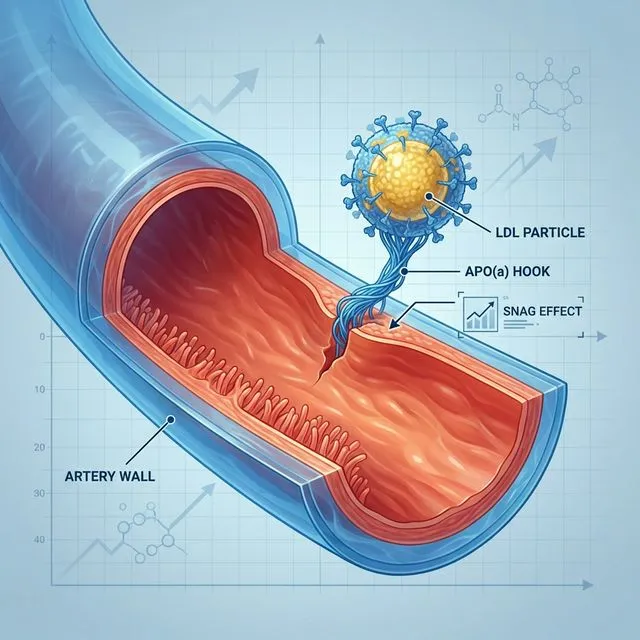

Lipoprotein(a), said L-P-little-A, is a genetic cholesterol particle that raises heart attack and stroke risk and can damage heart valves. About 1 in 5 adults carry high levels, and standard cholesterol panels miss it. Test once, treat the surrounding risk, and watch for new gene-silencing drugs in trial.
TL;DR: Lipoprotein(a), or Lp(a), is an inherited, extra-sticky cholesterol particle missed on standard lipid panels that independently increases heart attack, stroke, and aortic valve narrowing risk. Roughly 1 in 5 adults carry elevated levels, and diet or exercise barely change it. Test Lp(a) at least once (under 30 nmol/L optimal; 75 nmol/L or higher is a formal risk enhancer), and if elevated, drive ApoB down to 60 mg/dL or under while tightening blood pressure and metabolic health.
What is Lp(a) and why is it dangerous?
Lp(a), or lipoprotein(a), is a type of cholesterol particle that you inherit from your parents. About 1 in 5 adults carry high levels. Standard cholesterol panels do not test for it.
You can have "perfect" cholesterol and still die of a heart attack. The cause is often Lipoprotein(a). Imagine an LDL particle (the bad cholesterol). Now imagine it carrying a sticky tail (Apo(a)). That is Lp(a). It digs into the artery wall, encourages clotting, and speeds up plaque buildup faster than ordinary LDL. It is one of the leading causes of "premature" heart attacks in fit, healthy people.2
What does the science say about Lp(a)?
The science says Lp(a) risk is linear and causal. The 2022 European Atherosclerosis Society (EAS) consensus statement confirmed that higher Lp(a) means higher cardiovascular risk in a dose-dependent way.1
- Genetic: Lp(a) is roughly 90% determined by your genes. Diet and exercise do not lower it.
- Independent risk: Even if your LDL is 70, a high Lp(a) still drives risk.
- Aortic stenosis: Lp(a) calcifies the aortic heart valve as well as the arteries, narrowing the valve over time.
In Medicine 3.0, we test every patient for Lp(a) once. Because it is genetic, the level rarely changes. If you do not know your number, you are flying blind.
What is the Fishtown strategy if Lp(a) is high?
The Fishtown strategy if Lp(a) is high is to lower the surrounding risk while we wait for new specific drugs to mature. There are no FDA-approved drugs designed only for Lp(a) yet, though pelacarsen and olpasiran are in late-stage trials.4
If you have high Lp(a), we act on the rest of the picture:
- Crush ApoB: We drive your other harmful cholesterol particle count down to 60 mg/dL or lower. If we cannot remove the sticky particles (Lp(a)), we remove the standard particles (ApoB) so total burden drops.
- Baby aspirin (if appropriate): Lp(a) raises clot risk. Low-dose aspirin can help in select patients. We discuss bleeding risk first.
- Proactive imaging: We order a CT Coronary Angiogram (CTA), with Cleerly AI when we plan to track it over years, at age 40 (or earlier with strong family history) to see if the Lp(a) is already causing soft plaque that a calcium score would miss.
- Tight blood pressure and glucose control: Less stress on the artery wall.
What treatments move Lp(a)?
Treatments that move Lp(a) are limited today, but the field is changing fast.
| Intervention | Effect on Lp(a) | Use Case |
|---|---|---|
| Statins | Neutral or slight increase | Used to lower ApoB, which still reduces overall risk |
| PCSK9 inhibitors (Repatha, Praluent) | Lowers Lp(a) about 25 to 30% | Often the only currently approved drug class that meaningfully lowers Lp(a). Often covered for high-risk patients.3 |
| Niacin | Lowers Lp(a) about 20% | Rarely used now due to side effects and lack of outcome benefit |
| Pelacarsen, olpasiran (in trials) | Lowers Lp(a) about 80% in trials | Likely available within a few years if outcome trials succeed |
| Lipoprotein apheresis | Lowers Lp(a) acutely about 60 to 80% | Reserved for very high risk patients with progressive disease |
Guidance from the Clinic

Why We Start Early: At Fishtown Medicine, we have seen what happens when high Lp(a) is left unmanaged for decades. Our approach is shaped by years of treating those late-stage outcomes. That experience is why we test early and act early.
A common conversation: "Dr. Ash, my dad had a heart attack at 45. Is this why?"
Our answer: "It is very likely. Let's test you."
If you have a family history of early heart attacks, Lp(a) is a leading suspect. Having high Lp(a) is like driving on ice. You cannot change the weather (genes), but you can drive slower (lower ApoB) and put on snow tires (lifestyle, blood pressure control, low-dose aspirin when appropriate). You can still arrive safely.
Actionable Steps in Philly
Get the test. Then get a plan.
- Ask for it by name: At your next blood draw, write in "Lipoprotein(a)" or "Lp(a)." The cash price is usually about $40 if it is not covered.
- Interpret the number:
- Under 30 nmol/L: Optimal baseline.
- 30 to 74 nmol/L: Borderline zone; monitor alongside full ApoB and metabolic risk.
- 75 nmol/L or higher (roughly 30+ mg/dL): Formal ASCVD risk enhancer. Apply the full Fishtown strategy.
- Above 125 nmol/L (or 50+ mg/dL): High genetic risk. Drive ApoB to 60 mg/dL or under and evaluate imaging early.
- Drive ApoB down: Lower your atherogenic particle count to 60 mg/dL or under.
- Test your kids once they are adults: Lp(a) is autosomal dominant, which means each child has a 50% chance of inheriting it.
Unmask the risk.
Key Takeaways
- Lipoprotein(a) is an inherited, sticky cholesterol particle present at high risk levels in roughly 1 in 5 adults and missed on standard cholesterol panels.
- Because lifestyle barely moves Lp(a), test once in adulthood (under 30 nmol/L optimal; 75+ nmol/L formal ASCVD risk enhancer).
- When Lp(a) is high, drive ApoB down to 60 mg/dL or under, optimize blood pressure and insulin sensitivity, and consider cardiac CT imaging around age 40.
- Targeted RNA-silencing therapies (pelacarsen and olpasiran) have lowered Lp(a) by roughly 80% in trials and are finishing outcome testing.
Scientific References
- Kronenberg F, et al. "Lipoprotein(a) in atherosclerotic cardiovascular disease and aortic stenosis: a European Atherosclerosis Society consensus statement." European Heart Journal. 2022.
- Tsimikas S. "A Test in Context: Lipoprotein(a): Diagnosis, Prognosis, Controversies, and Emerging Therapies." Journal of the American College of Cardiology. 2017.
- O'Donoghue ML, et al. "Lipoprotein(a), PCSK9 Inhibition, and Cardiovascular Risk." Circulation. 2019.
- Tsimikas S, et al. "Lipoprotein(a) Reduction in Persons with Cardiovascular Disease." New England Journal of Medicine. 2020.
Related at Fishtown Medicine
- Borderline Cholesterol: How ApoB, Lp(a), and Blood Pressure Change the Plan - a patient case where 3 unmeasured numbers turned "recheck in a year" into a plan
- Stroke Prevention in Philadelphia - the 2024 AHA/ASA guideline applied across BP, GLP-1, diet, CRF, and insulin resistance
- ApoB and Heart Health - the cholesterol particle count that predicts heart attacks far better than standard LDL
- Lp(a): The 'Widowmaker' Genetic Risk - the genetic cholesterol particle that standard panels miss, present in 1 in 5 adults
- ED and Cardiovascular Risk - erectile dysfunction as the earliest warning sign of vascular disease
- Lowering Lp(a): The First Drugs That Can - the drugs in late-stage trials aimed at the particle itself
- Remnant Cholesterol - the other risk your standard panel carries without naming it

Frequently Asked Questions
Common Questions
Deep-Dive Questions
Ready when you are
The chat is our AI assistant, answering from our published guides. To talk it through with Dr. Ash himself, start with the intake.