

Lipoprotein(a), or Lp(a), is an inherited cholesterol particle (50 mg/dL or 125 nmol/L and above in 1 in 5 adults) that drives heart attacks, strokes, and aortic valve narrowing. Four new Phase 3 drugs - pelacarsen, olpasiran, lepodisiran, and oral muvalaplin - lower Lp(a) by 80% to 97%. However, in September 2026, the first Phase 3 outcomes trial (Lp(a)HORIZON with pelacarsen, ~80% reduction) missed its primary 4-point MACE endpoint, shifting attention to deeper 94% to 97% siRNA reducers like olpasiran (OCEAN(a)-Outcomes, due late 2026) and lepodisiran (ACCLAIM-Lp(a), due 2029). Today, driving ApoB below 50 mg/dL, keeping blood pressure under 120/80, and keeping hs-CRP under 1.0 mg/L cuts cardiovascular events by 50% to 65% even while Lp(a) stays high.
TL;DR:
- What Lp(a) is: Lipoprotein(a) (50 mg/dL or 125 nmol/L and above) is an inherited cholesterol particle carried by 1 in 5 adults that raises the risk of heart attacks, stroke, and aortic valve narrowing.1
- The September 2026 Lp(a)HORIZON update: Pelacarsen (an injectable drug that lowers Lp(a) by about 80%) did not meet its primary 4-point MACE endpoint in September 2026.23 That result shows that lowering a lab number is not always the same as preventing heart attacks, and puts the spotlight on olpasiran (OCEAN(a)-Outcomes, due late 2026) and lepodisiran (ACCLAIM-Lp(a), due 2029), which lower Lp(a) deeper (94% to 97%) and test coronary-focused endpoints.345
- What works right now (50% to 65% risk drop): High-Lp(a) patients who drive ApoB below 50 mg/dL, keep blood pressure under 120/80 mmHg, and keep hs-CRP under 1.0 mg/L cut heart attack and stroke events by 50% to 65%. PCSK9 inhibitors (Repatha, Praluent) also trim Lp(a) by 19% to 30% and cut heart events by 23%.6789
- Aspirin and niacin truths: Low-dose aspirin (81 mg) cuts events by 56% to 76% in carriers of the LPA rs3798220-C gene variant or when coronary plaque (CAC 100 or higher) is present.101112 Never take niacin for Lp(a): it failed in 29,000+ patients, raises diabetes and bleeding risk, and creates a breakdown product (4PY) that inflames arteries.1314
A 43-year-old software engineer in Fishtown came in after learning his father's heart attack at 51 was linked to high Lp(a). His own Lp(a) came back at 195 nmol/L, and he had been taking high-dose niacin from an online longevity forum while waiting for new Lp(a) shots to get approved. We stopped the niacin right away, started low-dose rosuvastatin plus ezetimibe to bring his ApoB from 104 down to 44 mg/dL, and ordered a baseline coronary CT angiogram so we could protect his arteries today instead of waiting on a drug pipeline.
Why has Lp(a) been so hard to treat - and what can you change today?
For decades, medicine could measure Lp(a) (50 mg/dL or 125 nmol/L and above) yet had no targeted drug to lower it safely. While Phase 3 RNA and oral drugs now cut Lp(a) by 80% to 97%, your strongest proven move today is lowering the risks around it: driving ApoB below 50 mg/dL, holding blood pressure under 120/80 mmHg, and keeping hs-CRP below 1.0 mg/L.167
Lipoprotein(a) is an LDL-like particle wrapped in a sticky protein tail called apolipoprotein(a). Because 80% to 90% of your Lp(a) level is set by your LPA gene at birth, diet and exercise barely move the number.1 Statins do not lower Lp(a) (they can nudge it up by 5% to 15%). Niacin was retired after two large outcome trials (AIM-HIGH and HPS2-THRIVE, n = 29,087 combined) proved it did not prevent heart attacks while causing diabetes, bleeding, and 4PY-driven artery inflammation.1314
Yet having a fixed Lp(a) number does not mean your heart attack risk is fixed. Across six randomized statin trials (Bhatia et al., Circulation 2025), EPIC-Norfolk (Verbeek 2018; Kraaijenhof 2025, n = 17,087), and the UK Biobank (Wang et al., 2025, n = 385,917), Lp(a) acts as a risk multiplier on top of ApoB, blood pressure, and artery inflammation (hs-CRP):671516
- When LDL-C (ApoB), hs-CRP, and Lp(a) are all high together, heart risk jumps 2.41-fold (HR 2.41).6
- When high-Lp(a) adults (125 nmol/L or higher) keep their changeable heart health markers strong (Life's Simple 7 score 10 or higher) and drive ApoB and LDL-C down, their excess heart event rate drops by 50% to 65% (HR 0.35).71617
- In the FOURIER (n = 25,096) and ODYSSEY OUTCOMES (n = 18,924) trials, adding a PCSK9 inhibitor (evolocumab or alirocumab) to a statin lowered LDL-C by 50% to 60% and trimmed Lp(a) by 19% to 30%, cutting major heart events by 23% (NNT = 40 over 3 years) in patients with high baseline Lp(a).89
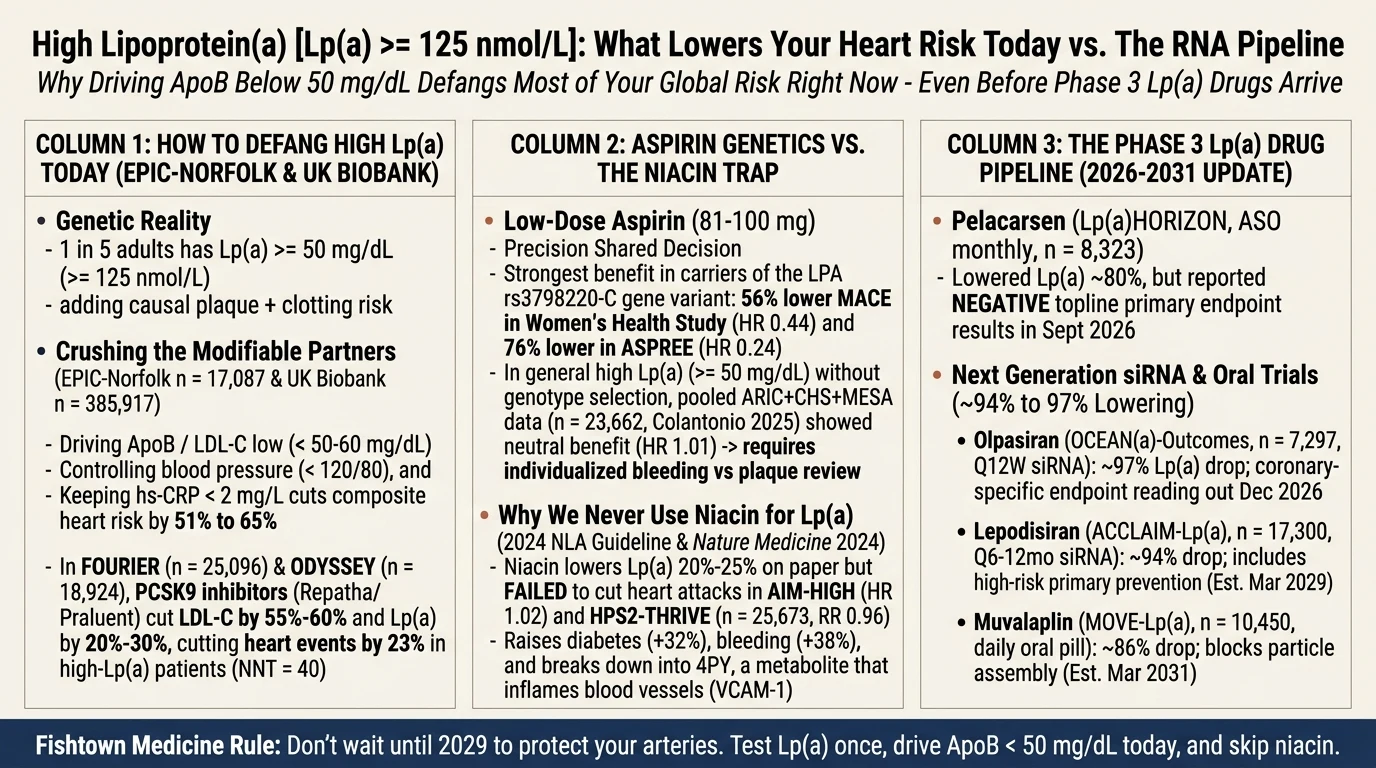
How do the four new Phase 3 Lp(a) drugs work - and what happened in Lp(a)HORIZON?
Four targeted drugs have reached Phase 3 trials: three injectable gene-silencers (pelacarsen, olpasiran, lepodisiran) that block the liver from building apolipoprotein(a) (80% to 97% reduction), and one daily oral pill (muvalaplin) that stops the particle from assembling (~86% reduction). In September 2026, pelacarsen's Lp(a)HORIZON trial missed its primary 4-point MACE endpoint, making the deeper 94% to 97% siRNA trials the key test for the class.234518
Instead of trying to clear finished Lp(a) particles from the blood, these therapies stop Lp(a) production inside liver cells:
| Drug (Sponsor) | Mechanism & Route | Dosing Schedule | Lp(a) Reduction | Phase 3 Outcomes Trial (n) & Population | Primary Readout Status |
|---|---|---|---|---|---|
| Pelacarsen (Novartis / Ionis) | Antisense oligonucleotide (ASO) degrading LPA mRNA (SubQ injection) | 80 mg once monthly | ~80% | Lp(a)HORIZON (n = 8,323): Prior MI, stroke, or PAD + Lp(a) >= 70 mg/dL | Sept 2026: Did NOT meet primary 4-point MACE endpoint.23 |
| Olpasiran (Amgen) | Small interfering RNA (siRNA) via RISC complex (SubQ injection) | 225 mg every 12 weeks (quarterly) | ~94% to 97% | OCEAN(a)-Outcomes (n = 7,297): Prior CAD + Lp(a) >= 200 nmol/L (~80-90 mg/dL) | Expected ~December 2026 (plus OCEAN(a)-PreEvent in ~11,000 first-event patients due ~2031).4 |
| Lepodisiran (Eli Lilly) | Ultra-long-acting GalNAc-siRNA (SubQ injection) | 400 mg every 6 to 12 months | ~94% over days 60-180 | ACCLAIM-Lp(a) (n = 17,300): Established ASCVD or high-risk primary prevention + Lp(a) >= 175 nmol/L | Estimated March 2029.5 |
| Muvalaplin (Eli Lilly) | Small-molecule oral blocker preventing apo(a) from binding apoB-100 | 60-240 mg daily oral pill | ~85.8% (intact Lp(a) assay) | MOVE-Lp(a) (n = 10,450): Prior ASCVD or high-risk primary prevention + Lp(a) >= 175 nmol/L | Estimated March 2031.18 |
Why did Lp(a)HORIZON (pelacarsen) miss its primary endpoint in September 2026 - and could olpasiran or lepodisiran still succeed?
In September 2026, Novartis announced that Lp(a)HORIZON (n = 8,323) did not achieve a clear win on its primary 4-point MACE composite (cardiovascular death, non-fatal heart attack, non-fatal stroke, or urgent coronary revascularization).23 That result is a sobering reminder of why we never treat an unapproved drug as a guaranteed cure before outcome trials finish.
Lipid specialists point to three biological differences that explain why OCEAN(a)-Outcomes (olpasiran, expected late 2026) and ACCLAIM-Lp(a) (lepodisiran) could still succeed:345
- Deeper Lp(a) suppression (94%-97% vs. ~80%): Genetic studies estimate you need an absolute Lp(a) drop of 50 to 100 mg/dL (125 to 250 nmol/L) to match the 22% relative risk drop of a 38.7 mg/dL (1 mmol/L) LDL-C reduction.1 In someone starting at 80 mg/dL, an 80% drop leaves Lp(a) around 16 mg/dL. A 95% to 97% siRNA drop drives Lp(a) down below 3 to 5 mg/dL.34
- Higher baseline entry cutoff (200 nmol/L or higher): OCEAN(a)-Outcomes enrolled patients with Lp(a) at or above 200 nmol/L (~80-90 mg/dL), ensuring a larger particle drop than Lp(a)HORIZON's 70 mg/dL cutoff.34
- Coronary-focused primary endpoint: Lp(a)HORIZON included non-fatal stroke in its 4-point composite (where non-plaque strokes can dilute a cholesterol signal). OCEAN(a)-Outcomes uses a focused 3-point coronary endpoint (coronary heart disease death, heart attack, or urgent coronary stent/bypass).34
A critical lab caveat on oral muvalaplin
Muvalaplin (KRAKEN Phase 2 trial, Nicholls et al., JAMA 2025) is the first daily oral pill for Lp(a).18 Because it works by binding free apo(a) tails so they cannot attach to apoB-100, standard lab tests that measure total apo(a) protein count those harmless drug-bound apo(a) fragments and understate the true drop (~70% on standard tests vs. 85.8% on an intact Lp(a) particle test).18
Should you take low-dose aspirin (81 mg) or niacin if your Lp(a) is high?
Never take niacin for high Lp(a) - it failed to cut heart events in 29,000+ patients and creates a toxic artery breakdown product (4PY).1314 Low-dose aspirin (81 mg) is not a blanket rule for everyone with Lp(a) at or above 50 mg/dL, yet it cuts events by 56% to 76% in carriers of the LPA rs3798220-C gene variant and is favored when high Lp(a) is paired with coronary plaque (CAC 100 or higher) and low bleeding risk.10111219
1. The Low-Dose Aspirin (81 mg) Nuance: Genotype vs. Blood Level
Because apolipoprotein(a) looks like plasminogen and slows clot breakdown, doctors long wondered whether daily aspirin (81 to 100 mg) could offset Lp(a) clotting risk. The evidence splits depending on how you select the patient:
- Strong protection in LPA rs3798220-C variant carriers (HR 0.24 to 0.44): In genetic analyses of two randomized placebo-controlled aspirin trials - the Women's Health Study (Chasman et al., 2009, n = 25,131) and ASPREE (Lacaze et al., JACC 2022, n = 12,815 older adults) - carriers of the rs3798220-C variant randomized to low-dose aspirin had a 56% drop in cardiovascular events in WHS (HR 0.44) and a 76% drop in MACE in ASPREE (HR 0.24, 95% CI 0.07-0.82) without excess major bleeding.1011
- Mixed results when using Lp(a) >= 50 mg/dL mass level alone: While an analysis in MESA (Bhatia et al., JAHA 2024, n = 2,183) found a 46% lower coronary event rate (HR 0.54) with aspirin in adults with Lp(a) > 50 mg/dL,20 a larger 2025 pooled study of ARIC, CHS, and MESA (Colantonio et al., Eur J Prev Cardiol 2025, n = 23,662) found no overall drop in CVD (HR 1.12) or CHD events (HR 1.01) from aspirin based on Lp(a) >= 50 mg/dL alone.12 A 2026 meta-analysis (Lopes et al., EJPC 2026, n = 6,628) confirmed that MACE reduction was proven in rs3798220-C carriers (HR 0.37) while unselected high-mass cohorts showed no clear benefit (HR 0.62, non-significant).21
- How we decide in the clinic: Following the 2024 NLA Update and 2026 ACC/AHA guidance, we do not put every 35-year-old with Lp(a) = 60 mg/dL and zero plaque on aspirin by default.19 Instead, we favor 81 mg daily aspirin when high Lp(a) is paired with coronary plaque on imaging (CAC 100 or higher, soft plaque on CCTA, or CAC > 0 with Lp(a) >= 125 nmol/L) or confirmed rs3798220-C carrier status, when bleeding risk is low.1119
2. Why Niacin (Vitamin B3) Is Off the Table for Lp(a)
High-dose niacin (1.5 to 2 g/day) lowers Lp(a) on a lab sheet by 20% to 25%,22 which still tempts some supplement protocols. Do not use it:
- Zero heart benefit in 29,087 patients: Both AIM-HIGH (n = 3,414, HR 1.02) and HPS2-THRIVE (NEJM 2014, n = 25,673, RR 0.96, p = 0.29) showed zero reduction in heart attacks or strokes when extended-release niacin was added to statin therapy.13
- Serious clinical harms: In HPS2-THRIVE, niacin raised new-onset diabetes by +32% (RR 1.32), diabetic complications (+55%), serious bleeding (+38%, including brain and gut bleeding), serious infections (+22%), and gout.13
- The 4PY artery toxin discovery (Ferrell et al., Nature Medicine 2024): Excess niacin is broken down into a metabolite called 4PY (N1-methyl-4-pyridone-3-carboxamide), which triggers VCAM-1 artery wall inflammation and predicts heart attacks and strokes.14 That explains the niacin paradox: the toxic 4PY inflammation cancels out the 20% Lp(a) drop.
Guidance from the Clinic

Actionable Steps: Your If -> Then High-Lp(a) Playbook
Use these four If -> Then triggers if your Lp(a) is 50 mg/dL (125 nmol/L) or higher:
- If your Lp(a) is 125 nmol/L (50 mg/dL) or higher -> drive your ApoB below 50 mg/dL and hs-CRP below 1.0 mg/L: Low-dose rosuvastatin (5 to 10 mg) plus ezetimibe (10 mg) typically drops ApoB by 50% to 60%. If ApoB stays above 50 mg/dL or plaque is present, adding a PCSK9 inhibitor (evolocumab or alirocumab) trims Lp(a) by 19% to 30% while dropping ApoB another 50% (NNT = 40 in FOURIER).689
- If you are over age 40 with high Lp(a) -> image your coronary arteries (CCTA or CAC): Because Lp(a) speeds up non-calcified soft plaque before calcium shows up, a Coronary CT Angiogram (CCTA) or Coronary Calcium Score (CAC) tells us whether your arteries are clear or building plaque.19
- If your scan shows coronary plaque (CAC 100 or higher, or soft plaque on CCTA) or you carry the LPA rs3798220-C variant -> discuss 81 mg daily aspirin: With low bleeding risk, low-dose aspirin offsets Lp(a)'s clotting tail where genetics (HR 0.24-0.44) or visible plaque confirms higher risk.101119
- If someone recommends high-dose niacin (Vitamin B3) for Lp(a) -> stop it right away: Niacin failed in 29,087 trial patients, raises diabetes (+32%) and bleeding (+38%), and produces the 4PY metabolite that inflames blood vessels (VCAM-1).1314
Key Takeaways
- Three RNA drugs cut Lp(a) by 80% to 97%, with outcomes pending: Pelacarsen lowered Lp(a) roughly 80% in Lp(a)HORIZON, while Phase 2 trials of olpasiran and lepodisiran achieved 94% to 97% reductions with primary prevention trials (OCEAN(a)-PreEvent and ACCLAIM-Lp(a)) finishing in 2029 to 2031.
- Lowering ApoB, blood pressure, and inflammation cuts event risk by 50% to 65% now: Driving ApoB to 60 mg/dL or under (and below 50 mg/dL when plaque is present), keeping home blood pressure below 120/80 mmHg, and holding hs-CRP below 1.0 mg/L strips plaque of fuel while RNA therapies finish Phase 3.
- Image early to measure plaque burden directly: Adults over 40 with high Lp(a) should consider a coronary calcium score or CT angiogram because finding soft or calcified plaque changes how aggressively we set ApoB targets.
- Aspirin requires genetic or plaque proof, and niacin should be avoided: Only rs3798220-C carriers or patients with confirmed coronary plaque show clear net aspirin benefit, while niacin raises toxic 4PY vascular inflammation metabolites despite lowering Lp(a).
Related at Fishtown Medicine
- Lp(a): The Genetic Risk Most Panels Miss - what Lp(a) is, the I-676 traffic model, and family cascade testing
- ApoB and Heart Health - the cholesterol particle target (under 50 mg/dL) to drive down alongside Lp(a)
- Beyond Statins: PCSK9 Inhibitors, Ezetimibe & Bempedoic Acid - how PCSK9 inhibitors lower ApoB 50%-60% and Lp(a) 20%-30%
- Coronary Calcium Score (CAC) vs. CCTA - checking whether Lp(a) has laid down soft or calcified plaque
- Heart Imaging Guide (CAC, CCTA, Cleerly) - choosing the right scan when Lp(a) is high
- Lp(a) and Cholesterol - why a normal standard lipid panel hides high Lp(a)
Scientific References
- Kronenberg F, Mora S, Stroes ESG, et al. Lipoprotein(a) in atherosclerotic cardiovascular disease and aortic stenosis: a European Atherosclerosis Society consensus statement. Eur Heart J. 2022;43(39):3925-3946. PMID: 36036785.
- Sabouret P, et al. Lipoprotein(a)-targeted therapies after Lp(a)HORIZON: lessons from the first Phase 3 outcomes readout. Am J Med. 2026. PMID: 42880684.
- Parcha V, Bittner VA. Lipoprotein(a)-Lowering Therapies in Clinical Trials: From Antisense Oligonucleotides to siRNAs and Oral Small Molecules. Curr Atheroscler Rep. 2026. DOI: 10.1007/s11883-026-01474-4.
- O'Donoghue ML, Rosenson RS, Gencer B, et al. Small Interfering RNA to Reduce Lipoprotein(a) in Cardiovascular Disease (OCEAN[a]-DOSE). N Engl J Med. 2022;387(20):1855-1864. DOI: 10.1056/NEJMoa2211023.
- Nissen SE, Ni W, Shen X, et al. Lepodisiran - A Long-Duration Small Interfering RNA Targeting Lipoprotein(a). N Engl J Med. 2025;392(17):1673-1683. DOI: 10.1056/NEJMoa2415818.
- Kraaijenhof JM, et al. Twenty-Year Cardiovascular Risk Associated With Combined Elevation of LDL Cholesterol, High-Sensitivity C-Reactive Protein, and Lipoprotein(a) in EPIC-Norfolk. Eur Heart J. 2025. PMID: 40167249.
- Wang M, et al. Joint associations of lipoprotein(a) and low-density lipoprotein cholesterol with incident coronary artery disease in 385,917 UK Biobank participants. Int J Epidemiol. 2025. PMID: 40064167.
- O'Donoghue ML, Fazio S, Giugliano RP, et al. Lipoprotein(a), PCSK9 Inhibition, and Cardiovascular Risk: Insights From the FOURIER Trial. Circulation. 2019;139(12):1483-1492. PMID: 30586750.
- Schwartz GG, Ballantyne CM, Barter PJ, et al. Effect of Alirocumab on Lipoprotein(a) and Cardiovascular Risk After Acute Coronary Syndrome (ODYSSEY OUTCOMES). J Am Coll Cardiol. 2021;78(5):421-433. PMID: 34325831.
- Chasman DI, Shiffman D, Zee RYL, et al. Polymorphism in the apolipoprotein(a) gene, plasma lipoprotein(a), cardiovascular disease, and low-dose aspirin therapy in the Women's Health Study. Atherosclerosis. 2009;203(2):371-376. PMID: 18775538.
- Lacaze P, Bakshi A, Riaz M, et al. Aspirin for Primary Prevention of Cardiovascular Events in Relation to Lipoprotein(a) Genotypes (ASPREE). J Am Coll Cardiol. 2022;80(14):1287-1298. PMID: 36175048.
- Colantonio LD, et al. Aspirin use and cardiovascular events among adults with high lipoprotein(a): a pooled analysis of ARIC, CHS, and MESA. Eur J Prev Cardiol. 2025. PMID: 40874494.
- HPS2-THRIVE Collaborative Group; Landray MJ, Haynes R, Hopewell JC, et al. Effects of Extended-Release Niacin with Laropiprant in High-Risk Patients. N Engl J Med. 2014;371(3):203-212. DOI: 10.1056/NEJMoa1300955.
- Ferrell M, Wang Z, Anderson JT, et al. A terminal metabolite of niacin promotes vascular inflammation and contributes to cardiovascular disease risk. Nat Med. 2024;30(2):424-434. DOI: 10.1038/s41591-023-02793-8.
- Bhatia HS, et al. Independent and Additive Cardiovascular Risk of Lipoprotein(a) and LDL Cholesterol Across Six Randomized Statin Trials. Circulation. 2025. PMC: PMC11771346.
- Verbeek R, Hoogeveen RM, Langsted A, et al. Cardiovascular disease risk associated with high lipoprotein(a) attenuates at low low-density lipoprotein cholesterol levels in a primary prevention setting. Eur Heart J. 2018;39(27):2589-2596. PMID: 29931232.
- Razavi AC, et al. Ideal Cardiovascular Health Attenuates Lipoprotein(a)-Associated Atherosclerotic Cardiovascular Disease Risk. Diabetes Obes Metab. 2025. DOI: 10.1111/dom.16469.
- Nicholls SJ, Ni W, Rhodes GM, et al. Oral Muvalaplin for Lowering of Lipoprotein(a): A Randomized Clinical Trial (KRAKEN). JAMA. 2025;333(3):222-231. DOI: 10.1001/jama.2024.24017.
- Koschinsky ML, Bajaj A, Boffa MB, et al. A focused update to the 2019 NLA scientific statement on use of lipoprotein(a) in clinical practice. J Clin Lipidol. 2024;18(3):e308-e319. PMID: 38565461.
- Bhatia HS, Trainor P, Carlisle S, et al. Aspirin and Cardiovascular Risk in Individuals With Elevated Lipoprotein(a): The Multi-Ethnic Study of Atherosclerosis. J Am Heart Assoc. 2024;13(3):e033562. PMID: 38293935.
- Lopes RD, et al. Aspirin for Primary Cardiovascular Prevention in Elevated Lipoprotein(a) and LPA Risk Genotypes: A Systematic Review and Meta-Analysis. Eur J Prev Cardiol. 2026. PMID: 42138694.
- Sahebkar A, Reiner Ž, Simental-Mendía LE, Ferretti G, Cicero AFG. Effect of extended-release niacin on plasma lipoprotein(a) levels: A systematic review and meta-analysis of randomized placebo-controlled trials. Metabolism. 2016;65(11):1664-1678. PMID: 27733255.

Frequently Asked Questions
Common Questions
Deep-Dive Questions
Ready when you are
The chat is our AI assistant, answering from our published guides. To talk it through with Dr. Ash himself, start with the intake.