

Zone 2 training is the highest steady effort you can hold while still speaking in full sentences, keeping blood lactate below 2 mmol/L. Total Zone 2 volume builds mitochondrial content (more power plants per cell), while short vigorous intervals drive mitochondrial respiration and stroke volume. If you have 2 to 4 hours per week to train, you capture 70 to 80% of the longevity payoff of exercise by combining two 45- to 60-minute Zone 2 sessions, one 4x4 interval session, and two 30- to 45-minute strength sessions. Because the 20% insulin-sensitivity boost from a workout fades back to baseline after 4 days of rest, frequency across the week beats a single weekend grind.
TL;DR:
- What Zone 2 does: Zone 2 is the highest steady effort you can hold while speaking in full sentences (lactate < 2 mmol/L). It trains slow-twitch (Type I) muscle fibers to burn fat and build more mitochondria.12
- The 3-hour weekly sweet spot: Across cohorts of more than 400,000 to 750,000 adults, 70 to 80% of the longevity benefit of exercise happens in the first 2 to 4 hours per week when you combine steady aerobic work, 15 to 20 minutes of vigorous intervals, and 2 sessions (60 to 120 minutes) of resistance training (HR 0.55 for combined aerobic plus strength training).345
- Volume vs. intensity inside the cell: Muscle biopsy trials show that total training volume builds mitochondrial content (more mitochondria), while high-intensity intervals drive mitochondrial respiration (+60% PGC-1alpha, +90% p53) and raise VO2max 4.6-fold faster per minute than steady Zone 2 alone.678
- The 4-day insulin clock: A single session of either Zone 2 or high-intensity intervals raises whole-body insulin sensitivity by ~20% the next day, and that metabolic gain vanishes back to baseline after 4 days without exercise.9
- The 6+ hour endurance ceiling: Pushing endurance volume past 6 to 7 hours per week adds very little extra survival benefit while raising atrial fibrillation (AFib) risk 2.5- to 5-fold along a U-shaped curve in middle-aged endurance athletes.1011
Why do busy adults burn out on all-out workouts or stall on easy walks?
High-intensity group workouts every morning leave busy professionals exhausted, while casual walking rarely pushes the heart or muscles hard enough to remodel metabolism. A balanced longevity plan pairs Zone 2 aerobic volume with one short vigorous interval session and two strength sessions inside a 3-hour weekly budget.358
At Fishtown Medicine, we see two patterns every week. One group wakes up at 5 AM five days a week for all-out bootcamps or hard runs where their heart rate stays at 165 bpm the entire hour. They are disciplined, yet their joints ache, their sleep is light, and their fasting insulin barely moves. The other group walks the dog for 20 minutes at a stroll that never lifts heart rate out of Zone 1.
In Medicine 3.0, exercise is the strongest longevity drug we have, and like any drug, the dose and the split matter. If you have 8 to 12 hours a week to train like a competitive cyclist, you can build a massive base with 4 hours of Zone 2 alone. If you are a time-crunched adult with 2 to 4 hours per week, spending every minute in slow Zone 2 leaves VO2 max, stroke volume, and muscle mass under-stimulated.812 Understanding what Zone 2 does - and what it cannot do by itself - lets you get the highest return on every hour you train.
What is Zone 2 training at the cellular level?
Zone 2 training is the highest steady aerobic effort you can sustain while keeping blood lactate below 2.0 mmol/L (typically 60 to 70% of maximum heart rate). At this pace, slow-twitch (Type I) muscle fibers burn fat as their primary fuel and clear lactate as fast as they make it.12
Most people treat cardio as a binary: walking (Zone 1) or running hard (Zone 3 and 4). Zone 2 lies right below your first ventilatory threshold (VT1). If you are a runner, true Zone 2 often feels frustratingly slow at first. If you are a walker, it requires a brisk incline or a weighted rucksack.
Inside your muscle cells, Zone 2 work recruits slow-twitch fibers that are packed with mitochondria. During steady Zone 2 work:
- Fat oxidation peaks: Adipose tissue releases free fatty acids, and muscle mitochondria burn them through beta-oxidation to generate ATP.1
- Lactate stays flat: Small amounts of lactate produced by working fibers are shuttled into neighboring slow-twitch fibers and burned as fuel through MCT1 transporters, keeping blood lactate steady below 2.0 mmol/L.1
- Capillaries expand: Sustained blood flow triggers new capillary growth around muscle fibers so oxygen and insulin reach the cell membrane faster.2
If you speed up into Zone 3 or 4 ("gray-zone" running), rising catecholamines and glycolytic flux switch your muscles toward burning stored glycogen (sugar). Lactate accumulates faster than MCT1 transporters can clear it, and fat oxidation drops sharply.1
How does Zone 2 compare to HIIT (4x4) when you only have 3 hours a week?
Total training volume drives mitochondrial quantity (how many mitochondria your cells hold), whereas exercise intensity drives mitochondrial quality (respiration rate) and cardiac stroke volume. Under a strict 2 to 4 hour weekly cap, you need both stimuli.678
A common longevity myth claims that Zone 2 is the only way to build mitochondria. Controlled human muscle-biopsy trials tell a more nuanced story:
- Volume builds mitochondrial count; intensity upgrades mitochondrial respiration: In biopsy studies by Granata et al. (FASEB J 2016) and a 2025 meta-analysis by Mølmen et al. (Sports Medicine), total training volume (such as 45- to 60-minute Zone 2 sessions) is the strongest driver of citrate synthase activity and total mitochondrial volume density.67 However, high-intensity intervals trigger a +60% surge in nuclear PGC-1alpha and a +90% increase in p53 signaling, producing larger gains in mass-specific mitochondrial oxidative phosphorylation (OXPHOS) respiration per hour of training.67
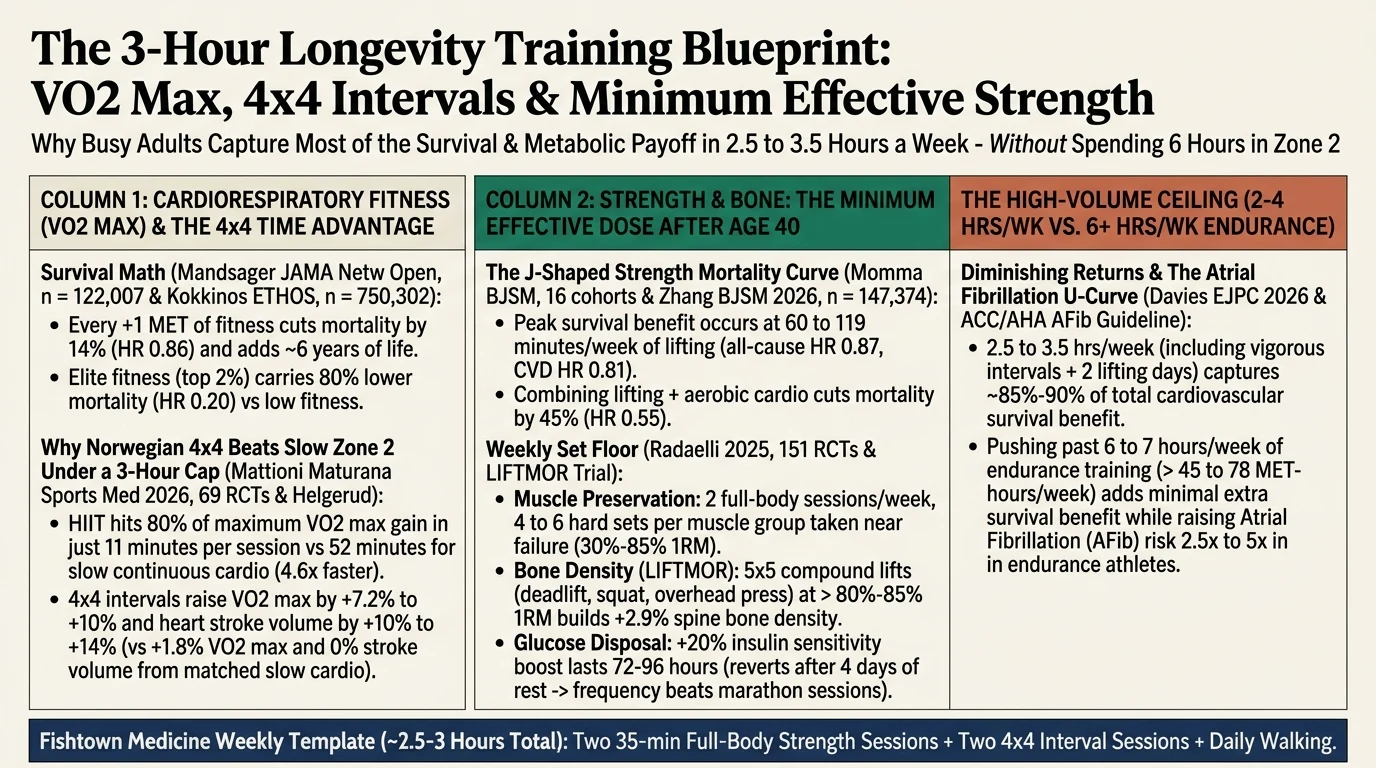
- Why Zone 2 alone barely moves VO2max on a small time budget: In the classic work-matched randomized trial by Helgerud et al. (MSSE 2007, n = 40), 8 weeks of long slow distance (70% HRmax for 45 minutes, 3 times per week) raised VO2max by only +1.8% (p > 0.05) and changed cardiac stroke volume by 0%.12 In contrast, the Norwegian 4x4 interval group (4 x 4 minutes at 90 to 95% HRmax with 3-minute active recoveries) raised VO2max by +7.2% and increased heart stroke volume by +10% (+14.4% stroke volume in Bækkerud et al., 2016).1213
- The 4.6x time-efficiency gap: A 2026 dose-response meta-analysis of 69 randomized trials by Mattioni Maturana et al. (Sports Medicine) found that high-intensity training reaches 80% of its maximum VO2max gain (+3.45 mL/kg/min) in roughly 11 minutes per session (~5 minutes of hard work, or ~15 minutes/week), whereas moderate continuous training requires ~52 minutes per session (~156 minutes/week) to reach 80% of a smaller ceiling (+2.47 mL/kg/min).8
- The 4-day insulin-sensitivity rule: What about blood sugar? In a gold-standard hyperinsulinemic-euglycemic clamp crossover trial (Ryan et al., JCEM 2020, n = 31 adults with obesity), a single session of moderate Zone 2 and a single session of high-intensity intervals improved whole-body insulin sensitivity identically (+19 to 21% the next day).9 Even more important, by Day 4 after the workout, the insulin-sensitivity gain had vanished (0% above baseline) in both groups.9
That clamp finding explains why training frequency across the week matters more than a single Saturday long run. Spreading your sessions so you never go more than 48 to 72 hours without contracting your muscles keeps insulin sensitivity high all week long.9
| Adaptation / Outcome | Steady Zone 2 (60-70% HRmax, < 2 mmol/L) | Norwegian 4x4 HIIT (90-95% HRmax) | Heavy Strength (2x/wk, 4-6 sets/muscle) |
|---|---|---|---|
| Primary Cellular Driver | Total aerobic volume -> mitochondrial content (citrate synthase) & fat oxidation (MCT1) | Peak intensity -> mitochondrial respiration (+60% PGC-1alpha) & stroke volume (+10-14%) | Mechanical tension -> myofibrillar protein synthesis (+0.6-0.8 kg lean mass) & bone strain |
| VO2max Time Efficiency | Requires ~52 min/session (~156 min/wk) for 80% of max gain (+2.47 mL/kg/min) | Reaches 80% of max gain (+3.45 mL/kg/min) in ~15 min/wk of hard work (4.6x faster) | Minimal direct VO2max change; protects the muscle sink that uses oxygen |
| Insulin Sensitivity (GLUT4) | +20% next day**; resets to **0% after 4 days of rest | +20% next day**; resets to **0% after 4 days of rest | Expands total muscle glycogen storage capacity 24/7 |
| Optimal Weekly Dose (3-hr budget) | 1 to 2 sessions (45-60 min each) | 1 session (4x4 min intervals = ~35 min total) | 2 sessions (30-45 min each; 60-120 min/wk total) |
How do you find your true Zone 2 without a lab?
You do not need a metabolic cart to start training in Zone 2. The Talk Test and nasal breathing keep you below your 2.0 mmol/L lactate threshold with high reliability.114
While we can arrange formal blood lactate or metabolic-cart testing (CPET) in Philadelphia, three field checks lock in your Zone 2 ceiling on day one:
Performance Medicine
Stop guessing at recovery and energy. Get the data behind your performance.
- The Talk Test (Most Reliable Field Check): Recite a 30-word paragraph out loud while moving.
- Zone 1 (Too easy): You could sing a song or speak without any change in breathing.
- Zone 2 (< 2.0 mmol/L sweet spot): You can speak in complete sentences, but your listener can hear your breathing through the phone and you would prefer not to chat continuously.
- Zone 3+ (Too hard): You have to pause for a breath every 4 to 5 words.
- Heart Rate Calibration (70 to 75% HRmax or 180 minus age): A useful starting ceiling is 180 minus your age (for example, ~140 bpm at age 40), or 65 to 75% of your true maximum heart rate. Always let the Talk Test override a formula on hot days, hills, or poor-sleep mornings.
- Zero Cardiac Drift Over 45 Minutes: On an indoor bike or flat trail at a fixed wattage or pace, your heart rate should rise less than 5% between minute 15 and minute 45. If your heart rate climbs from 138 bpm to 155 bpm at the same pace, your starting output is above your true Zone 2 ceiling.
How much exercise is enough - and when does 6+ hours of cardio backfire?
Observational cohorts of more than 750,000 adults show that 2 to 4 hours per week of structured exercise captures 70 to 80% of the maximum longevity benefit, while endurance volumes above 6 to 7 hours per week flatten out for survival and raise atrial fibrillation (AFib) risk 2.5- to 5-fold.341011
More exercise is not linearly better forever, and the shape of the curve depends on what you are measuring:
- Cardiorespiratory fitness (VO2max) has no upper mortality ceiling: In the Cleveland Clinic cohort (Mandsager et al., JAMA Netw Open 2018, n = 122,007) and the Veterans Affairs ETHOS cohort (Kokkinos et al., JACC 2022, n = 750,302), every +1 MET of fitness lowered all-cause mortality by 14% (HR 0.86), and moving from the bottom fitness tier to the top tier cut mortality by 75 to 80% (HR 0.20 to 0.24) and added ~6 years of life expectancy with no upturn in death risk at elite fitness levels.415
- Strength training follows a J-shaped curve peaking at 60 to 120 minutes/week: In a 16-cohort meta-analysis (Momma et al., BJSM 2022) and a 2026 cohort of 147,374 adults (Zhang et al., BJSM 2026), resistance training lowered all-cause, cardiovascular, and cancer mortality by 10 to 19%, with maximum survival benefit between 60 and 120 minutes per week (HR 0.87 all-cause, HR 0.81 CVD) and no added survival drop above 120 minutes/week.516 Combining aerobic work with 1 to 2 weekly strength sessions delivered the lowest mortality of any pattern (HR 0.55 to 0.60 - a 40 to 45% risk reduction).35 Notably, women achieve the same peak mortality reduction from 1 weekly strength session that men reach at 2 to 3 sessions (Ji et al., JACC 2024, n = 412,413).17
- The 6+ hour/week endurance AFib U-curve: While fitness itself (VO2max) has no mortality penalty, training volume in hours plateaus around 3 hours per week (Coleman et al., BJSM 2022, n = 416,420).3 When vigorous endurance volume exceeds 6 to 7 hours per week (> 45 to 78 MET-hours/week) over years - typical of marathoners and long-course triathletes - chronic left-atrial stretch, vagal tone changes, and atrial fibrosis drive a 2.5- to 5-fold increase in atrial fibrillation (AFib) (Davies et al., Eur J Prev Cardiol 2026; 2023 ACC/AHA AFib Guideline), alongside higher prevalence of dense coronary calcium plaques (MARATHON and Master@Heart studies).1011
Guidance from the Clinic

Actionable Steps: Your If -> Then Training Blueprint
Use these four If -> Then triggers to match your weekly schedule to the physiology:
- If you have 2.5 to 3.5 hours per week total -> run the 2 + 1 + 2 Longevity Split: Schedule two 45- to 60-minute Zone 2 sessions (incline walk, rucking on Kelly Drive, or indoor cycling), one 35-minute Norwegian 4x4 session (4 x 4 minutes at 90 to 95% HRmax with 3-minute easy recoveries), and two 30- to 40-minute compound strength sessions (2 to 3 sets per movement taken within 1 to 3 reps of failure).581218
- If you are targeting blood sugar, fasting insulin, or afternoon fatigue -> never go 4 days without a session: Because the +20% insulin-sensitivity boost from either Zone 2 or intervals resets to baseline by Day 4, alternate your strength and cardio days across Monday through Saturday instead of cramming workouts into the weekend.9
- If you are over 40 and lifting for muscle and bone -> pair near-failure sets (30 to 85% 1RM) with heavy compound axial loads (> 80% 1RM): Meta-analyses of 151 RCTs show 4 to 6 sets per muscle group per week across 2 sessions builds and preserves muscle mass as long as sets approach fatigue, while spine and hip bone density (LIFTMOR trial: +2.9% lumbar BMD) require heavier multi-joint loads (5 sets of 5 reps at 80 to 85% 1RM).181920
- If you train 6+ hours per week for marathons or triathlons -> monitor left-atrial rhythm and coronary plaque: High-volume endurance training is a personal sport goal instead of a survival requirement; track resting heart rate trends, check a 12-lead ECG or wearable rhythm strip if palpitations appear, and review your ApoB and heart imaging with your physician.1011
Start Your Intake with Dr. Ash
Key Takeaways
- Zone 2 keeps blood lactate under 2.0 mmol/L (able to speak in full sentences) to expand mitochondrial count and capillarization.
- Within a 3-hour weekly plan, pair two 45-to-60-minute Zone 2 sessions with one 4x4 interval session and two strength sessions to capture 70 to 80% of longevity benefit.
- Because the 20% workout insulin-sensitivity boost fades back to baseline after 4 days of rest, spread training every 48 to 72 hours.
- Very high chronic endurance volumes past 6 to 7 hours weekly offer diminishing survival gains while raising AFib risk in middle-aged athletes.
Scientific References
- San-Millán I, Brooks GA. Assessment of Metabolic Flexibility by Means of Measuring Blood Lactate, Fat, and Carbohydrate Oxidation Responses to Exercise in Professional Endurance Athletes and Less-Fit Individuals. Sports Med. 2018;48(2):467-479. PMID: 28623613.
- Hawley JA, Hargreaves M, Joyner MJ, Zierath JR. Integrative Biology of Exercise. Cell. 2014;159(4):738-749. PMID: 25417152.
- Coleman CJ, McDonough DJ, Pope ZC, et al. Dose-response association of aerobic and muscle-strengthening physical activity with mortality: a national cohort study of 416,420 US adults. Br J Sports Med. 2022;56(21):1218-1223. PMID: 35953241.
- Kokkinos P, Faselis C, Samuel IBH, et al. Cardiorespiratory Fitness and Mortality Risk Across the Spectra of Age, Race, and Sex. J Am Coll Cardiol. 2022;80(6):598-609. PMID: 35926933.
- Zhang Y, et al. Dose-response associations of resistance training volume and combined aerobic physical activity with all-cause and cardiovascular mortality in 147,374 adults. Br J Sports Med. 2026. PMID: 42230125.
- Granata C, Oliveira RSF, Little JP, Renner K, Bishop DJ. Training intensity modulates changes in PGC-1alpha and p53 protein content and mitochondrial respiration, but not markers of mitochondrial content, in human skeletal muscle. FASEB J. 2016;30(2):959-970. PMID: 26572168.
- Mølmen KS, Almquist NW, Skattebo Ø. Effects of Exercise Training on Mitochondrial and Capillary Growth in Human Skeletal Muscle: A Systematic Review and Meta-Regression. Sports Med. 2025;55:115-144. DOI: 10.1007/s40279-024-02120-2.
- Mattioni Maturana F, et al. Dose-Response Relationships of High-Intensity Interval Training Versus Moderate-Intensity Continuous Training on Cardiorespiratory Fitness: A Systematic Review and Meta-Analysis of 69 Randomized Controlled Trials. Sports Med. 2026. DOI: 10.1007/s40279-026-02528-y.
- Ryan BJ, Schleh MW, Ahn C, et al. Moderate-Intensity Exercise and High-Intensity Interval Training Affect Insulin Sensitivity Similarly in Obese Adults. J Clin Endocrinol Metab. 2020;105(8):e2941-e2959. PMID: 32492705.
- Davies EJ, et al. Long-term endurance exercise volume and risk of atrial fibrillation: a U-shaped dose-response analysis. Eur J Prev Cardiol. 2026. PMID: 42861574.
- Joglar JA, Chung MK, Armbruster AL, et al. 2023 ACC/AHA/ACCP/HRS Guideline for the Diagnosis and Management of Atrial Fibrillation. J Am Coll Cardiol. 2024;83(1):109-279. PMC: PMC11104284.
- Helgerud J, Høydal K, Wang E, et al. Aerobic high-intensity intervals improve VO2max more than moderate training. Med Sci Sports Exerc. 2007;39(4):665-671. PMID: 17414804.
- Bækkerud FH, Solberg F, Leinan IM, Wisløff U, Karlsen T, Rognmo Ø. Comparison of Three Popular Exercise Modalities on V̇O2peak in Overweight and Obese. Med Sci Sports Exerc. 2016;48(3):491-498. PMID: 26440134.
- Seiler S. What is best practice for training intensity and duration distribution in endurance athletes? Int J Sports Physiol Perform. 2010;5(3):276-291. PMID: 20861519.
- Mandsager K, Harb S, Cremer P, Phelan D, Nissen SE, Jaber W. Association of Cardiorespiratory Fitness With Long-term Mortality Among Adults Undergoing Exercise Treadmill Testing. JAMA Netw Open. 2018;1(6):e183605. PMID: 30646252.
- Momma H, Kawakami R, Honda T, Sawada SS. Muscle-strengthening activities are associated with lower risk and mortality in major non-communicable diseases: a systematic review and meta-analysis of cohort studies. Br J Sports Med. 2022;56(13):755-763. PMID: 35228201.
- Ji H, Gulati M, Huang TY, et al. Sex Differences in Association of Physical Activity With All-Cause and Cardiovascular Mortality. J Am Coll Cardiol. 2024;83(8):783-793. PMID: 38383092.
- Radaelli R, et al. Dose-Response Effects of Resistance Training Volume and Frequency on Muscular Strength and Hypertrophy in Middle-Aged and Older Adults: A Systematic Review and Network Meta-Analysis of 151 Randomized Controlled Trials. Sports Med. 2025. DOI: 10.1007/s40279-024-02123-z.
- Marques DL, Neiva HP, Marinho DA, Marques MC. Manipulating the Resistance Training Volume and Intensity in Older Adults: A Systematic Review and Meta-Analysis. Sports Med. 2023;53(6):1149-1168. DOI: 10.1007/s40279-022-01769-x.
- Watson SL, Weeks BK, Weis LJ, Harding AT, Horan SA, Beck BR. High-Intensity Resistance and Impact Training Improves Bone Mineral Density and Physical Function in Postmenopausal Women With Osteopenia and Osteoporosis: The LIFTMOR Randomized Controlled Trial. J Bone Miner Res. 2018;33(2):211-220. PMID: 28975661.
- Refalo MC, Hamilton DL, Paval DR, Fyfe JJ. Influence of Resistance Training Load on Measures of Skeletal Muscle Hypertrophy and Improvements in Maximal Strength: A Systematic Review and Meta-Analysis. Sports Med. 2021;51(6):1245-1267. PMID: 33874848.
Related at Fishtown Medicine
- VO2 Max: The Ultimate Longevity Metric - the strongest single predictor of all-cause mortality and how 4x4 intervals build stroke volume
- Grip Strength - why each 5 kg drop raises all-cause mortality by 16% (PURE study)
- Metabolic Efficiency - how your body switches between burning fat and carbohydrate
- Creatine for the Brain & Muscle - the RCT evidence for muscle, bone geometry, and cognitive sleep-deprivation resilience
- DEXA Body Composition Testing - tracking your ALMI muscle floor and VAT visceral fat
- Can You Test Your Mitochondria? - what testing shows about the adaptations Zone 2 is built to drive
- The Philly Fitness Guide - the routes, gyms, and classes that make this easy here

Frequently Asked Questions
Common Questions
Deep-Dive Questions
Ready when you are
The chat is our AI assistant, answering from our published guides. To talk it through with Dr. Ash himself, start with the intake.