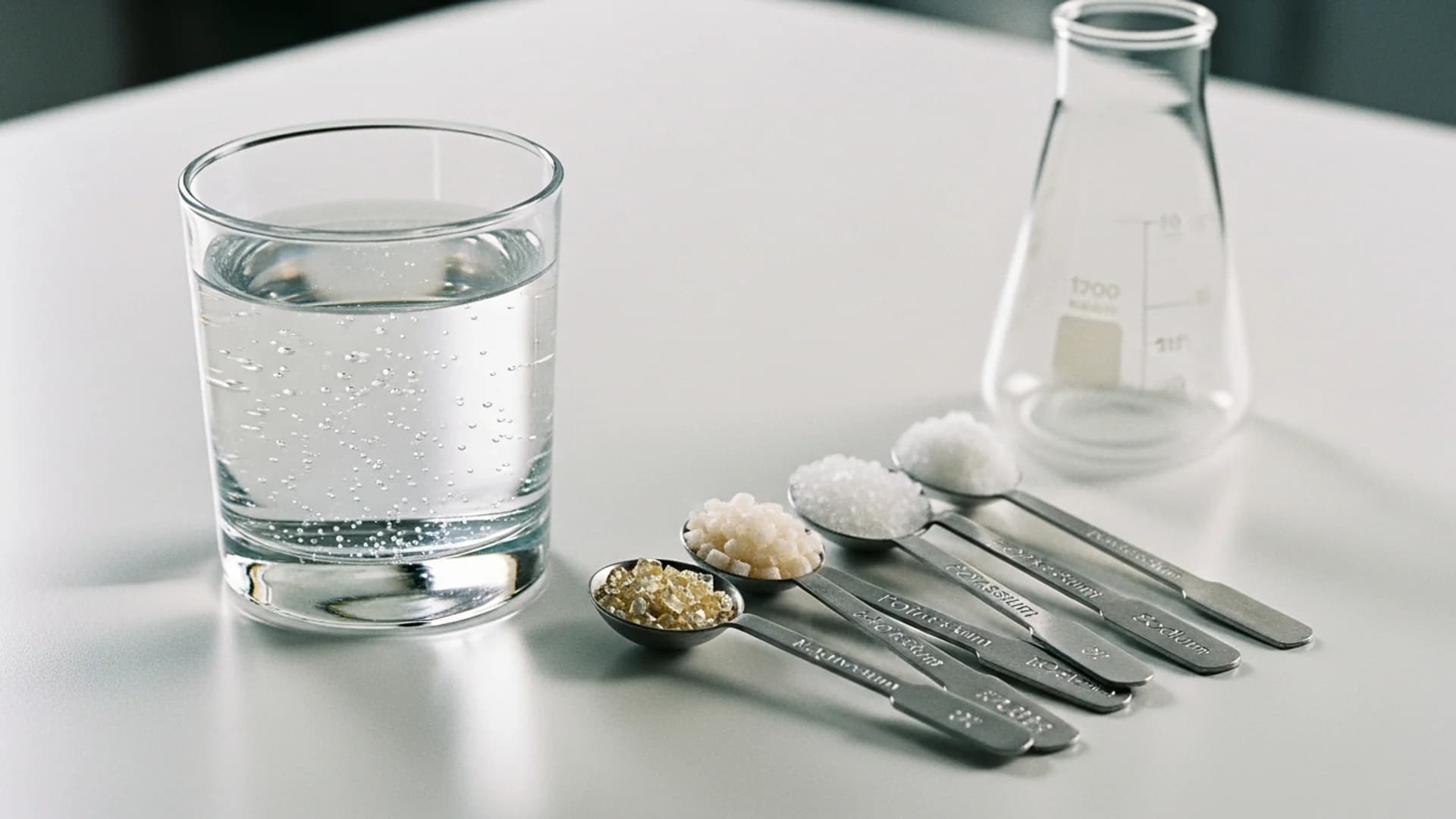

Plain water alone does not keep you hydrated. Without sodium (and potassium and magnesium alongside it), most of what you drink moves through the kidneys and out as urine within an hour or two. For everyday adult hydration, a pinch of grocery-store low-sodium salt added to your water through the day and a separate magnesium glycinate supplement do most of the work. For patients with POTS, hypermobile Ehlers-Danlos syndrome (hEDS), or ME/CFS who need 3 to 5+ grams of sodium daily and struggle with nausea from plain water or stomach upset from table salt, World Health Organization oral rehydration salts (such as TriOral, with about 1,700 mg sodium, 780 mg potassium, and 13.5 g glucose per 1-liter packet) use the gut's SGLT1 sodium-glucose pump to expand blood volume as effectively as IV saline, and a spill-resistant bite-valve bottle kept in bed lets you sip while lying flat on crash days.
A recent case
A patient I will call Margaret came into an emergency room recently for shortness of breath, nausea, and a few days of feeling unlike herself. She is in her seventies. She has a history of cardiac disease and a pacemaker, a few stents, and a hiatal hernia and gastroparesis that occasionally flare. She is on Jardiance (an SGLT2 inhibitor for diabetes), Ramipril (an ACE inhibitor for blood pressure), and a handful of other reasonable medications. She drinks four to five bottles of water a day, on purpose, because she has been told to stay well hydrated.
Her workup was, in clinical terms, mostly unremarkable. Her heart looked fine on echo. Her cardiologist did not see anything acute. Her kidneys were not damaged. The only lab that was clearly off was her BUN at 29.7 - a sign of dehydration, not kidney damage. Her heart rate was being paced more than usual by her pacemaker, which is what the heart does when it senses the body needs more output.
She was, almost certainly, under-hydrated and electrolyte-depleted, despite drinking what most clinicians would consider plenty of water. That is the whole point.
Why does drinking plain water alone not hydrate you?
Hydration is not the same thing as water intake. Hydration is whether water is inside the right compartments of your body - in your blood plasma, in your tissue, and inside your cells where it can do its work.
Plain water has no electrolytes. When you drink a bottle of it, the water enters your bloodstream and the kidneys read the falling osmolality (the concentration of solutes in blood) as a signal to dump that water through urine. Within an hour or two, most of it has come back out. You stay dehydrated despite drinking.
Water stays in your system by being held there by sodium, potassium, and to a lesser degree magnesium, calcium, and chloride. These minerals create the osmotic gradient that keeps water in tissue and inside cells where you need it. Without enough of them, water flows through you instead of into you.
This is mainstream physiology. It is the same reasoning that explains why hospital IV bags always contain salt. There is no such thing as a "bag of water" given through an IV. A 0.9% normal saline bag has 154 mEq/L of sodium and 154 mEq/L of chloride in it. Even D5W (5% dextrose in water), which sounds salt-free, is paired with electrolytes for any sustained infusion. We never give plain water through an IV because plain water alone would move fluid in dangerous ways. The same biology applies, less dramatically, to what you sip from a glass.
Why are salt and blood pressure not opposites?
This is the part where most public health messaging goes off the rails.
Patients hear "you have high blood pressure, watch the salt" and translate that into "salt is the enemy." For some people in some contexts that is true. For most people most of the time it is not.
Two things help:
-
High blood pressure is mostly a problem when salt comes in without water. A bag of chips eaten while dehydrated will pull water from tissue into the blood vessels to dilute the sodium load, and the resulting volume spike is what raises pressure. A pinch of salt added to a glass of water - so the sodium comes in with the fluid it needs - is a fundamentally different physiologic event.
-
Dehydration artificially lowers your blood pressure reading. When you are running low on intravascular volume, the cuff reads a number below your well-hydrated baseline. So when you rebuild hydration with water plus salt, the blood pressure number sometimes comes up. You did not cause hypertension. The cuff is now reading what your body runs at when it has the volume it needs, and that is a healthy correction. The right response is to manage blood pressure properly with medication if needed, and keep the salt in your hydration protocol.
There is a separate conversation about salt restriction for specific populations: people with severe heart failure, certain kidney conditions, very high baseline blood pressures (180/110 and above), and a few others. That conversation belongs with your physician. Most adults are not in those categories.
What should you do to stay hydrated?
The minimum-viable version:
-
Add a pinch of low-sodium salt to your water through the day. Low-sodium salt is sold over the counter in any grocery store. The "low-sodium" label is a little misleading - it contains both sodium chloride and potassium chloride, which is the balance most people are short on. A pinch in each glass is enough. You are not trying to taste salt; you are trying to give the water something to anchor to.
-
Aim for water that has electrolytes more often than water that does not. You do not have to do this with every sip - having a plain glass of water is fine. But the default through your day should be water + a pinch of salt, particularly if you sweat, are out in the heat, are on the medications below, or are recovering from any kind of GI bug.
-
Get your magnesium from a separate source. Salt does not cover magnesium. We use glycinate, malate, or L-threonate depending on the goal (sleep, GI tolerance, cognitive). We avoid magnesium oxide (poor absorption) and magnesium citrate unless we are specifically trying to move the bowels. Read our magnesium glycinate clinical guide for the dosing and form discussion - we will not duplicate it here.
-
Watch for the early signal. Fatigue, fogginess, lightheadedness when you stand, mild nausea, headaches, salt cravings (potato chips and pretzels are the body asking), muscle cramps overnight, constipation. All of these can be the first signs of under-hydration long before a lab tells you.
The packet options (LMNT and WHO oral rehydration salts)
If carrying low-sodium salt around is not practical, or if you need clinical volume expansion for POTS, hypermobile Ehlers-Danlos syndrome (hEDS), or ME/CFS, two packet styles serve two different jobs:
- Zero-sugar sodium sticks for heat and athletic sweat (LMNT, optional): For everyday convenience, exercise, or summer heat, LMNT uses a simple formula - 1,000 mg sodium, 200 mg potassium, and 60 mg magnesium, with zero sugar or fillers. Note: we are a partner with LMNT, and because our agreement does not let us opt out of commissions or pass through discounts directly, those funds go to a pool for people in job transitions who need affordability support for ongoing healthcare coverage. Most healthy adults do this with a grocery store salt jar at a tenth the cost. See our supplement guide framework for how we think about product picks.
- World Health Organization Oral Rehydration Salts for POTS, hEDS, ME/CFS, and GI recovery (TriOral): When you need to expand blood plasma volume by 2 to 3 liters a day without stomach upset, raw table salt often hurts the stomach and plain water triggers nausea. TriOral follows the reduced-osmolarity World Health Organization (WHO) formula (245 mOsm/L). One packet mixes straight into 1 liter of water and delivers 1,695 mg (about 1,700 mg) of sodium, 780 mg of potassium, 13.5 g of glucose, and 2.9 g of trisodium citrate, with zero citric acid, stevia, artificial sweeteners, or dyes. Buying a 100-packet bulk box brings the cost down to roughly $0.42 per liter (compared with $1.50 to $2.00+ per stick for most retail electrolyte brands).
Who needs to pay extra attention to hydration?
The basic protocol is enough for most adults. These are the categories of patient where under-hydration shows up earlier and harder, and where the protocol should be more deliberate.
POTS, hypermobile EDS (hEDS), and ME/CFS (and how to hydrate on crash days)
Patients with POTS, hypermobile Ehlers-Danlos syndrome (hEDS), and ME/CFS live with chronic low blood volume (hypovolemia) and lax blood vessels that let blood pool in the belly and legs on standing. Guidelines call for 2.5 to 3+ liters of fluid and 8 to 12 grams of salt (4,000 to 6,000 mg sodium) daily (Garland JACC 2021). On a good day, sipping salted water works fine. On a post-exertional malaise (PEM) or autonomic crash day, three practical obstacles break that plan:
- The crash-day nausea trap: During a crash, patients often sleep for long stretches and wake already volume-depleted, struggling to drink even 1 liter all day. Chugging plain water on an empty stomach triggers nausea, and without solutes the kidneys dump that plain water within an hour. Meanwhile, taking plain table salt (NaCl) or salt tablets by themselves often irritates the stomach lining.
- Why WHO Oral Rehydration Salts (TriOral) beat plain salt and sports drinks: The small intestine has a built-in sodium-glucose pump called SGLT1. When sodium (75 mEq/L) and glucose (75 mmol/L) arrive in an equal 1:1 molar ratio, SGLT1 actively pulls sodium and water across the gut wall into the bloodstream before fluid can sit in the stomach and cause nausea. In a crossover trial by Medow et al. in The Journal of Pediatrics (2019), drinking 1 liter of WHO oral rehydration solution expanded blood volume and improved upright tolerance in POTS patients just as effectively as 1 liter of intravenous (IV) normal saline, while improving brain blood flow and symptoms even more.
- Why the 1-liter TriOral packet works in practice:
- 1 packet = 1 liter math: One packet mixes into 1 liter of water (~1,700 mg sodium, 780 mg potassium, 13.5 g glucose), matching how most POTS and ME/CFS patients track daily fluid goals in liters without converting ounces. Two liters of TriOral covers 3,400 mg of your daily sodium target alongside 1,560 mg of potassium.
- Gentle on MCAS and sensitive stomachs: Because mast cell activation (MCAS) often travels with POTS and hEDS, many patients react to the citric acid, stevia, sugar alcohols, and food dyes in commercial electrolyte sticks. Unflavored TriOral contains only the 4 WHO ingredients buffered with trisodium citrate (2.9 g), which calms stomach acid instead of irritating it.
- Masking the taste: Unflavored WHO salts have a mildly salty, flat taste on their own. Chilling the liter bottle in the fridge or adding a small splash of a tolerated mixer - such as lemonade flavoring, tart cherry juice, or pure lemon juice - makes it smooth and easy to sip.
- Bedside setup for crash days - the spill-resistant bite-valve bottle: On a crash day, sitting upright to unscrew or tip an open-cap water bottle drives your heart rate up and risks spilling water across the sheets, so you drink less when you need volume most. Keeping a spill-resistant bite-valve bottle (such as a CamelBak Eddy+ bite-valve straw bottle or a bedside hydration reservoir with a silicone bite valve) lying right on the mattress lets you take small, steady sips while lying flat. You can rebuild blood volume horizontal on the pillow before trying to sit or stand.
| Hydration Option | Sodium & Potassium (per Liter) | Carbohydrate & Buffer | Best Clinical Fit | Approximate Cost |
|---|---|---|---|---|
| TriOral (WHO ORS) (1 packet per 1 L) | 1,695 mg Na (75 mEq/L) + 780 mg K (20 mEq/L) | 13.5 g glucose (SGLT1 pump) + 2.9 g trisodium citrate (zero citric acid, stevia, or dyes) | POTS, hEDS, ME/CFS crash days, MCAS overlap, acute GI recovery (matches 1 L IV saline in POTS, Medow 2019) | ~$0.42 / liter (100-pack box) |
| LMNT (1 stick per 16-32 oz) | 1,000 mg Na + 200 mg K (+ 60 mg Mg) | 0 g sugar (flavored versions use citric/malic acid and stevia; Raw Unflavored has none) | Summer heat, heavy sweat, endurance training, or POTS patients who prefer zero carbohydrate | ~$1.50 / stick |
| Grocery Low-Sodium Salt (1/4 tsp pinch per glass) | ~290 mg Na + ~350 mg K per 1/4 tsp | 0 g sugar | Everyday adult baseline hydration, blood pressure support, SGLT2i maintenance | <$0.05 / day |
| Standard Sports Drinks (Gatorade, Powerade) | ~450 mg Na + ~130 mg K per 1 L | ~55-60 g sugar per 1 L (high osmolarity, slows gut uptake) | Sustained high-output endurance events (> 90 min) only; poor fit for POTS or GI bugs | ~$2.00-$3.00 / liter |
SGLT2 inhibitors (Jardiance, Farxiga, Invokana)
These diabetes medications work by pushing glucose out through the urine. The trade-off is that water follows the sugar. Patients on SGLT2 inhibitors are functionally on a mild, continuous diuretic. Plain water alone is even less effective for them than for the general population. Electrolyte attention is not optional - it is part of the care plan.
Diuretics (loop, thiazide, potassium-sparing)
Longevity Medicine
A personalized longevity strategy starts with knowing your real baselines.
Different diuretics move electrolytes differently. Loop and thiazide diuretics tend to deplete potassium and magnesium. Potassium-sparing diuretics (and ACE inhibitors like ramipril or lisinopril) tend to retain potassium. The point is that the medication is moving the electrolyte picture, and a deliberate hydration plan is part of the medication being safe.
Acute GI illness (vomiting, diarrhea, gastroparesis flare)
This is where most of the avoidable ER visits for dehydration come from. A 24-hour stomach bug can deplete a remarkable amount of electrolytes. The recovery protocol is more aggressive than the maintenance protocol. Plain Pedialyte (or a frozen Pedialyte pop) is reasonable here for short stints. Sports drinks are not - the sugar load makes the GI worse.
Older adults
Two physiologic changes compound: the thirst response is blunted with age (you do not feel thirsty until you are already meaningfully dehydrated), and the kidneys are less efficient at conserving water. Add any of the medications above and the picture compounds further. Older adults should not wait until they feel thirsty.
Summer heat and active days
Sweat takes both water and salt out simultaneously. A serious sweat session - long bike ride, hot yoga, gardening for three hours in July, a Phillies game in the upper deck on a 95-degree day - meaningfully changes the math. This is where the LMNT-style packet or a deliberately stronger pinch of salt is worth the trouble.
Athletes
Endurance and high-intensity athletes are in a different metabolic context. The general guidance still applies, but volume goes up substantially. A daily sodium intake well above standard recommendations is normal for athletes training in heat. Talk to your physician or a sports-medicine specialist about your specific numbers.
During a long event, the rules change. Everything above describes your daily baseline. Once you are 90 minutes or more into a race or a long training session, drinking to a schedule or a pre-set volume target is the main way athletes develop dangerously low blood sodium. The guidance for that setting is to drink to thirst with sodium in the fluid, and to add carbohydrate past roughly 90 minutes. Our guide to training load and recovery covers the during-exercise version in full.
One situation reverses the low-sodium salt advice. If you are dealing with significant muscle breakdown after a hard session, the potassium chloride in a low-sodium blend points the wrong way, because damaged muscle is already releasing potassium into the blood. Plain sodium chloride is the right choice until that is sorted out, and the same goes for potassium supplements and salt substitutes. See is it rhabdo, or just very sore? for how to tell whether this applies to you.
Pregnancy
Hydration and electrolyte needs are higher in pregnancy. Sodium needs go up, not down (despite older guidance to the contrary). Pregnant patients should work this out with their obstetrician.
Are sports drinks like Gatorade a good way to hydrate?
Sports drinks are a reasonable rehydration option in a narrow context: an elite athlete burning through significant glycogen during a sustained athletic effort needs both the carbohydrate and the electrolytes simultaneously. That is a specific physiologic situation and most people sipping a Gatorade at a Wawa do not match it.
For everyone else, sports drinks deliver about 30 grams of sugar per 20 ounce bottle alongside the electrolytes you want. The sugar load:
- Drives insulin and crashes you within an hour or two
- Defeats the purpose if you are using the drink to hydrate during illness
- Compounds metabolic risk over time when used daily
- Frequently outperforms the electrolyte signal it was bought to deliver
We do not recommend Gatorade, Powerade, Vitaminwater, or most colored sports drinks as part of a routine hydration plan. Low-sodium salt in plain water is simpler, cheaper, and works better. See our digital health literacy guide on supplements and marketing for the broader framing on how wellness products like these are sold versus what they deliver.
Pedialyte is a different category - it was designed for pediatric rehydration during illness, the sugar load is lower, and it is reasonable for short stints during GI bugs. A frozen Pedialyte pop on a hot day is a fine occasional treat. It is not a daily product for healthy adults.
When does under-hydration show up in the ER?
Most people do not know about this part, and it is why Margaret's case matters.
Under-hydration shows up at the emergency room dressed as more serious problems:
-
Demand ischemia. When your heart is working harder than usual because the body is volume-depleted, the increased oxygen demand on the heart muscle can cause chest pain that looks like an acute coronary event. The cardiac enzymes go up. The ECG can change. The workup costs thousands of dollars and ends with a "we did not find an acute heart attack" discharge, when the problem all along was dehydration.
-
Acute kidney injury. A modest BUN rise is the early signal. Sustained dehydration over days raises creatinine and the eGFR (estimated glomerular filtration rate) drops. With a baseline of chronic kidney disease, this can convert a stable picture into a hospital admission.
-
Falls and altered mental status in older adults. Orthostatic hypotension (the blood pressure drop when you stand up) is more pronounced when volume-depleted. A fall that breaks a hip in someone over 75 is a meaningful inflection point in life expectancy. The dehydration that caused the fall is usually invisible until the fall happens.
-
Pacemaker pacing more often than usual. A pacemaker is set to support the heart when the heart's own pacing falls below a threshold. When the body is volume-depleted, the heart often needs to work harder, and the pacemaker steps in more frequently. Patients sometimes notice this as feeling their pacemaker "kicking in" more.
Most of these scenarios resolve quickly once volume and electrolytes are restored. None of them should have to reach the emergency room.
Key Takeaways
- Plain water alone does not hydrate you. Without sodium, potassium, and magnesium, most of what you drink leaves through urine within an hour or two.
- A pinch of low-sodium salt in your water through the day is the cheapest, simplest, most underused tool in primary care. Grocery store, over the counter, a few dollars a year.
- For POTS, hEDS, and ME/CFS, WHO oral rehydration salts (TriOral) beat plain salt and plain water. One packet in 1 liter of water (~1,700 mg sodium, 780 mg potassium, 13.5 g glucose, zero citric acid or stevia) turns on the gut's SGLT1 pump to expand blood volume as effectively as 1 liter of IV saline (Medow 2019) without stomach upset.
- On ME/CFS or POTS crash days, keep a spill-resistant bite-valve bottle in bed. Sipping horizontally while lying flat prevents the waking dehydration-and-nausea spiral without sitting upright or spilling.
- Salt and blood pressure are not opposites. Dehydration artificially lowers BP readings. Rebuilding hydration sometimes makes the number come up to its baseline value. That is a healthy correction, managed with BP medication if needed instead of stripping out the salt.
- Magnesium is its own conversation. Glycinate, malate, or L-threonate. Not oxide, not citrate. See our magnesium glycinate guide.
- Sports drinks are sugar and marketing in a bottle for most people. Grocery-store low-sodium salt or WHO oral rehydration salts are cleaner, cheaper, and work better.
- The categories that need to pay extra attention: POTS, hEDS, ME/CFS, SGLT2 inhibitors (Jardiance), diuretics, GI illness, summer heat, older adults, endurance athletes, pregnancy.
- Under-hydration shows up in the ER dressed as more serious problems: demand ischemia, acute kidney injury, falls in older adults, pacemaker over-pacing. Most of these never had to reach the emergency room.
Scientific References
- Sterns RH. Disorders of plasma sodium - causes, consequences, and correction. New England Journal of Medicine. 2015;372(1):55-65.
- Cogswell ME, Loria CM, Terry AL, et al. Estimated 24-hour urinary sodium and potassium excretion in US adults. JAMA. 2018;319(12):1209-1220.
- Mente A, O'Donnell M, Rangarajan S, et al. (PURE Study Investigators). Urinary sodium excretion, blood pressure, cardiovascular disease, and mortality: a community-level prospective epidemiological cohort study. Lancet. 2018;392(10146):496-506.
- DiNicolantonio JJ, O'Keefe JH. The history of the salt wars. American Journal of Medicine. 2017;130(9):1011-1014.
- Stookey JD, Constant F, Popkin BM, et al. Drinking water is associated with weight loss in overweight dieting women independent of diet and activity. Obesity. 2008;16(11):2481-2488.
- Ferreira JP, Zannad F, Pocock SJ, et al. Interplay of mineralocorticoid receptor antagonists and empagliflozin in heart failure: EMPEROR-Reduced. Journal of the American College of Cardiology. 2021;77(11):1397-1407. (SGLT2 / volume context.)
- Sica DA. Sodium and water retention in heart failure and diuretic therapy: basic mechanisms. Cleveland Clinic Journal of Medicine. 2006;73(Suppl 2):S2-S7.
- Stookey JD. Higher predicted vasopressin secretion is associated with greater chronic kidney disease prevalence in a large general adult population. American Journal of Nephrology. 2011;34(5):417-426.
- Armstrong LE, Casa DJ, Maresh CM, Ganio MS. Caffeine, fluid-electrolyte balance, temperature regulation, and exercise-heat tolerance. Exercise and Sport Sciences Reviews. 2007;35(3):135-140.
- Murray B. Hydration and physical performance. Journal of the American College of Nutrition. 2007;26(5 Suppl):542S-548S.
- Valtin H. "Drink at least eight glasses of water a day." Really? Is there scientific evidence for "8 x 8"? American Journal of Physiology - Regulatory, Integrative and Comparative Physiology. 2002;283(5):R993-R1004.
- Hew-Butler T, Rosner MH, Fowkes-Godek S, et al. Statement of the Third International Exercise-Associated Hyponatremia Consensus Development Conference. Clinical Journal of Sport Medicine. 2015;25(4):303-320.
- Maughan RJ, Watson P, Cordery PA, et al. A randomized trial to assess the potential of different beverages to affect hydration status: development of a beverage hydration index. American Journal of Clinical Nutrition. 2016;103(3):717-723.
- Medow MS, Guber K, Chokshi S, Terilli C, Visintainer P, Stewart JM. The Benefits of Oral Rehydration on Orthostatic Intolerance in Children with Postural Tachycardia Syndrome. Journal of Pediatrics. 2019;214:96-102. PubMed
- Garland EM, Gamboa A, Nwazue VC, et al. Effect of High Dietary Sodium Intake in Patients With Postural Tachycardia Syndrome. Journal of the American College of Cardiology. 2021;77(17):2174-2184. PubMed
Related at Fishtown Medicine
- POTS Treatment in Philadelphia - the 10-minute stand test, salt and fluid targets, compression, and matched medications
- Hypermobility and hEDS Care in Philadelphia - managing joint laxity, POTS, and MCAS together
- ME/CFS and Post-Exertional Malaise: Raising Your Energy Ceiling - heart-rate-ceiling pacing and crash-day volume support
- Dizziness and a Racing Heart When You Stand - a patient case on diagnosing and treating POTS
- Magnesium Glycinate Clinical Guide - forms, dosing, who needs which version
- How We Choose Supplements - the 4-gate framework
- IV Vitamin Therapy: Expensive Urine or Useful Tool? - when drip bars are medicine and when they are theater
- Digital Health Literacy - the broader frame for sports drinks, wellness marketing, and electrolyte hype
- UV Index in Philadelphia: What to Do at Every Tier - hot-weather context
- Severe Weather in Philadelphia: What to Do - hydration and heat / cold edge cases
- Stroke Prevention in Philadelphia - the cardiovascular context behind much of this
- Swollen Feet and Ankles - what to check when fluid collects in the wrong place
Medical Disclaimer: This article is for educational purposes only and is not medical advice for any individual. Hydration and electrolyte needs depend on your specific medical history, medications, kidney and heart function, activity level, and physiology. The patient case described uses a pseudonym and rounded details, with identifying information changed or removed. If you have heart failure, kidney disease, advanced hypertension, or are taking diuretics or other medications that affect electrolytes, work out your specific protocol with your physician before making changes.

Fishtown Medicine | Longevity
Frequently Asked Questions
Common Questions
Deep-Dive Questions
Ready when you are
The chat is our AI assistant, answering from our published guides. To talk it through with Dr. Ash himself, start with the intake.