
You cannot reach zero environmental exposure in a modern city, and you do not need expensive detox kits. When we rank home hazards by hard clinical proof, basement radon testing and bedroom HEPA air filtration top the list, followed by NSF/ANSI 53 or 58 water filtration for lead and PFAS, and simple kitchen swaps (never microwaving plastic, storing food in glass, and cooking on stainless steel or cast iron) that cut urinary BPA and phthalates by 38% to 66% in less than a week.
TL;DR
- Rank your home upgrades by clinical proof: Basement radon and indoor fine dust (PM2.5) have the strongest proof for preventing lung cancer and lowering blood pressure. Water filters and glass food containers quickly cut lead, PFAS, and plastic chemicals.
- Test your basement for radon ($20 to $30 kit): Radon is the number-one cause of lung cancer in people who have never smoked. Vent the basement slab if levels reach 4.0 pCi/L or higher, and consider venting between 2.0 and 4.0 pCi/L.
- Run a bedroom HEPA purifier and stove exhaust hood: Randomized trials show a bedroom HEPA unit cuts indoor fine dust in half and lowers systolic blood pressure by 3 to 4 mmHg when your top blood pressure number is 120 or higher.
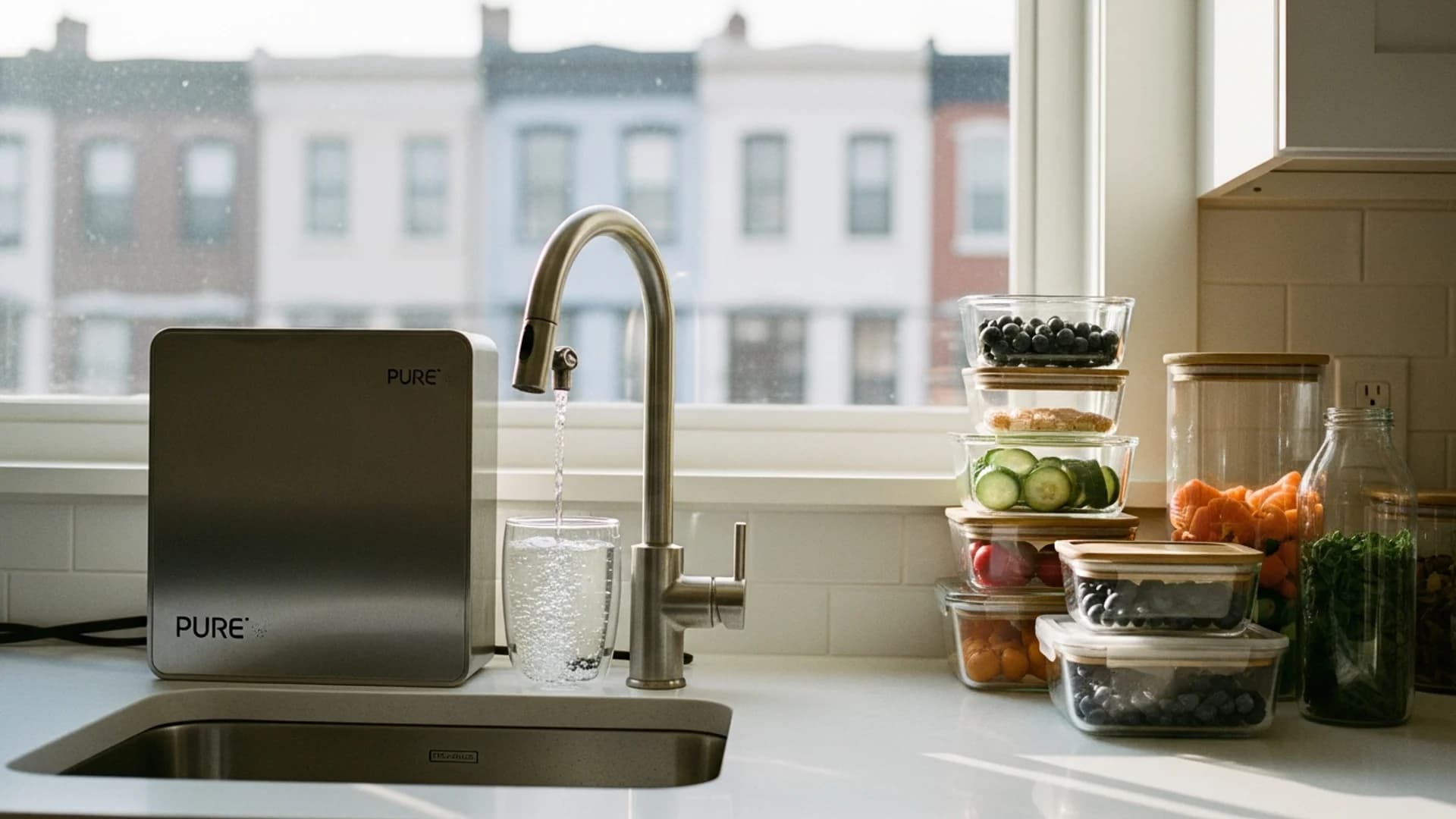
- Filter Philadelphia tap water (NSF/ANSI 53 or 58) and change cartridges on time: An NSF 53 carbon block removes over 97% of pipe lead, while an NSF 58 reverse-osmosis filter removes 95% to 99% of both long- and short-chain PFAS. Replace carbon filters on schedule so trapped PFAS do not wash back into your glass.
- Never microwave plastic or pour hot food into takeout tubs: Heating plastic releases millions of plastic specks per square centimeter. Switching to glass bowls and stainless steel or cast-iron pans drops urine BPA and phthalate levels by 38% to 66% within 3 to 7 days.
- Skip commercial blood microplastic tests and detox pills: Current lab methods can mistake normal artery and brain fats for polyethylene plastic, and provoked urine metal tests create false alarms.
A few weeks ago, a young couple who had just bought a renovated 1920s rowhome in Graduate Hospital came in for a visit holding a $650 online cart of microplastic and heavy-metal detox pills. They were drinking only out of single-use plastic water bottles because they worried about old Philadelphia pipes, and they had never tested their cellar for radon or turned on their range hood while cooking. In twenty minutes, we canceled the $650 supplement cart and swapped in a $35 NSF/ANSI 53 water filter, glass food bowls, a bedroom HEPA purifier, and a $20 radon test kit - cutting their daily exposure tenfold without buying a single unproven pill.
How Do Household Toxins Rank by Clinical Evidence?
Basement radon, indoor air particles (PM2.5), and pre-1978 lead top the medical priority list because fixing them lowers lung cancer risk, blood pressure, and child lead poisoning. PFAS, bisphenol, and microplastic swaps mainly lower blood and urine chemical levels while long-term outcome trials continue.12469
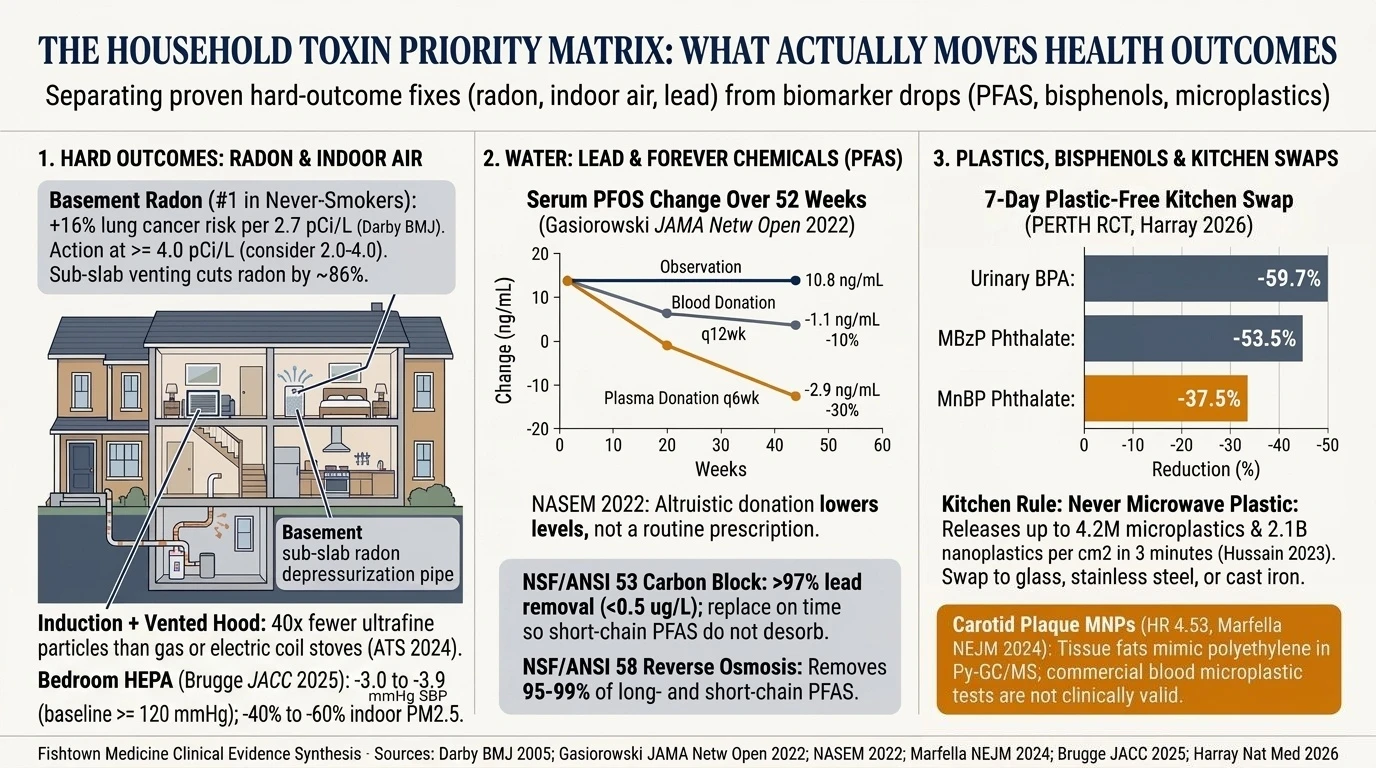
Online wellness checklists treat every chemical headline as an equal emergency. In clinic, we separate three levels of proof: cutting exposure (fewer particles in your air, water, or food), lowering body burden (lower levels in your blood or urine), and improving hard outcomes (fewer heart attacks, lower blood pressure, or less cancer).
| Priority Rank & Exposure | Strength of Proof | What Human Trials Show | Highest-Leverage Home Fix | What to Skip |
|---|---|---|---|---|
| 1. Basement Radon Gas | Hard clinical outcome (lung cancer mortality).12 | Linear +16% lung cancer risk per 2.7 pCi/L (100 Bq/m3); #1 cause in never-smokers (~21,000 US deaths/yr).12 | Run a $20-$30 radon test in your lowest lived-in room; sub-slab venting cuts radon by ~86% (61%-95%) at >= 4.0 pCi/L (consider at 2.0-4.0).2 | Turning a rowhome basement into a gym or office without testing first. |
| 2. Indoor Air (PM2.5 & Stove Emissions) | RCT physiologic outcome (systolic blood pressure).345 | Bedroom HEPA filtration cuts indoor PM2.5 by 40%-60% and lowers systolic BP by 3.0 to 3.9 mmHg.34 Induction stoves emit ~40x fewer ultrafine particles than gas.5 | Run a bedroom HEPA purifier (CADR >= 2/3 room area), a MERV 13 HVAC filter, and an outdoor-vented hood (or plug-in induction cooktop).345 | Ozone or "ionic" air cleaners that irritate lungs. |
| 3. Lead (Pre-1978 Paint, Dust & Plumbing) | Hard clinical & biomarker proof (CDC reference 3.5 ug/dL).67 | NSF/ANSI 53 filters cut water lead below 0.5 ug/L in >97% of homes; professional source removal beats post-hoc cleaning.67 | Use NSF/ANSI 53 or 58 filters on pre-1986 plumbing, hire EPA RRP-certified pros for pre-1978 paint, and screen kids plus high-risk imported spices.67 | DIY dry-sanding old trim or ordering "provoked" urine metal tests. |
| 4. PFAS ("Forever Chemicals") | Biomarker RCT proof + NASEM 2022 clinical tiers.891011 | NSF 58 RO removes 95%-99% of all PFAS; community filtration cuts blood PFOA ~26%/yr; plasma donation cuts PFOS -2.9 ng/mL (~30%).810 | Filter drinking water (NSF 58 RO or NSF 53 carbon replaced on time) and eat oat beta-glucan soluble fiber.8911 | Letting carbon filters run past their replacement date (causes PFAS desorption).8 |
| 5. Bisphenols (BPA/BPS) & Phthalates | Rapid urinary biomarker RCT proof (3 to 7 days).1213 | 7-day low-plastic kitchen swap (PERTH 2026 RCT) cut urinary BPA by 59.7%, MBzP by 53.5%, and MnBP by 37.5%; fresh-food swap cut BPA 66%.1213 | Store and reheat food in glass, ceramic, or stainless steel; favor fresh whole foods and fragrance-free personal care.1213 | Expecting kitchen container swaps alone to clear upstream DEHP from ultra-processed foods.12 |
| 6. Microplastics & Nanoplastics (MNPs) | Exposure reduction + associative tissue data.14151617 | Microwaving plastic sheds up to 4.22M microplastics & 2.11B nanoplastics/cm2 in 3 min.17 Carotid plaque MNPs tracked with HR 4.53 for CV events, though fat interference affects lab tests.1416 | Never microwave or machine-wash plastic; swap scratched nonstick pans for steel or cast iron; drink filtered tap water from steel or glass.1718 | Paying for commercial blood microplastic tests or "plastic detox" supplements.16 |
Why Do Basement Radon and Bedroom HEPA Filtration Top the List?
Radon and indoor fine dust (PM2.5) top our checklist because human studies prove that venting a basement prevents lung cancer and running a bedroom HEPA purifier lowers blood pressure within days.1234
1. Basement Radon in Southeastern Pennsylvania (Darby BMJ 2005 & EPA Thresholds)
Southeastern Pennsylvania lies over the uranium-rich Reading Prong and Piedmont rock formations, which release odorless radon gas through basement floor cracks.
- The Dose-Response Proof: Radon causes roughly 21,000 US lung cancer deaths each year - including 2,900 deaths in lifelong never-smokers.2 That makes it the #1 cause of lung cancer in never-smokers and #2 overall.2 In the pooled analysis of 13 European studies (Darby et al., BMJ 2005), lung cancer risk rose linearly by 16% for every 100 Bq/m3 (~2.7 pCi/L) rise in long-term home radon. There is no safe threshold, and never-smokers face a 15% excess relative risk per 100 Bq/m3.12
- What to Do: Place a $20 to $30 charcoal test kit or digital monitor (such as Airthings) in your lowest lived-in room. The EPA recommends fixing your home at 4.0 pCi/L or higher and considering action between 2.0 and 4.0 pCi/L (the WHO reference level is 100 Bq/m3, or ~2.7 pCi/L).2 Active sub-slab venting (a quiet pipe-and-fan system that vents soil gas outdoors) cuts indoor radon by 61% to 95% (average ~86%).2
2. Bedroom HEPA Filtration & Blood Pressure RCTs (Walzer 2020, Faridi 2023 & Brugge JACC 2025)
We spend roughly 90% of our lives indoors, and a third of every day asleep in one bedroom. Fine dust (PM2.5) from I-95 traffic, wildfire smoke, and kitchen searing crosses from the lungs into the blood. It stiffens arteries and raises blood pressure.
- Randomized Trial Blood-Pressure Drop: Portable HEPA air purifiers lower indoor PM2.5 by 40% to 60% (59.8% in trials and 49% in home field studies).3 Across 10 randomized trials (Walzer et al., Hypertension 2020), running an indoor HEPA filter lowered systolic blood pressure by 3.94 mmHg (-3.62 mmHg in low-bias trials in Faridi 2023, and -3.2 mmHg within 3 days among Detroit seniors in Morishita JAMA Intern Med 2018).3
- The 2025 JACC Crossover Trial (Brugge et al., n = 154): In a crossover trial of adults living near highway traffic, home HEPA filtration lowered systolic blood pressure by 3.0 mmHg (P = 0.04) in adults whose starting systolic blood pressure was 120 mmHg or higher.4
- Sizing & Stove Upgrades: Choose a true HEPA purifier (never an ozone or ionizer unit) with a CADR rating equal to at least two-thirds of your bedroom's floor area (or full square footage for wildfire smoke). Pair it with a MERV 13 HVAC filter (or a 4-filter MERV 13 Corsi-Rosenthal box). In the kitchen, the 2024 American Thoracic Society report notes that gas burners push indoor nitrogen dioxide (NO2) above outdoor limits. Switching to an induction cooktop produces roughly 40-fold fewer ultrafine particles than gas or electric coils.5 Run an outdoor-vented range hood over the back burner (or crack a window) when searing food (see our Philadelphia AQI guide).
How Should You Filter Tap Water and Handle Lead or PFAS in Your Body?
Use an NSF/ANSI 53 carbon block filter (replaced on time) or an NSF/ANSI 58 reverse-osmosis unit to remove pipe lead and PFAS from Philadelphia tap water. Eat soluble oat beta-glucan fiber to support gut clearance.68911
1. Lead in Pre-1978 Philadelphia Rowhomes (Water, Paint Dust, and Non-Traditional Sources)
The CDC blood lead reference value for children is 3.5 ug/dL, and there is no safe blood lead level in pregnancy or early childhood.6
- Primary Source Removal Beats Cleaning: Randomized trials (Braun JAMA Pediatr 2018; Cochrane 2020) show that dust wiping alone rarely lowers children's blood lead. Sealing or removing the source - peeling pre-1978 paint handled by EPA RRP-certified pros, or pre-1986 lead solder and pipes - is what works.6
- NSF/ANSI 53 Water Filtration: Point-of-use filters certified to NSF/ANSI Standard 53 cut tap water lead below 0.5 ug/L in over 97% of Flint homes and met lead benchmarks in 99% of 1,678 field-tested homes.7
- Hidden Non-Paint Sources: When a child or adult has an unexplained blood lead rise, we also check imported ground spices (turmeric, cinnamon), glazed ceramics, herbal remedies, and food pouches. In 2023-2024, a US outbreak of 566 childhood lead cases was traced to lead-chromate-tainted cinnamon applesauce pouches.6
2. PFAS Filtration: Why Timely Carbon Filter Replacement Matters (NSF 53 vs. NSF 58)
Per- and polyfluoroalkyl substances (PFAS, such as PFOA, PFOS, and PFHxS) enter regional rivers and Bucks or Montgomery County well plumes (Horsham, Warminster, Willow Grove). The EPA's April 2024 water rule set a limit of 4.0 parts per trillion (ppt) for PFOA and PFOS (with utility compliance extended to 2031).9 Community water filtration cuts residents' blood PFOA by roughly 26% per year (40% to 60% total drop in the Mid-Ohio Valley and 20% to 40% lower levels in Hyannis, Massachusetts).8
- NSF/ANSI 58 Reverse Osmosis (Gold Standard): Under-sink reverse osmosis removes 95% to 99% of both long-chain (PFOA, PFOS) and short-chain PFAS.8
- NSF/ANSI 53 Activated Carbon (The Desorption Warning): New carbon-block filters remove 90% to 100% of long-chain PFAS, but short-chain PFAS break through much earlier. Water studies (Belkouteb 2020; Nakazawa Water Res 2024) show that overdue, saturated carbon cartridges can release trapped PFAS back into filtered water at levels higher than raw tap water.8 If you use an NSF 53 pitcher or under-sink carbon filter, replace the cartridge on schedule. Basic NSF 42 pitcher filters only improve chlorine taste and do not remove lead or PFAS.
3. Can You Clear PFAS Already in Your Blood? (Firefighter RCT, NASEM 2022, and Fiber Nuances)
PFAS bind to blood proteins and get reabsorbed in bile, giving them human half-lives of 2 to 7 years.9 Clinical trials separate three clearance pathways:
- Blood and Plasma Donation (Gasiorowski et al., JAMA Netw Open 2022 vs. NASEM Caution): In a 52-week trial of 285 Australian firefighters with baseline PFOS >= 5 ng/mL, donating plasma every 6 weeks cut blood PFOS by 2.9 ng/mL (~30%) and PFHxS by 1.1 ng/mL.10 Donating whole blood every 12 weeks cut PFOS by 1.1 ng/mL (~10%).10 However, the 2022 National Academies (NASEM) guidance notes that no trial shows phlebotomy improves disease outcomes. It warns against prescribing blood-letting solely as a "PFAS detox" (donated blood also transfers trace PFAS to recipients).910 If you donate blood or plasma altruistically and have healthy iron stores, lower PFOS is a bonus. Natural clearance also occurs through menstruation and breastfeeding; maternal PFAS drops 18% to 31% after 6+ months of nursing, and CDC, AAP, and ACMT recommend continuing breastfeeding.9
- Oat Beta-Glucan vs. Psyllium vs. Prescription Resins: In a 4-week human pilot study of 72 Canadian men (Schlezinger Environ Health 2025), oat beta-glucan soluble fiber lowered blood PFOA and PFOS (~8% in higher-exposure men). That matches NHANES data where each quartile rise in dietary fiber tracked with 6.7% lower PFOS and 3.6% lower PFOA.11 While psyllium husk binds bile acids to lower LDL/ApoB cholesterol and is plausible for PFAS, psyllium has not yet been tested in a direct human PFAS trial.11 Stronger drops seen with colesevelam (-38% blood PFOS in 12 weeks) and cholestyramine (23-fold higher stool PFOS excretion in the 2025 Ronneby crossover trial) use prescription bile-acid drugs with gut side effects and vitamin trade-offs - not over-the-counter supplements.11
- NASEM 2022 Blood PFAS Testing Tiers: For firefighters, chemical workers, or residents near well plumes, NASEM groups the sum of 7 blood PFAS (PFOS, PFOA, PFHxS, PFNA, PFDA, PFUnDA, MeFOSAA) into three tiers:9
- < 2 ng/mL: Usual preventive care.
- 2 to < 20 ng/mL: Cut exposure, check lipids (LDL/ApoB), keep up routine breast cancer screening, and check blood pressure at all prenatal visits.
- >= 20 ng/mL: At every well visit, check lipids (after age 2), thyroid function (TSH) (after age 18), signs of kidney cancer (after age 45), and signs of testicular cancer and ulcerative colitis (after age 15).9
Longevity Medicine
A personalized longevity strategy starts with knowing your real baselines.
What Did the 2024-2026 Microplastic and Kitchen Swap Studies Prove?
Human artery plaque and brain studies found strong links to plastic specks, though fat-interference artifacts mean commercial blood microplastic tests are not valid. Meanwhile, randomized kitchen swap trials prove you can cut urinary BPA and phthalates by 38% to 66% in 3 to 7 days.1213141516
1. Carotid Plaque & Brain Microplastics: The Signal and the Lab Caveat (Marfella NEJM 2024 & Nihart Nat Med 2025)
- The Clinical Signal: In NEJM (Marfella et al., 2024, n = 257 patients followed for 33.7 months after carotid surgery), surgeons found polyethylene in 58.4% (150/257) and PVC in 12.1% (31/257) of removed plaques. Patients with plaque plastics had higher local artery swelling and a 20.0% vs. 7.5% rate of heart attack, stroke, or death (adjusted HR 4.53, 95% CI 2.00 to 10.27, P < 0.001).14 In 2025, Nihart et al. (Nature Medicine) reported that postmortem human brains held 7 to 30 times higher micro/nanoplastic readings than liver or kidney samples, with higher levels in dementia brains.15
- The Analytical Caveat (Py-GC/MS Lipid Interference): Both studies relied on pyrolysis-GC/MS, which vaporizes tissue at high heat. Chemistry validation studies (Rauert ES&T 2025; Bissonnette Anal Chim Acta 2025) showed that natural human tissue fats (abundant in artery plaque and brain tissue) break down during heating into short-chain alkenes that mimic polyethylene, causing false positives. In Bissonnette 2025, 10 of 22 placental blood polyethylene hits were false positives, overestimating polyethylene by up to 233%.16 Unmeasured socioeconomic or air-pollution confounding and blood-brain barrier breakdown in dementia can also inflate links.141516
- The Bottom Line: The artery and brain findings are a good reason to cut home plastic exposure and treat proven plaque drivers like ApoB and blood pressure. They also explain why you should skip commercial "blood microplastic" lab tests, which lack clinical validation.16
2. Randomized Kitchen Swap Trials: PERTH 2026, Fresh Food, and Heat Release
Because bisphenols (BPA, BPS, BPF) and phthalates leave the body in under 24 hours, kitchen changes show up in urine within days:
- The 2026 PERTH Randomized Trial (Harray et al., Nature Medicine 2026, n = 60): Just 7 days of eating low-plastic food and using plastic-free kitchenware cut urinary bisphenol A (BPA) by 59.7%, MBzP phthalate by 53.5%, and MnBP phthalate by 37.5%.12 High-molecular-weight DEHP phthalates did not fall from home container swaps alone because DEHP enters food upstream through factory tubing and belts. Pairing glass storage with fewer ultra-processed foods solves both.1213
- The 3-Day Fresh-Food & Personal-Care Trials (Rudel 2011 & HERMOSA 2016): Replacing canned and plastic-wrapped meals with fresh foods for 3 days cut urinary BPA by 66% and DEHP metabolites by 53% to 56%.13 Switching to phthalate- and paraben-free personal care products for 3 days cut urinary MEP by 27% and methylparaben by 44%.13
- Why Heat Is the Trigger in Your Kitchen:
- Microwaving Plastic (Hussain ES&T 2023): Heating food or drink in plastic containers for 3 minutes releases up to 4.22 million microplastics and 2.11 billion nanoplastics per square centimeter.17 The AAP advises never microwaving or machine-dishwashing plastic containers (codes 3 PVC, 6 polystyrene, and 7 polycarbonate). Dishwashing sheds 1,025 to 1,370 microplastics per load.17
- Cookware & Utensils: A scratch on a PTFE nonstick pan can shed thousands of plastic specks (~2,400 to 5,000 microplastics per year from cooking), and overheating PTFE above 260 C (500 F) emits acid fumes.18 Recycled black plastic spatulas can also leach flame retardants into hot oil.18 Cook on stainless steel, cast iron, carbon steel, or enameled cast iron with wood or steel tools.
- Bottled vs. Tap Water & Boiling: While laser-microscopy counts of ~240,000 plastic specks per liter in bottled water (Qian PNAS 2024) carry lab blank caveats (Materic PNAS 2024), head-to-head testing confirms bottled water holds far more microplastics than tap water.19 Bonus tip: boiling hard tap water for 5 minutes and pouring it through a coffee filter traps over 70% of micro- and nanoplastics inside harmless mineral scale.20
Guidance from the Clinic

Key Takeaways
- Start where clinical outcomes are proven: A $20 basement radon test (mitigating at >= 4.0 pCi/L, considering at 2.0-4.0 pCi/L) and a bedroom HEPA purifier (-3.0 to -3.9 mmHg systolic blood pressure in randomized trials) deliver the strongest hard health returns in a Philadelphia home.134
- Filter tap water and replace cartridges on schedule: Use NSF/ANSI 53 (for >97% lead reduction and long-chain PFAS) or NSF/ANSI 58 reverse osmosis (for 95%-99% of all PFAS), and never let carbon cartridges run overdue so PFAS cannot desorb back into your water.78
- Keep heat away from plastic in the kitchen: Never microwave plastic containers (which releases millions of microplastics per cm2); switching to glass storage, fresh foods, and stainless steel or cast-iron cookware drops urinary BPA and phthalates by 38% to 66% in 3 to 7 days.121317
- Use evidence-based PFAS follow-up, not detox scams: Follow NASEM 2022 serum PFAS tiers (< 2, 2 to < 20, and >= 20 ng/mL) for targeted lipid, thyroid, and prenatal blood-pressure checks, eat oat beta-glucan fiber, and skip unvalidated blood microplastic tests or provoked urine metal panels.91116
Scientific References
- Darby S, Hill D, Auvinen A, et al. Radon in homes and risk of lung cancer: collaborative analysis of individual data from 13 European case-control studies. BMJ. 2005;330(7485):223.
- Murphy B, et al. Residential Radon Exposure and Lung Cancer in Never-Smokers. JAMA. 2025; and Khan SM, Gomes J, Krewski DR. Radon mitigation effectiveness: systematic review. Environ Int. 2019;129:372-383.
- Walzer D, Gordon T, Thorpe L, et al. Effects of Home Particulate Air Filtration on Blood Pressure: A Systematic Review. Hypertension. 2020;76(1):44-50; and Faridi S, et al. Sci Total Environ. 2023;884:163801.
- Brugge D, Eliasziw M, Thanikachalam M, et al. Home HEPA Filtration and Blood Pressure Among Adults Near Highway Traffic: A Pragmatic Randomized Crossover Trial. J Am Coll Cardiol. 2025;86(5):345-356.
- Nassikas NJ, McCormack MC, Ewart G, et al. Household Air Pollution From Cooking With Gas and Health: An Official American Thoracic Society Workshop Report. Ann Am Thorac Soc. 2024;21(11):1483-1494.
- Ruckart PZ, Jones RL, Courtney JG, et al. Update of the Blood Lead Reference Value - United States, 2021. MMWR Morb Mortal Wkly Rep. 2021;70(43):1509-1512; and Braun JM, et al. JAMA Pediatr. 2018;172(10):938-946.
- Bosscher V, Lytle DA, Schock MR, et al. POU water filters effectively reduce lead in drinking water: a demonstration field study in Flint, Michigan. J Environ Sci Health A. 2019;54(5):484-493; and Tang M, et al. Water Res. 2023;242:120213.
- Nakazawa K, et al. Breakthrough and desorption of short- and long-chain PFAS in household activated carbon filters. Water Res. 2024;253:121284; and Bartell SM, et al. Environ Health Perspect. 2010;118(2):222-228.
- National Academies of Sciences, Engineering, and Medicine (NASEM). Guidance on PFAS Exposure, Testing, and Clinical Follow-Up. Washington, DC: The National Academies Press; 2022.
- Gasiorowski R, Forbes MK, Silver G, et al. Effect of Plasma and Blood Donations on Levels of Perfluoroalkyl and Polyfluoroalkyl Substances in Firefighters in Australia: A Randomized Clinical Trial. JAMA Netw Open. 2022;5(4):e226257.
- Schlezinger JJ, et al. Oat beta-glucan dietary fiber intervention and serum PFAS concentrations in men. Environ Health. 2025;24:12; and Andersson EM, et al. Environ Int. 2025;195:109214.
- Harray AJ, et al. Plastic Exposure Reduction Transforms Health (PERTH): A randomized controlled trial of low-plastic dietary and kitchen interventions on urinary bisphenols and phthalates. Nat Med. 2026;32(2):284-293.
- Rudel RA, Gray JM, Engel CL, et al. Food packaging and bisphenol A and bis(2-ethyhexyl) phthalate exposure: findings from a dietary intervention. Environ Health Perspect. 2011;119(7):914-920; and Harley KG, et al. (HERMOSA Study). Environ Health Perspect. 2016;124(10):1600-1607.
- Marfella R, Prattichizzo F, Sardu C, et al. Microplastics and Nanoplastics in Atheromas and Cardiovascular Events. N Engl J Med. 2024;390(10):900-910.
- Nihart AJ, Garcia MA, El Hayek E, et al. Bioaccumulation of microplastics in decedent human brains. Nat Med. 2025;31(3):452-460.
- Rauert C, et al. Lipid interference and analytical false positives in pyrolysis-GC/MS quantification of polyethylene in human tissues. Environ Sci Technol. 2025;59(4):1980-1991; and Bissonnette L, et al. Anal Chim Acta. 2025;1336:343482.
- Hussain KA, Romanova S, Okur I, et al. Assessing the Release of Microplastics and Nanoplastics from Plastic Containers and Reusable Food Pouches: Implications for Human Health. Environ Sci Technol. 2023;57(26):9782-9792.
- Luo Y, Gibson CT, Chuah C, et al. Raman imaging for the identification of Teflon microplastics and nanoplastics released from non-stick cookware. Sci Total Environ. 2022;851:158293; and Liu M, et al. Chemosphere. 2024;365:143319.
- Qian N, Gao X, Lang X, et al. Rapid single-particle chemical imaging of nanoplastics by SRS microscopy. Proc Natl Acad Sci U S A. 2024;121(3):e2300582121; and Materic D, et al. Proc Natl Acad Sci U S A. 2024;121(24):e2405228121.
- Yu Z, Wang JJ, Liu LY, Zeng EY. Drinking Boiled Tap Water Reduces Human Intake of Nanoplastics and Microplastics. Environ Sci Technol Lett. 2024;11(3):273-279.
Related at Fishtown Medicine
- Philadelphia AQI: What to Do - the practical playbook for wildfire smoke and high-PM2.5 days in Philly
- Pollen in Philadelphia - the tree/grass/weed calendar and when to pre-treat
- Philadelphia Environmental Health (Overview) - the city-wide environmental health framework
- Heavy Metal Detox: The Science - why provoked urine chelation tests are risky and when medical lead or mercury testing matters
Medical Disclaimer
This page is provided for educational purposes and is not a substitute for individualized medical advice. Consult your primary care physician about specific environmental concerns, particularly if you are pregnant or nursing, have known occupational or military-base water exposure, or have small children at home.

Fishtown Medicine | Longevity
Frequently Asked Questions
Common Questions
Deep-Dive Questions
Ready when you are
The chat is our AI assistant, answering from our published guides. To talk it through with Dr. Ash himself, start with the intake.