
Long-haul flying combines mild cabin hypoxia (6,000 to 8,000 feet equivalent), sub-10% humidity, immobility (venous thromboembolism risk rises 18% per 2 hours of flight), and circadian phase disruption. To advance your clock eastward without backfiring, avoid bright outdoor dawn light on arrival if it falls before your home core body temperature minimum (roughly 4:00 to 5:00 AM home time), and use 0.5 mg to 3 mg of USP-verified immediate-release melatonin timed to your phase-response curve. Carry all prescription and GLP-1 medications in original pharmacy-labeled containers in your carry-on with a physician letterhead letter, and never pack Adderall into Japan or unpermitted controlled medications through UAE or Singapore layovers.
TL;DR: Long flights stress your body with 6,000-to-8,000-foot cabin pressure, desert-dry air, cramped seating, and sudden time-zone changes.
- Protect your clock eastward: When you arrive in Europe at 7:00 AM local time, your brain is still at 2:00 AM Philadelphia time, before your core body temperature minimum (around 4:00 to 5:00 AM home time). Bright sunlight before that low point pushes your clock backward in the wrong direction, so wear dark sunglasses until mid-morning, then get 30 to 60 minutes of outdoor light.
- Use low-dose immediate-release melatonin (0.5 mg): Taking 0.5 mg advances the circadian clock nearly as far as 3.0 mg (about 1.5 hours vs. 1.8 hours) with far less afternoon grogginess. Never take zolpidem (Ambien) on the plane or mix it with melatonin.
- Pack GLP-1 pens and prescriptions in your carry-on: Ozempic and Wegovy FlexTouch pens tolerate room temperature (59-86°F) for up to 56 days, Wegovy single-dose pens for 28 days, and Mounjaro or Zepbound single-dose pens for 21 days (30 days for Mounjaro KwikPen). Never escalate your dose right before a trip, and never buy Ozempic abroad due to counterfeit pens containing insulin.
- Verify destination and layover drug laws 4 weeks out: Japan bans Adderall (amphetamine) outright even with a prescription, while Vyvanse (lisdexamfetamine) has a separate advance-permission pathway. The UAE, Saudi Arabia, and Singapore require online government prior approval for stimulants, sleep aids, and gabapentinoids.
Last month, a patient flying out of PHL to Tokyo via Dubai messaged me from his kitchen table with his weekly Mounjaro pen, his daily Adderall bottle, and a box of 10 mg melatonin gummies spread out next to his passport. Had he boarded that plane without checking transit and destination drug laws, Japanese customs could have detained him under Japan's Stimulants Control Law for carrying amphetamine, and his plan to step into bright morning sunlight the moment he arrived in Europe the following month would have pushed his body clock in the wrong direction. Spending twenty minutes four weeks before departure sorting out the chronobiology, the room-temperature stability of his injectable pen, and the specific customs rules for every layover turned two brutal trips into smooth, clear-headed arrivals.
What happens to your physiology on a long-haul flight?
A long-haul commercial flight exposes you to four simultaneous stressors: mild cabin hypoxia (6,000 to 8,000 feet altitude equivalent), below-10% humidity, prolonged leg vein stasis (18% higher clot risk for every 2 hours of travel), and circadian rhythm disruption. Treating flight like an athletic event lets you counter each stressor step by step.
- Cabin Hypoxia: Commercial cabins are pressurized to an equivalent altitude of 6,000 to 8,000 feet. In healthy passengers, blood oxygen (SpO2) routinely drops to 90% to 94%. That mild drop contributes to fatigue, slower thinking, and headaches (McMorris et al., 2017).
- Severe Cabin Dehydration: Recirculated cabin air stays below 10% humidity (drier than the Sahara Desert at ~25%). You lose water with every breath. For patients taking GLP-1 or GIP/GLP-1 medications (semaglutide, tirzepatide), combining cabin dryness with low fluid intake or stomach upset can trigger dehydration and acute kidney injury (Dobbie et al., Lancet D&E 2026).
- Leg Vein Stasis & Blood Clots (VTE): Staying cramped in a seat for hours slows blood return from your calves while bending the vein behind your knee. Immobility is linked to roughly 75% of all air-travel blood clots (Bartholomew et al., Vasc Med 2019). Travel lasting >= 4 hours roughly doubles the risk of venous thromboembolism (VTE), with risk rising by 18% for every 2 hours of any travel and 26% per 2 hours of air travel (Freedman, NEJM 2016; CDC Yellow Book 2025).
- Cosmic Radiation: A single transatlantic round trip adds roughly 0.1 mSv of cosmic radiation, comparable to one chest X-ray. Occasional trips are minor, while flyers logging > 100,000 miles per year accumulate occupational-level exposure (Langner et al., 2004).
How do you beat eastward and westward jet lag using chronobiology?
You move your internal master clock (suprachiasmatic nucleus, or SCN) by timing bright light around your core body temperature minimum (CBTmin) and low-dose immediate-release melatonin (0.5 mg to 3 mg) around your dim light melatonin onset (DLMO) (Burgess et al., 2008, 2010; Khalsa et al., 2003; Sack, NEJM 2010). Flying eastward (Philadelphia to London or Paris) requires a phase advance (setting your clock earlier). Eastward travel feels harder because the human body clock naturally runs slightly longer than 24 hours (~24.2 hours), so it prefers delaying (westward travel).
1. The CBTmin Rule and the Eastward Dawn-Light Trap
Your core body temperature hits its daily low point (CBTmin) about 7 hours after DLMO, which is 2 to 3 hours before your normal wake time (~4:00 to 5:00 AM Philadelphia time if you normally wake at 7:00 AM). Human phase-response curve (PRC) studies (Khalsa et al., J Physiol 2003; St Hilaire et al., J Physiol 2012) show that CBTmin is the dividing line for light:
- Bright light after CBTmin advances your clock (moves it earlier for eastward travel).
- Bright light before CBTmin delays your clock (moves it later for westward travel).
The Philadelphia-to-London/Paris Dawn Trap: Suppose you fly overnight from Philadelphia to London (+5 hours) or Paris (+6 hours) and arrive at 7:00 AM local time. Inside your brain, 7:00 AM in London is still 2:00 AM Philadelphia time - two to three hours before your 4:00 to 5:00 AM CBTmin! If you step into bright outdoor sunlight right off the plane, that light hits the phase-delay zone of your clock and pushes your rhythm backward toward California (Sack, NEJM 2010; Hatamiya et al., Sports Med 2026). Instead, wear dark sunglasses upon arrival and avoid bright outdoor light until ~9:30 to 10:00 AM local time (once your home clock has passed 4:00 to 5:00 AM). Then go outside for 30 to 60 minutes of bright late-morning sun. Just 30 minutes of timed morning light captures roughly 75% of the clock-moving effect of a 2-hour exposure (Crowley & Eastman, 2015), and 1 hour achieves ~2.2 hours of advance (St Hilaire et al., 2012).
2. The Melatonin Phase-Response Curve: Why 0.5 mg Rivals 3.0 mg
Melatonin's phase-response curve runs in the opposite direction to bright light (Burgess et al., J Physiol 2008 & JCEM 2010). Taking melatonin in your biological afternoon or evening advances your clock (eastward). Taking melatonin in your biological morning delays your clock (westward).
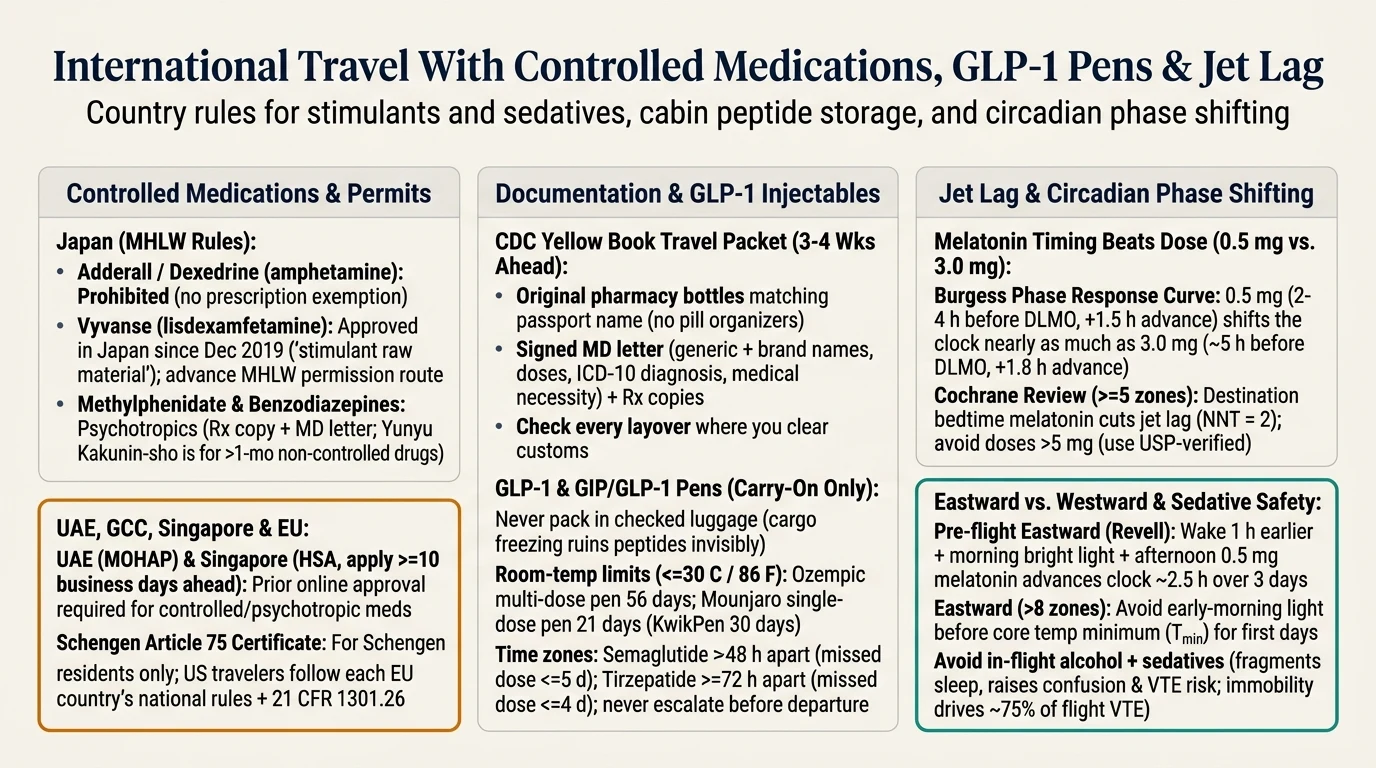
In laboratory phase-response trials comparing 0.5 mg (n = 34) against 3.0 mg (n = 27) of immediate-release melatonin (Burgess et al., 2008, 2010) and pre-flight trials (Revell et al., 2006), both doses produced nearly identical peak phase advances (~1.5 hours with 0.5 mg vs. ~1.8 hours with 3.0 mg in Burgess 2010; 2.5 hours with 0.5 mg vs. 2.6 hours with 3.0 mg vs. 1.7 hours with placebo in Revell 2006):
| Parameter | Low-Dose Melatonin (0.5 mg Immediate-Release) | Higher-Dose Melatonin (3.0 mg Immediate-Release) | Clinical Takeaway (Burgess 2008/2010; Cochrane 2002) |
|---|---|---|---|
| Peak Phase-Advance Timing (Eastward) | ~2 to 4 hours before DLMO (~5 to 7 hours before habitual bedtime) | ~5 hours before DLMO (~8 to 9 hours before habitual bedtime) | 3.0 mg must be taken earlier in the afternoon to hit peak phase advance, when it is more likely to cause afternoon drowsiness (Crowley & Eastman 2013). |
| Destination Bedtime Dosing (Cochrane 2002) | 0.5 mg to 3 mg taken at target destination bedtime (10:00 PM to midnight) | 3.0 mg to 5.0 mg taken at target destination bedtime | Across 10 randomized trials (Herxheimer & Petrie, Cochrane 2002), 0.5 to 5 mg immediate-release melatonin cut jet-lag severity with NNT = 2. Doses > 5 mg added zero benefit. |
| Hypnotic vs. Chronobiotic Effect | Pure clock-moving signal; minimal daytime sleepiness; clears before morning (no spillover into the delay zone). | Adds mild sleep-onset push if trying to sleep early, but stays in blood longer and risks morning fog. | Choose USP-verified immediate-release 0.5 mg for clock resetting (3 mg only if you want a mild sleep push on night 1). Avoid slow-release tablets (Herxheimer 2002). |
3. Eastward vs. Westward Tactical Protocol
| Direction & Scenario | Pre-Flight (2 to 3 Days Out) | In-Flight & Arrival Day | First 3 to 4 Days at Destination |
|---|---|---|---|
| Eastward (5 to 8 Time Zones, e.g., Philly -> London/Paris/Rome) | Move wake time and bedtime 30 to 60 min earlier per day. Get 30 to 60 min of bright outdoor light right after waking (Revell 2006). Take 0.5 mg melatonin in the late afternoon (~5 to 6 hours before bedtime). | Eat lightly on the plane; drink 8 oz/hr water with electrolytes; skip alcohol and in-flight zolpidem. On 6-8 AM European arrival: wear dark sunglasses outdoors until ~9:30 to 10:00 AM local time (after home CBTmin), then get 30 to 60 min of outdoor sun. | Advance your morning light exposure 1 hour earlier each day as your CBTmin moves earlier. Take 0.5 mg (or up to 3 mg) immediate-release melatonin 30 to 60 min before local bedtime (plus 100 to 300 mg phosphatidylserine and 400 mg magnesium glycinate). |
| Westward (3 to 6 Time Zones, e.g., Philly -> LA/Hawaii) | Stay up 1 hour later for 6+ zones and get bright evening light before bed. | Stay awake during daytime flight hours; cap naps at 20 minutes. Get late-afternoon and early-evening bright outdoor light at your destination (before CBTmin to delay your clock). | Keep the room dark if you wake up at 3:00 to 5:00 AM local time. If needed, 0.5 mg melatonin taken during the second half of the night helps delay the clock (Burgess 2010). |
| Ultra-Long Eastward (> 8 to 10 Time Zones, e.g., Philly -> Tokyo/Sydney) | Crossing > 8 to 10 time zones eastward can trigger antidromic re-entrainment (your clock tries to delay while light tries to advance). | Adapt using a phase-delay (westward) schedule (Janse van Rensburg et al., 2021; Sack 2010): avoid bright light during biological late-night hours (0:00 to 5:00 home time) and seek bright light during biological afternoon/evening. | Protect total sleep time for the first 48 hours while stepping light exposure by 1.5 to 2 hours per day. |
Why should you never take Ambien (zolpidem) in flight or mix it with melatonin?
Clinical guidelines (AASM; Cochrane 2021, Beros et al.; CDC Yellow Book 2025) advise against taking zolpidem (Ambien), other Z-drugs, or benzodiazepines during a flight. Randomized trials also show that combining zolpidem with melatonin adds zero sleep benefit while worsening confusion and next-day grogginess (Suhner et al., 2001).
- In-Flight Blood Clot (DVT / VTE) Risk: Natural sleep includes periodic posture changes. Prescription sedatives lock you into slumped immobility in a cramped seat with bent knees. Because immobility drives roughly 75% of air-travel clots (Bartholomew et al., 2019) and VTE risk rises 18% per 2 hours of travel (Freedman, NEJM 2016), sedated immobility compounds clot risk and impairs your alertness if an emergency happens. Never take a sleep medication on a flight shorter than the drug's duration of action, and test any prescription sleep aid at home before using it on a trip (CDC Yellow Book 2025).
- Do Not Combine Zolpidem + Melatonin: In a randomized double-blind trial of 137 eastward transatlantic flyers (Suhner et al., J Travel Med 2001), combining zolpidem 10 mg + melatonin 5 mg gave no extra jet-lag relief over zolpidem alone while increasing morning drowsiness, confusion, and nausea.
- Never Combine Sedatives with Alcohol: Alcohol fragments REM sleep, worsens cabin hypoxia, speeds dehydration, and interacts dangerously with sedatives. If a short-acting sleep medication (zolpidem 5 mg or low-dose doxepin 3 mg) is used at all, save it for bedtime in your hotel room after arrival for 1 to 3 nights when you have a full 7 to 8 hours in bed (Jamieson et al., 2001; Beros et al., Cochrane 2021). Also avoid driving within 8 hours of taking melatonin, because commercial U.S. supplements vary from -83% to +478% of the labeled dose (CDC Yellow Book 2025; Cohen et al., JAMA 2023).
How do you travel internationally with controlled medications (Adderall, Vyvanse, Ritalin, sleep aids)?
Fishtown Medicine
A 90-minute conversation with Dr. Ash. A written plan you can follow.
There is no universal "30-day supply" rule that makes US prescriptions automatically legal across foreign borders (CDC Yellow Book 2025, Halsey & Evans; INCB). Under the 1961 and 1971 UN Drug Conventions, each country enforces its own supply caps, advance import permits, and outright bans. Always check the rules for every destination AND every layover airport (3 to 4 weeks before departure). A missed connection or overnight delay in Tokyo, Dubai, or Singapore can require you to walk through local customs with your carry-on bag.
| Country / Region | Prohibited or Restricted Medications | Personal Quantity Caps & Advance Permit Rules (INCB / National Authorities) | What You Must Do 3 to 4 Weeks Before Departure |
|---|---|---|---|
| Japan (Ministry of Health, Labour & Welfare / NCD) | Adderall & Dexedrine (amphetamine / dextroamphetamine) are STRICTLY BANNED under Japan's Stimulants Control Law - bringing even a few pills with a US prescription can lead to arrest and detention (Tsuji & Tsutani 2008; Suzuki 2026; Brewster & Sagara 2023). | Vyvanse (lisdexamfetamine) is NOT in the same banned category: Japan approved it in December 2019 under a strict registration system (Suzuki 2026) and classifies it as a "stimulant raw material" with an advance MHLW permission pathway for personal medical import (verify current MHLW procedure before departure). Psychotropics (methylphenidate / Ritalin / Concerta, zolpidem, benzodiazepines): Permitted up to drug-specific milligram thresholds (traveler guidance commonly cites 2,160 mg for methylphenidate; verify current MHLW limits); quantities above the threshold require a prescription copy or physician certificate. Note that the Yunyu Kakunin-sho import certificate is for > 1 month of non-controlled prescription drugs or injectable kits (Tsuji & Tsutani 2008). | If you take Adderall, transition weeks before departure to methylphenidate, lisdexamfetamine (with advance MHLW permission), or a non-stimulant (atomoxetine or guanfacine), which is not internationally controlled. |
| United Arab Emirates (UAE - Dubai, Abu Dhabi), Saudi Arabia (SFDA), & GCC States | Stimulants (amphetamine, methylphenidate), benzodiazepines, Z-drugs (zolpidem), opioids, and gabapentinoids (pregabalin / Lyrica, controlled in Saudi Arabia since 2017) (Alshammari 2019; Althunian 2022; Alfageh 2024; Alotaibi 2025). | Prior online approval required (up to 3-month supply in GCC/SFDA): The UAE Ministry of Health and Prevention (MOHAP) and the Saudi Food & Drug Authority (SFDA) require travelers to upload their physician letterhead letter and prescription for an electronic permit before arrival (GCC guidance generally allows up to a 3-month personal supply with prior clearance, Alfageh 2024; in Saudi Arabia only 7% of ADHD clinicians prescribe amphetamines, Alotaibi 2025). | Submit your MOHAP or SFDA online permit application 3 to 4 weeks before flying - including if you have a layover in Dubai (DXB) or Abu Dhabi (AUH). |
| Singapore (HSA) | Psychotropics, stimulants (methylphenidate, amphetamine), benzodiazepines (lorazepam, clonazepam), and zolpidem (Sng 2024; Lin 2023). | Online HSA prior approval required (>= 10 working days ahead): Singapore's Health Sciences Authority (HSA) allows up to a 3-month personal supply with prior online verification and approval; unapproved import carries fines up to S$100,000 or up to 3 years in prison (Sng 2024). | Use the HSA online tool to verify your medication and submit your approval application at least 10 working days (2 to 3 weeks) before arrival. |
| Schengen Area / European Union (29 Countries) & China | Narcotics and psychotropic medications (Schedule I/II stimulants, benzodiazepines, Z-drugs). | US residents CANNOT get an Article 75 Schengen Certificate (issued only by Schengen authorities to their own residents, valid up to 30 days; Vranken 2016; Makinen 2002; Miguel 2014). US travelers follow each destination EU country's national rules (typically <= 30 days). China allows amounts "reasonable for personal use" with a prescription copy and physician letter (CDC Yellow Book 2025). | Carry your original US pharmacy-labeled bottles plus a signed physician letterhead letter stating generic + brand names, daily dose, and total quantity, and verify each country on your route. |
| United Kingdom (UK) | Controlled Drugs (Schedules 2, 3, and 4, including stimulants, benzodiazepines, zolpidem, pregabalin, gabapentin). | Travelers may carry up to 3 months supply of personal controlled drugs without a UK Home Office import licence (Parker & Aslett, BJA Educ 2024), provided they carry a physician letter and original pharmacy bottles. Trips > 3 months require a Home Office licence (apply >= 10 business days ahead). | Carry a signed physician letterhead letter and keep all controlled medications in original pharmacy bottles in your carry-on. |
The 5-Point Customs Documentation Package (CDC Yellow Book 2025; Rupert, AFP 2025)
- Original Pharmacy-Labeled Containers in Carry-On Only: Never put controlled substances or daily prescriptions into unmarked 7-day pill organizers before clearing customs, and never pack essential medications in checked luggage.
- Matching Passport Name: Ensure the full name on your prescription labels and physician letter matches your passport name.
- Signed Physician Letterhead Letter (Request 3 to 4 Weeks Pre-Departure): Lists your full name, date of birth, travel dates, diagnoses, both generic (INN) and brand names of every medication, strength, daily dose, total quantity carried, medical necessity for needles, syringes, or injectable pens, and your physician's NPI, license number, phone, and signature.
- Separate Supply Rules for Controlled vs. Routine Drugs: For non-controlled maintenance medications (like statins or blood pressure pills), pack a 7-to-14-day buffer for flight delays. For controlled substances (stimulants, zolpidem, benzodiazepines), never exceed the destination country's legal day-supply cap (<= 30 days in many EU states, or up to 3 months with prior approval in the UK, Singapore, or GCC states).
- US Exit & Re-Entry Rule (21 CFR 1301.26): Federal law allows US residents to leave and re-enter with lawfully prescribed controlled substances in their original US pharmacy bottles when declared to US Customs and Border Protection (CBP). While federal DEA rules permit sequential Schedule II prescriptions totaling up to a 90-day supply, state laws and insurer 30-day dispensing caps often govern how much you can fill before departure.
How do you travel with injectable GLP-1 and GIP pens (Ozempic, Wegovy, Mounjaro, Zepbound)?
Bring your full supply of GLP-1 or GIP/GLP-1 pens from your home US pharmacy in your carry-on bag (never in checked luggage, where cargo holds can freeze and ruin the peptide invisibly without cloudiness; Heinemann et al., 2021). Never escalate your GLP-1 dose right before a trip (Rosen & Ingelfinger, NEJM 2026), and never plan to buy Ozempic or Mounjaro abroad (WHO Medical Product Alert / Ruder, JAMA 2024). The World Health Organization has documented counterfeit Ozempic pens in 14+ countries - including fake pens filled with insulin that caused severe hypoglycemia (Ruder, JAMA 2024).
FDA-Approved Room-Temperature Excursion Limits & Time-Zone Dosing Rules (2026 FDA Labels)
Once removed from the fridge (36°F to 46°F / 2°C to 8°C), each pen has a strict limit on how many days it can stay at room temperature (never freeze, and keep away from direct heat > 86°F / 30°C):
| Medication & Device Format | Max Room-Temperature Excursion (FDA Label) | Allowed Temperature Range | Changing Weekly Dose Day Across Time Zones | Missed-Dose Window & Restart Rule (FDA Label; Apovian 2025) |
|---|---|---|---|---|
| Ozempic (semaglutide multi-dose pen) | Up to 56 days | 59°F to 86°F (15°C to 30°C) (or refrigerated 36-46°F); store with cap on and never with a needle attached. | You may change your weekly injection day as long as at least 48 hours (2 days) separate two doses. | Take within 5 days of the missed dose; if > 5 days have passed, skip and take the next scheduled weekly dose. |
| Wegovy (semaglutide single-dose autoinjector pen) | Up to 28 days | 46°F to 86°F (8°C to 30°C) when removed from the fridge; keep in the original carton to protect from light. | You may change your weekly injection day as long as at least 48 hours (2 days) separate two doses. | If missed and the next scheduled dose is > 48 hours away, take right away; if < 48 hours away, skip. If >= 2 consecutive doses are missed, consult your clinician about restarting titration at a lower dose (Apovian et al., Obesity Society 2025). |
| Wegovy FlexTouch (semaglutide multi-dose pen) | Up to 56 days | 59°F to 86°F (15°C to 30°C) after first use; discard 56 days after first use. | At least 48 hours (2 days) must separate two doses. | Same 48-hour rule before next scheduled dose; restart titration if >= 2 consecutive doses are missed. |
| Mounjaro / Zepbound (tirzepatide single-dose pen or vial) | Up to 21 days (unopened multi-dose vial up to 30 days) | Up to 86°F (30°C); do not return to the fridge once kept at room temperature; keep in original carton protected from light. | You may change your weekly injection day as long as at least 72 hours (3 days) separate two doses. | Take within 4 days (96 hours) of the missed dose; if > 4 days have passed, skip and resume on schedule (restart titration if >= 2 consecutive doses are missed; Apovian 2025). |
| Mounjaro KwikPen (tirzepatide multi-dose pen) | Up to 30 days | Up to 86°F (30°C); discard after 30 days at room temperature or after 4 weekly doses. | At least 72 hours (3 days) must separate two doses. | Take within 4 days (96 hours) of the missed dose. |
- Airport Security (TSA & International Screening): Insulated medical cooler pouches (FRIO evaporative cooling wallets or cool gel packs) and unused pen needles are allowed through security in your carry-on with your labeled pens and physician letter. Avoid rock-hard frozen ice packs that can freeze the pen (0°C / 32°F ruins the peptide invisibly; Heinemann et al., 2021); cool gel packs or room-temperature carry-on storage within the 21-to-56-day window is safer. For trips to Japan exceeding 1 month of injectable pens/syringes, apply for a Yunyu Kakunin-sho import certificate in advance.
- No Dose Escalation Right Before Departure & Hydration Protection (Rosen & Ingelfinger, NEJM 2026; Dobbie et al., 2026): Because GI side effects peak right after a dose increase, hold off on stepping up to a higher milligram pen right before boarding a flight. Drink 2.0 to 2.5+ liters/day of fluids during travel, eat small low-fat meals on flight days, and pack oral rehydration salts in case of heat or traveler's diarrhea.
What goes in the Frequent-Flyer Go-Bag and In-Flight Protocol?
Building a dedicated carry-on physiology kit takes the guesswork out of departure day:
- Graduated Compression Stockings (20 to 30 mmHg, below-knee): Put them on before leaving for the airport. A Cochrane meta-analysis of airline trials (Clarke et al., 2021) showed a large reduction in symptomless deep vein thrombosis on flights >= 4 hours. Pair stockings with hourly aisle walks and seated calf pumps.
- Light & Sound Control: A contoured blackout eye mask and noise-canceling headphones block cabin light during your biological night and cut the stress load of 80+ dB engine noise.
- Hydration & Supplement Stack (Carry-On Compliant):
- Electrolyte Packets + 8 oz Water per Flight Hour: Sodium-glucose transport helps you hold onto fluids in < 10% cabin humidity.
- USP-Verified Immediate-Release Melatonin (0.5 mg tablets or liquid drops): For timed circadian phase advances (Burgess 2010; Herxheimer 2002).
- Creatine Monohydrate (5 g single-serve packets): Supports cellular energy buffering during mild cabin hypoxia (McMorris et al., 2017) and short sleep.
- Magnesium Glycinate (200 to 400 mg) & Phosphatidylserine (100 to 300 mg): Taken in the hotel room at destination bedtime to support relaxation and calm evening stress-induced cortisol (Starks et al., 2008).
Guidance from the Clinic
"In our practice, we treat long-haul travel as an athletic and logistical event. Four weeks before an international trip, we check every medication against destination and layover customs rules, print a signed letterhead customs letter for your carry-on, map your GLP-1 pen storage and dose timing, and give you a day-by-day light and 0.5 mg melatonin schedule matched to your flight times."
- Dr. Ash
Key Takeaways
- Eastward Dawn-Light Rule (Khalsa 2003; Sack 2010): Never step into bright outdoor dawn light when arriving in Europe at 6:00 to 8:00 AM local time (1:00 to 3:00 AM Philadelphia time, *before* your 4:00 to 5:00 AM CBTmin). Wear dark sunglasses until ~9:30 to 10:00 AM local time, then get 30 to 60 minutes of bright sunlight.
- Low-Dose Melatonin (Burgess 2008, 2010; Cochrane 2002): 0.5 mg of USP-verified immediate-release melatonin advances the circadian clock nearly as far as 3.0 mg without morning grogginess (NNT = 2 across 10 RCTs; doses > 5 mg add zero benefit). Never take zolpidem in flight or mix zolpidem + melatonin (Suhner 2001).
- Controlled-Medication Customs (CDC Yellow Book 2025; INCB): Check destination and layover laws 3 to 4 weeks out. Japan strictly bans Adderall; the UAE (MOHAP), Saudi Arabia (SFDA), and Singapore (HSA) require online prior permits; US residents cannot get an EU Article 75 certificate and must carry a signed physician letterhead letter + original pharmacy bottles (<= 30 days).
- Injectable GLP-1 Pens (FDA Labels 2026; WHO 2024): Pack your full supply in your carry-on (Ozempic & Wegovy FlexTouch 56 days room temp; Wegovy single-dose 28 days; Mounjaro single-dose 21 days), space moved doses by >= 48 hours (semaglutide) or >= 72 hours (tirzepatide), drink 2.0 to 2.5+ L/day, and never buy counterfeit-prone pens abroad.
Tell Dr. Ash what's going on. Let's build a personalized travel protocol, customs letter, and time-zone plan for your itinerary.
Scientific References
- Melatonin Phase-Response Curves (0.5 mg vs. 3.0 mg): Burgess, H. J., Revell, V. L., Molina, T. A., & Eastman, C. I. (2010). "Human phase response curves to three days of daily melatonin: 0.5 mg versus 3.0 mg." Journal of Clinical Endocrinology & Metabolism, 95(7), 3325-3331; and Burgess, H. J., Revell, V. L., & Eastman, C. I. (2008). "A three-pulse phase response curve to three milligrams of melatonin in humans." Journal of Physiology, 586(2), 639-647.
- Light Phase-Response Curve & Duration: Khalsa, S. B. S., Jewett, M. E., Cajochen, C., & Czeisler, C. A. (2003). "A phase response curve to single bright light pulses in human subjects." Journal of Physiology, 549(Pt 3), 945-952; St Hilaire, M. A., et al. (2012). Journal of Physiology, 590(13), 3035-3045; and Crowley, S. J., & Eastman, C. I. (2015). Chronobiology International, 32(1), 119-126.
- Clinical Jet Lag Management (NEJM, Cochrane & AASM): Sack, R. L. (2010). "Clinical practice. Jet lag." New England Journal of Medicine, 362(5), 440-447; Herxheimer, A., & Petrie, K. J. (2002). "Melatonin for the prevention and treatment of jet lag." Cochrane Database of Systematic Reviews, (2), CD001520; and Suhner, A., et al. (2001). "Melatonin and zolpidem for jet lag." Journal of Travel Medicine, 8(2), 69-76.
- International Controlled Medication Regulations & Customs (CDC Yellow Book 2025 & INCB): Halsey, M. S., & Evans, V. K. (2025). "Traveling Safely with Medications & Medical Supplies." CDC Yellow Book 2026; Suzuki, H., et al. (2026). BMC Psychiatry, 26, 204; Tsuji, K., & Tsutani, K. (2008). Journal of Clinical Pharmacy and Therapeutics, 33(5), 553-559; Alfageh, B. H., et al. (2024). Frontiers in Pharmacology, 15, 1365130; Alotaibi, M. M., et al. (2025). International Journal of Environmental Research and Public Health; Sng, G. G. R., et al. (2024). Drug Safety; Makinen, M. (2002). Bulletin on Narcotics; Miguel, A., et al. (2014). Atencion Primaria; and Parker, P., & Aslett, M. (2024). BJA Education, 24(7), 237-244.
- Injectable GLP-1 Travel Safety, Counterfeit Alerts & VTE Risk: Ruder, K. (2024). "As Semaglutide's Popularity Soars, Rare but Serious Adverse Effects and Counterfeit Products Emerge." JAMA, 332(10), 776-779; Rosen, C. J., & Ingelfinger, J. R. (2026). "Traveling with GLP-1 Receptor Agonists." New England Journal of Medicine; Apovian, C. M., et al. (2025). Obesity; Heinemann, L., et al. (2021). Journal of Diabetes Science and Technology; Dobbie, L. J., et al. (2026). The Lancet Diabetes & Endocrinology, 14(2), 160-172; Bartholomew, J. R., et al. (2019). Vascular Medicine; Freedman, D. O., et al. (2016). "Medical Considerations before International Travel." New England Journal of Medicine, 375(3), 247-260; and Clarke, M. J., et al. (2021). Cochrane Database of Systematic Reviews, (4), CD004002.

Frequently Asked Questions
Common Questions
Deep-Dive Questions
Ready when you are
The chat is our AI assistant, answering from our published guides. To talk it through with Dr. Ash himself, start with the intake.