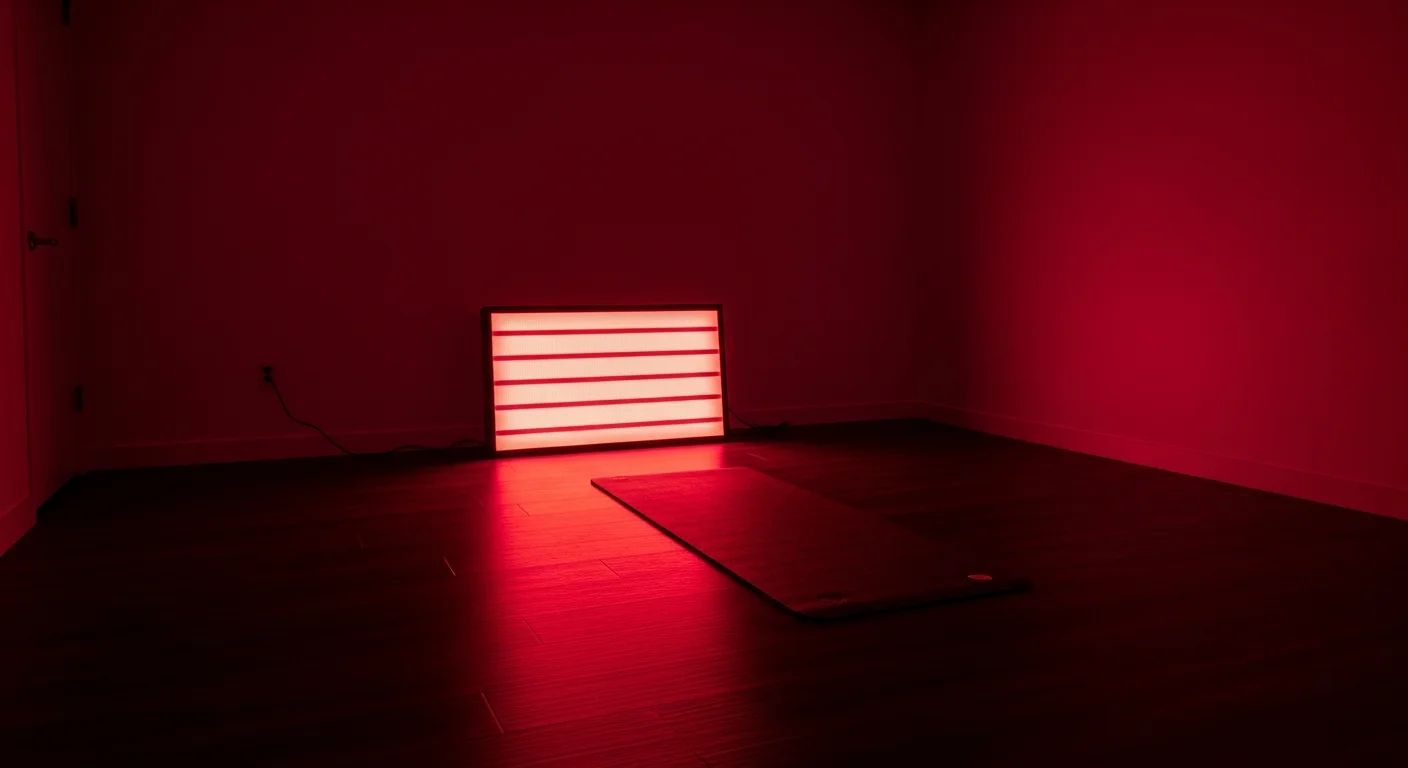

Red and near-infrared LED photobiomodulation (633-660 nm red and 830 nm near-infrared) has fair (Grade C) randomized trial support as a non-invasive skin and recovery adjunct. In the landmark double-blind split-face RCT by Lee et al. (J Photochem Photobiol B 2007, n = 76), 8 sessions over 4 weeks of 633 nm (126 J/cm²) and 830 nm (66 J/cm²) LED reduced wrinkles by 26% to 36% and increased skin elasticity by 14% to 19% versus sham, with biopsy-proven increases in collagen, elastic fibers, and TIMP-1/TIMP-2. However, other trials show mixed results (Nam 2017; Jagdeo 2018), and recent biochemistry shows light acts across multiple targets beyond cytochrome c oxidase alone (Lima 2019; Quirk & Whelan 2021; Shi 2026). Use LED as a safe add-on after daily SPF 30+ and nightly tretinoin, and always wear eye protection.
TL;DR: Red (633 to 660 nm) and near-infrared (830 nm) LED light therapy (photobiomodulation) is a safe, modest (Grade C evidence) add-on for skin texture, pattern hair thinning, and sore joints or muscles - never a substitute for daily SPF 30+ and nightly tretinoin.
- Know the split-face trial numbers and the home-mask power gap: In the top split-face clinical trial (76 people, 8 sessions over 4 weeks at 55 mW/cm²), 633 nm red light (126 J/cm²) cut wrinkles by 26%, 830 nm near-infrared (66 J/cm²) cut wrinkles by 33%, and both together cut wrinkles by 36% vs. zero change with sham. However, most consumer masks deliver 10 to 100 times less power (0.03 to 6.4 mW/cm²), and reviews rate facial LED as Grade C ("fair") evidence.
- Understand the evolving cell mechanism: While the classic model credits mitochondrial cytochrome c oxidase (Complex IV) and nitric oxide release, newer lab tests prove 660 to 830 nm light still stimulates cells that lack working cytochrome c oxidase. Light acts on several parallel targets (TRP ion channels, nitric oxide stores, and cell water layers).
- Follow the dose curve and protect your eyes (skip blue-light mask modes): More light is not better. Over-dosing blunts the cell response, melasma skin can darken with heat, and blue-light face masks have caused retinal damage (photochemical retinopathy with choroidal neovascularization), so wear eye goggles and avoid blue-light modes near your eyes.
A 39-year-old software engineer in Fishtown showed me an $800 flexible red-light face mask she was about to buy online, while admitting she only wore sunscreen at the Jersey Shore and had never tried prescription tretinoin. Looking at the clinical trial hierarchy and the consumer mask power numbers together saved her from buying the roof before pouring the foundation. Daily SPF 30+ (Hughes 2013) and a $15 tube of 0.025% tretinoin (+80% dermal collagen I gain in Griffiths NEJM 1993) carry far stronger biopsy proof than any LED mask (rated Grade C across small trials with a median sample size of 26, Jagdeo 2018; Grimes 2025), and most home masks deliver 1 to 2 orders of magnitude less power than the 55 mW/cm² clinical trial device (Couturaud 2023). Once she locked in morning sunscreen and nightly tretinoin for three months, we added a verified 633 / 830 nm panel for ten minutes three times a week with realistic goals.
What do randomized clinical trials show for LED red and near-infrared light on skin aging, and how do consumer masks compare?
Double-blind split-face and controlled trials (Lee 2007; Wunsch & Matuschka 2014) show modest improvements in eye-area wrinkles (26% to 36%), skin roughness, and collagen density over 4 to 15 weeks, earning a Grade C ("fair") evidence rating (Jagdeo 2018; Das 2026). Most consumer masks deliver 10 to 100 times less irradiance than the Lee 2007 trial device (Couturaud 2023; Grimes 2025).
| Clinical Study / Device Comparison | Design, Wavelengths & Fluence (Dose) | Measured Outcomes & Consumer Dosimetry | Methodological Caveats & Premise Corrections |
|---|---|---|---|
| Lee et al., J Photochem Photobiol B 2007 | Double-blind, sham-controlled, split-face RCT (correct n = 76, 8 sessions twice weekly over 4 weeks at 55 mW/cm²): - Arm 1: 633 nm red (126 J/cm²) - Arm 2: 830 nm NIR (66 J/cm²) - Arm 3: 633 + 830 nm combo - Arm 4: Sham light | - 633 nm: -26% wrinkles, +14% elasticity - 830 nm: -33% wrinkles, +19% elasticity - 633 + 830 nm: -36% wrinkles, +16% elasticity - Sham: 0% change - Biopsies: Increased collagen, elastic fibers, activated fibroblasts, and TIMP-1/2. | Most rigorous LED trial; note that a widely cited review misreports the sample size as n = 112 instead of n = 76 (Jagdeo 2018). |
| Wunsch & Matuschka, Photomed Laser Surg 2014 | Controlled trial (n = 136, 30 sessions over 15 weeks) comparing red (611-650 nm) vs. broadband (570-850 nm, ~9 J/cm²) vs. untreated controls. | Improved skin roughness and ultrasound collagen density vs. controls; broadband 570-850 nm offered no advantage over red light alone. | Premise correction: Used polychromatic lamps, not LEDs, and had no discrete 830 nm arm (Shi 2026). |
| 1072 nm & Pooled Reviews (Mineroff 2023; Ngoc 2023; Grimes PLoS One 2025) | - 1072 nm trials (Mineroff 2023): 1 RCT (n = 79) + 7-man 633/830/1072 nm pilot - Ngoc 2023 meta-analysis (6 studies) - Grimes 2025 audit of 27 LED studies | - 1072 nm: Relied on self-reported outcomes (n = 79), and the 7-man pilot reached significance only after removing an outlier (zero objective collagen endpoints). - Ngoc 2023: Pooled wrinkle SMD -3.45 (implausibly large from small samples). | Across 27 LED dermatology studies (Grimes 2025), median n was 26, fluences spanned 3 orders of magnitude, 37% were manufacturer-sponsored, and only one-third had both a proper control and blinded scoring. |
| Consumer Mask Dosimetry vs. Lee 2007 Trial (Couturaud 2023; Bragato 2025) | Optical irradiance (mW/cm²) and dose per session (J/cm²) across clinical and consumer devices. | - Lee 2007 clinical device: 55 mW/cm² (66-126 J/cm²) - Dior x Lucibel mask: 21.7 mW/cm² (15.6 J/cm²) - Bragato 2025 RCT mask (660 nm): 6.4 mW/cm² (8.0 J/cm²) - CurrentBody mask: 1.2 mW/cm² (0.7 J/cm²) - Generic "3-color" mask: 0.03 mW/cm² (0.04 J/cm²) | Most consumer masks deliver 1 to 2 orders of magnitude less irradiance than the Lee 2007 trial device (Couturaud 2023). |
How does red and near-infrared light work inside cells, and why is the cytochrome c oxidase story evolving?
The classic textbook model states that 620-680 nm red and 760-825 nm near-infrared light knocks nitric oxide off mitochondrial cytochrome c oxidase (Complex IV, Hamblin 2018). However, newer lab tests (Lima 2019; Quirk & Whelan 2021; Shi 2026) show light works through several cell targets at once.
- The Classic Mitochondrial Model (Karu / Hamblin 2018; Kim 2016): In the standard model, cytochrome c oxidase (CCO, Complex IV) inside mitochondria absorbs red (~620-680 nm) and near-infrared (~760-825 nm) light. This frees bound nitric oxide (NO), raises mitochondrial voltage and ATP output, and sparks mild ROS, calcium, and cAMP signals (Hamblin 2018; Maghfour JAAD 2024). In human skin fibroblasts, 630 nm LED raises procollagen I and lowers collagen-chewing MMP-1 (Kim et al., 2016).
- Why CCO Is Not the Single Main Target (Lima 2019; Quirk & Whelan 2021; Shi 2026):
- In purified enzyme tests, 670 nm and 830 nm light did not change oxygen use by isolated cytochrome c oxidase or reverse nitric oxide blocking (Quirk & Whelan, 2021).
- Even more telling, in cells bred to lack working cytochrome c oxidase, 660 nm light still sped up cell growth (Lima et al., J Photochem Photobiol B 2019).
- Current reviews (Shi et al., Lasers Med Sci 2026) show that red and near-infrared light acts through several parallel targets: light-gated TRP ion channels, nitric oxide stores outside this enzyme (nitrosothiols), TGF-beta 1, and thin interfacial water layers inside the cell.
Where does red light therapy help beyond wrinkles, and what is overhyped?
Beyond Grade C facial skin gains, red and near-infrared light has randomized trial support as an add-on for pattern hair thinning (650-680 nm caps, Afifi 2017) and short-term joint or workout soreness. Claims of fat melting, "detox," and whole-body cures are unsupported.
- Worth Considering as an Add-On (Modest RCT Support):
- Facial Photoaging (633 nm + 830 nm): Modest fine-line and elasticity gains (Lee 2007) layered on top of daily SPF 30+ and nightly tretinoin.
- Pattern Hair Loss (Androgenetic Alopecia, Afifi 2017): FDA-cleared laser and 650-680 nm LED caps yield modest hair-count gains over 4 to 6 months when paired with proven meds like minoxidil and finasteride.
- Local Joint, Tendon, and Workout Soreness: Short-term relief of muscle soreness (DOMS) and joint ache.
- Early / Unsettled Signal (Small Studies Only): Autoimmune thyroiditis (Hashimoto's, Ferhatoglu 2020) and fibromyalgia pain, where light stays a minor adjunct to standard care.
- Overhyped Claims (Skip): Whole-body "detox," spot fat melting, or replacing bright 10,000-lux white-light boxes for winter mood slumps (SAD works through your eyes, whereas red panels target skin).
Fishtown Medicine
A 90-minute conversation with Dr. Ash. A written plan you can follow.
How do you dose red light safely without overdoing it?
Light therapy follows a two-phase (biphasic) dose curve (Huang et al., 2009). Using 630-660 nm and 810-830 nm light for 10 to 20 minutes 3 to 5 times per week (~20 to 55 mW/cm²) helps fibroblasts, while too much heat or time blunts the benefit and blue-light mask modes can injure the retina (Kim 2020).
- Respect the Biphasic Curve (Huang 2009): Too little light does nothing; the sweet-spot dose (~10 to 60 J/cm² for skin) sparks repair; too much light or heat shuts the signal down.
- Always Wear Protective Eye Goggles & Skip Blue-Light Mask Modes (Kim Medicine 2020; Shi 2026): Red light is bright, near-infrared (810-850 nm) is invisible to your blink reflex, and blue-light LED face masks have caused photochemical retinopathy with choroidal neovascularization (Kim et al., Medicine 2020). Wear eye protection every session and avoid blue-light modes in anyone with retinal disease or taking photosensitizing drugs.
- Watch Melasma & Light-Sensitizing Drugs: Heat and strong light can darken melasma patches on the face. Check with your doctor first if you take light-sensitizing drugs (doxycycline, isotretinoin, hydrochlorothiazide).
Guidance from the Clinic
"Before spending $500 to $1,000 on an LED mask, check two numbers: are you already using daily SPF 30+ and nightly 0.025% tretinoin, and what irradiance (in mW/cm²) does the mask emit? The clinical trial that cut wrinkles by 26% to 36% used 55 mW/cm², whereas many popular home masks put out 0.03 to 1.2 mW/cm² - and you should never run blue-light modes near unshielded eyes." - Dr. Ash
Key Takeaways
- Fair (Grade C) Evidence as a Skin & Hair Adjunct: Split-face RCTs (Lee J Photochem Photobiol B 2007, n = 76 at 55 mW/cm²) show 26% to 36% wrinkle reduction with 633 nm and 830 nm LED over 4 weeks, plus ultrasound collagen gains with polychromatic red lamps (Wunsch 2014). Because consumer masks are 10x to 100x weaker (Couturaud 2023; Grimes 2025), LED stays in a supporting role behind SPF 30+ and tretinoin.
- Multi-Target Cell Physics (Lima 2019; Quirk & Whelan 2021; Shi 2026): Red and near-infrared light works through mitochondrial signaling (Hamblin 2018) alongside CCO-independent targets including TRP channels, nitric oxide stores, and cell water layers.
- Dose Conservatively & Protect Your Eyes: Use verified 633-660 nm / 810-830 nm panels for 10 to 20 minutes 3 to 5x/week, wear eye goggles, avoid blue-light modes near the eyes (photochemical retinopathy risk, Kim 2020), and go slow if you have melasma.
Scientific References
- Split-Face, Controlled & Dosimetry Facial Photobiomodulation Trials: Lee SY, Park KH, Choi JW, et al. "A Prospective, Randomized, Placebo-Controlled, Double-Blinded, and Split-Face Clinical Study on LED Phototherapy for Skin Rejuvenation." J Photochem Photobiol B. 2007;88(1):51-67; Wunsch A, Matuschka K. Photomed Laser Surg. 2014;32(2):93-100; Bragato EF, et al. Lasers Med Sci. 2025; Couturaud V, Le Fur M, Pelletier M, Granotier F. Skin Res Technol. 2023; and Nam CH, et al. Dermatol Surg. 2017;43(3):371-380.
- Systematic Reviews, Methodological Audits & Retinal Safety: Jagdeo J, Austin E, Mamalis A, et al. Lasers Surg Med. 2018;50(6):613-628; Grimes DR. "Methodological issues in visible LED therapy dermatological research and reporting." PLoS One. 2025; Ngoc LTN, Moon JY, Lee YC. Photodermatol Photoimmunol Photomed. 2023;39(4):303-313; Mineroff J, Austin E, Jagdeo J. Arch Dermatol Res. 2023; Das RK, et al. Aesthetic Plast Surg. 2026; and Kim TG, Chung J, Han J, et al. (Blue-Light Photochemical Retinopathy). Medicine. 2020;99(24):e20568.
- Cytochrome C Oxidase & Alternative Photobiomodulation Mechanisms: Hamblin MR. Photochem Photobiol. 2018;94(2):199-212; Lima PLV, Pereira CV, Nissanka N, et al. "Photobiomodulation Enhancement of Cell Proliferation at 660 nm Does Not Require Cytochrome C Oxidase." J Photochem Photobiol B. 2019;194:71-75; Quirk B, Whelan HT. Photobiomodul Photomed Laser Surg. 2021;39(6):395-402; Maghfour J, Ozog DM, Mineroff J, et al. J Am Acad Dermatol. 2024; and Shi L, Lu J, Wei B, Zhou P. Lasers Med Sci. 2026.
- Biphasic Dose Response & Hair Loss: Huang YY, Chen ACH, Carroll JD, Hamblin MR. Dose-Response. 2009;7(4):358-383; and Afifi L, et al. Lasers Surg Med. 2017;49(1):27-39.

Fishtown Medicine | Articles
Frequently Asked Questions
Common Questions
Ready when you are
The chat is our AI assistant, answering from our published guides. To talk it through with Dr. Ash himself, start with the intake.