
A disposable 1-night WatchPAT One home sleep apnea test costs about $129.99 on CPAP Store USA (HSA/FSA eligible; select "Sleep Test & Results" so Dr. Ash can read your 3% pAHI and pRDI report and write any needed prescription himself). While WatchPAT correlates strongly with in-lab polysomnography (PSG) across groups (pooled r = 0.89, Yalamanchali 2013), individual severity-tier agreement is 83% in severe OSA but only 41% to 42% in mild-to-moderate OSA (Ioachimescu 2020; Iftikhar 2022), and the 3% vs 4% desaturation setting changes pAHI by +4 to -6 events/hour. Per AASM guidelines (Kapur 2017; Caples 2021), any negative, inconclusive, or borderline (pAHI 10-20) home test, or any patient on alpha-blockers, with atrial fibrillation, heart failure, or chronic opioid use, requires an in-lab PSG.
TL;DR: A 1-night disposable WatchPAT One home sleep test ($129.99, HSA/FSA eligible) is the fastest first test for uncomplicated adults with suspected sleep apnea, once you know how to read the numbers and when to confirm in a sleep lab.
- Pick "Sleep Test & Results" ($129.99) and check both 3% and 4% scores: Skip the retail prescription upcharge - Dr. Ash reads your full report (3% pAHI, pRDI, pODI, REM vs. NREM, and central events) and writes any needed prescription himself. WatchPAT 3% scoring reads about 4 events per hour higher than a sleep lab, while 4% scoring reads about 6 events per hour lower.
- Know when a home test is enough vs. borderline: WatchPAT catches moderate-to-severe sleep apnea (AHI 15 or higher) with 88% to 92% sensitivity and matches severe sleep apnea well (83% agreement), while mild or moderate scores match the lab only 41% to 42% of the time and vary by more than 10 events per hour between nights in 35% of people.
- Never repeat a negative home test - go to an in-lab study instead: Home tests miss sleep apnea in 17% to 25% of tired snorers. If your home test is normal but you still wake up unrefreshed, or if you take alpha-blockers (tamsulosin, doxazosin), have atrial fibrillation or heart failure, or need a borderline score confirmed for Zepbound (tirzepatide), an overnight in-lab study (PSG) is the right next step.
A 38-year-old commercial driver from Port Richmond came to me with a 90-day temporary DOT medical card and a $1,450 hospital price quote for an overnight sleep lab that could not book him for seven weeks. Because he had no heart failure, atrial fibrillation, or alpha-blocker medications, we had him order a $129.99 disposable WatchPAT One kit that arrived in two days. It recorded a pAHI of 34 events/hour (severe OSA, where WatchPAT has 83% severity match and 87%-90% specificity, Ioachimescu 2020; Iftikhar 2022) from his own bed, and we started him on auto-titrating CPAP with full DOT compliance logs five weeks before his license deadline. Knowing when a $129.99 home sensor gives a clear answer - and when a mild, negative, or confounded result needs an in-lab study (PSG) - saves both time and diagnostic mistakes.
How does the WatchPAT One score breathing events, and how does the 3% vs. 4% setting change your number?
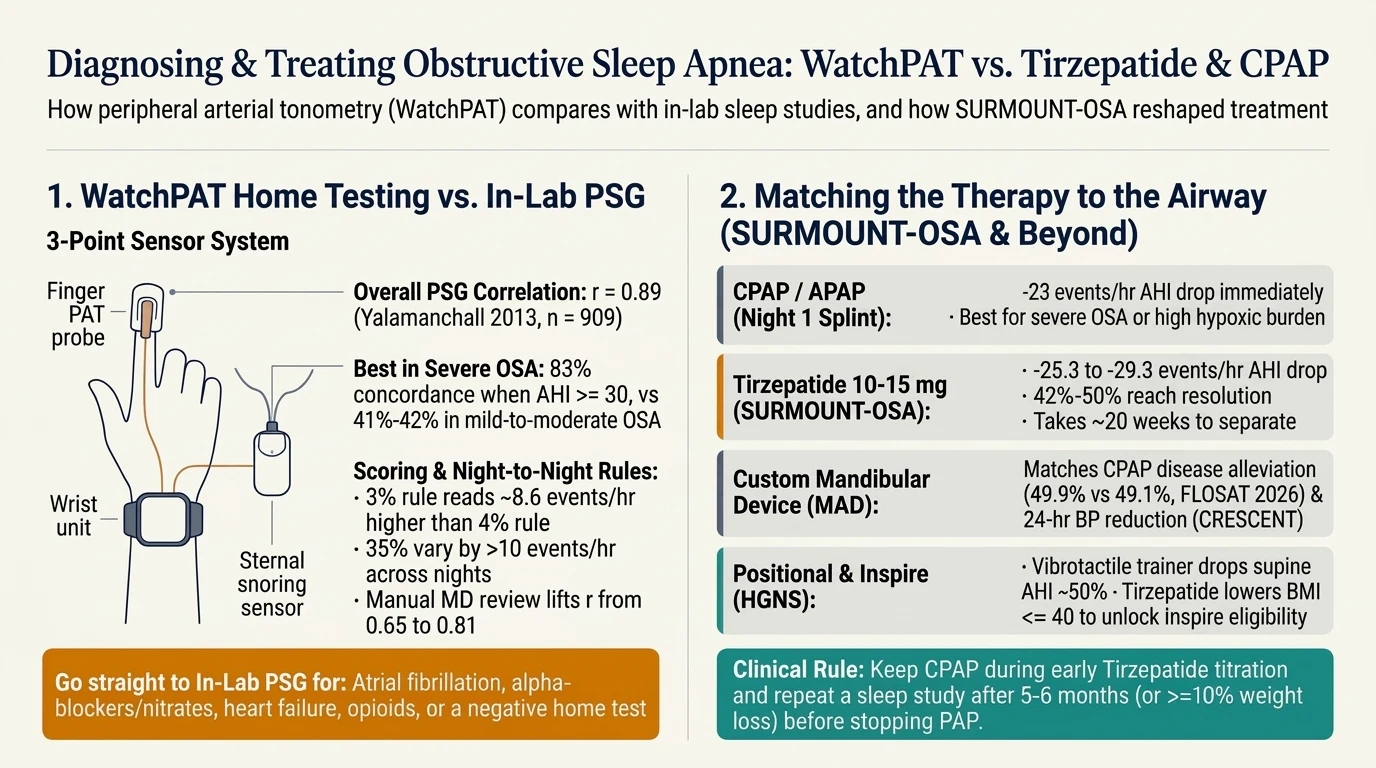
The WatchPAT One combines a finger peripheral arterial tonometry (PAT) probe, pulse oximetry, wrist actigraphy, and a chest sensor (RESBP) to score events without nasal tubes (Gan 2017; Pillar 2020). Choosing the 3% vs. 4% oxygen rule changes pAHI by +4 to -6 events/hour (Ioachimescu 2020).
Unlike older home monitors that use a nasal tube, WatchPAT reads tiny arterial pulse-wave drops in your fingertip alongside blood oxygen and chest movement. It scores a breathing event whenever any of three rules fires (Gan et al., 2017):
- A >= 30% drop in PAT pulse-wave size plus a >= 10% rise in heart rate (an autonomic arousal marker);
- A >= 30% drop in PAT size plus a >= 3% oxygen drop; OR
- A >= 4% oxygen drop alone.
Three technical rules guide how we read your WatchPAT report:
- pAHI, pRDI, and pODI Definitions (Ioachimescu JIM 2020): The denominator is actigraphy-estimated sleep time (not total recording hours). pAHI and pRDI change depending on whether the report uses the 3% or 4% oxygen cutoff, whereas pODI (oxygen desaturation index) is always calculated at 4%.
- The +4 vs. -6 events/hour Rule Difference (Ioachimescu et al., JCSM 2020): In a simultaneous 500-patient study comparing WatchPAT with in-lab PSG, WatchPAT scored with the 3% rule overestimated AHI by ~+4 events/hour (and up to +8.6 events/h in Röcken 2023), whereas the 4% rule underestimated AHI by ~-6 events/hour. (On in-lab PSG, CMS 4% hypopnea scoring yields AHI values ~8.6 events/h lower than AASM 3%-or-arousal scoring, Tu 2024, causing up to 71.1% of 3%A mild OSA patients to lose their diagnosis, Oo 2026.)
- Central vs. Obstructive Events (Pillar et al., Sleep Breath 2020): Newer WatchPAT models use the chest sensor (RESBP) and PAT pulse upstroke to separate central from obstructive apneas. In a simultaneous-PSG study (n = 84, Pillar 2020), central AHI correlated at r = 0.90 (sensitivity 67%, specificity 100% for central AHI >= 15, AUC 0.866), though WatchPAT slightly underestimated central AHI (4.2 vs. 5.9 events/h, P = 0.034). Suspected central sleep apnea still calls for in-lab PSG (AASM 2017).
- Manual Physician Review & Night-to-Night Swings (Zhang 2020; Tschopp JCSM 2021 & 2023): Having a physician review the raw automated WatchPAT signals raises correlation with in-lab PSG from 0.65 to 0.81 (Zhang 2020; Tschopp 2023). Across back-to-back nights at home (Tschopp JCSM 2021), single-night pAHI varied by more than 10 events/hour in 35% of patients, shifting the OSA severity category on a single night in 24%.
How accurate is WatchPAT compared with in-lab PSG across AHI cutoffs (5, 15, and 30)?
While WatchPAT correlates well with in-lab PSG across large groups (pooled r = 0.889, Yalamanchali 2013), individual severity match is 83% in severe OSA (AHI >= 30) vs. only 41% to 42% in mild-to-moderate OSA (Ioachimescu 2020; Iftikhar 2022; Ichikawa 2022).
| Study / Meta-Analysis | Sample Size & Design | Accuracy by AHI Cutoff (Sensitivity / Specificity) | Individual Severity Match & Misclassification Rate |
|---|---|---|---|
| Yalamanchali et al., JAMA Otolaryngol 2013 | Meta-analysis of 14 studies (n = 909; 13 simultaneous PAT + PSG). | Overall group correlations: - Overall: r = 0.889 (simultaneous AHI r = 0.896) - RDI: r = 0.879 - ODI: r = 0.953 - Home PAT vs. PSG: r = 0.862 | High group correlation hides wide person-to-person scatter; most studies excluded diabetes, neuropathy, vascular disease, or alpha-blockers. |
| Ichikawa et al., J Sleep Res 2022 | Meta-analysis of 13 studies (n = 1,227). | - AHI >= 5: Sens 96% / Spec 44% - AHI >= 15: Sens 88% / Spec 74% - AHI >= 30: Sens 80% / Spec 90% | Frequent false positives and false negatives at mild and moderate cutoffs. |
| Iftikhar et al., JCSM 2022 | Meta-analysis of 17 simultaneous PAT + PSG studies (n = 1,318). | - AHI >= 5: Sens 94% / Spec 43% - AHI >= 15: Sens 92% / Spec 72% - AHI >= 30: Sens 74% / Spec 87% | Mean bias was small (+0.30 events/h), yet percentage error reached 230% and severity kappa was only 0.25 to 0.64. |
| Ioachimescu et al., JCSM 2020 & O'Reilly 2022 | n = 500 simultaneous sleep-clinic cohort (Ioachimescu 2020); n = 208 military cohort (O'Reilly 2022). | Severity-tier match (n = 500): - Severe OSA (>= 30): 83% - Moderate OSA (15-29): 41% - Mild OSA (5-14): 42% | Among PAT-mild patients (Ioachimescu 2020), 20% had moderate-to-severe OSA on PSG and 30% had no OSA; among PAT-moderate/severe, 19% were only mild on PSG. In O'Reilly (2022), 56% changed severity tier (NPV 50%). |
Guidance from the Clinic
"A home WatchPAT test is like a wide-angle lens: when your score is 35 events an hour, the picture is crystal clear and we can start treatment right away. When the score is 8 or 13 in someone who wakes up exhausted, or when a borderline number decides whether your insurance covers Zepbound, we do not guess on a single night of finger-pulse data - we verify in the sleep lab." - Dr. Ash
Who Should Skip WatchPAT (Contraindications & Confounders)
Because WatchPAT relies on fingertip artery tone and a steady pulse, skip WatchPAT and order an in-lab PSG if any of these apply (Moffa 2023/2024; Stafford 2025; Kapur AASM 2017):
- Alpha-blockers (tamsulosin / Flomax, doxazosin, terazosin, prazosin) or short-acting nitrates within 3 hours: These drugs block fingertip vessel tightening, blunting the PAT signal.
- Atrial fibrillation or sustained arrhythmias (Stafford et al., JCSM 2025): In patients with atrial fibrillation, home WatchPAT agreed with in-lab PSG only slightly to fairly (kappa 0.15 to 0.40), and some pacemaker modes also interfere.
- Heart failure (Schindhelm 2024), stiff arteries (Kinoshita 2018), nerve/vessel disease in the hands, chronic opioid use, muscle weakness, prior stroke, or severe insomnia (COMISA): AASM rules (Kapur 2017) recommend first-line in-lab PSG for these groups.
Fishtown Medicine
A 90-minute conversation with Dr. Ash. A written plan you can follow.
When does a WatchPAT result require confirmatory in-lab PSG (including for Zepbound AHI >= 15 eligibility)?
Per the American Academy of Sleep Medicine (Kapur AASM 2017; Caples AASM 2021), any negative, inconclusive, or flawed home sleep test must be followed by an in-lab PSG (never a repeat home test). We also confirm borderline pAHI results (~10 to 20 events/h) when they gate Zepbound (tirzepatide) coverage.
- After a Negative, Inconclusive, or Flawed Home Test (AASM Strong Recommendation): Home sleep tests have a ~17% overall false-negative rate (and 25% to 50% in high-risk patients, Gottlieb JAMA 2020). Repeating a home test fails technically 40% of the time (Rosen 2012), whereas 26% to 77% of patients sent for in-lab PSG after an inconclusive home test are found to have OSA (Sim 2025).
- In Lean Adults and Women With 3 AM Insomnia (COMISA), Nocturia, or Teeth Grinding (Röcken 2023): Younger age, female sex, and lower BMI predict the widest gap between WatchPAT and PSG (Röcken 2023, n = 940). A "normal" or "mild" WatchPAT in a symptomatic lean adult or woman needs an in-lab PSG scored with AASM 3%A and RDI rules (see our guide on invisible sleep apnea and UARS).
- Near the AHI >= 15 Cutoff That Gates Zepbound (Tirzepatide) for OSA: Zepbound (10 or 15 mg weekly, which cut AHI by -25.3 to -29.3 events/h in SURMOUNT-OSA, Malhotra NEJM 2024) is FDA-approved for moderate-to-severe OSA (AHI >= 15) in adults with obesity. Because 20% of WatchPAT-mild patients have AHI >= 15 on PSG (Ioachimescu 2020), any patient with obesity and a WatchPAT pAHI of 5 to 19 events/hour should get an in-lab PSG.
How much does the WatchPAT One cost, which checkout option should I pick, and how do I set it up?
On CPAP Store USA, pick "Sleep Test & Results" ($129.99, HSA/FSA eligible) and upload the next-day PDF report to your Fishtown Medicine portal so Dr. Ash can read your 3% and 4% numbers and write any needed prescription himself.
(Fishtown Medicine has zero financial link with CPAP Store USA or Itamar/ZOLL and makes $0 when you order.)
- Prep your hand & chest before turning out the lights: Remove rings and watches, skip hand lotion, and trim the nail on your test finger (no nail polish or acrylics, which block the sensor). Stick the RESBP chest sensor below the notch at the base of your throat with a piece of medical tape over it.
- Put on the wrist unit and finger probe: Strap the wrist unit on your non-dominant hand, slide any finger except your thumb all the way into the probe ("TOP" tab up), press firmly on a table, and pull the "TOP" tab straight out.
- Record at least 6 hours (AASM minimum is 4 hours of good data): Keep your phone plugged in within 15 feet with Bluetooth on. In the morning, tap stop in the app, wait for the upload confirmation, and upload the emailed PDF report (arrives in ~12 hours) to your portal.
- DOT Physical Rule: The WatchPAT One is FDA-cleared and DOT/FAA accepted; check with your DOT medical examiner before ordering and bring the full multi-page PDF report to your visit.
Key Takeaways
- $129.99 Fast First Step for Uncomplicated High-Risk Adults: Order the disposable WatchPAT One ("Sleep Test & Results" tier) and upload the PDF report to your portal so a physician can review the 3% and 4% tables (manual review lifts PSG correlation from 0.65 to 0.81, Zhang 2020; Tschopp 2023).
- Respect the 41%-42% Mild/Moderate Severity Gap & Night-to-Night Swings (Ioachimescu 2020; Tschopp 2021): WatchPAT matches 83% of severe OSA (AHI >= 30), yet misclassifies about half of mild and moderate cases (20% of PAT-mild patients have moderate-to-severe OSA on PSG) and varies by > 10 events/h between nights in 35% of people.
- Know When to Go Straight to In-Lab PSG (Kapur 2017; Caples 2021): Order in-lab PSG after any negative, inconclusive, or borderline (pAHI 10-20) home test, or first-line if you take alpha-blockers, nitrates, or opioids, or have atrial fibrillation (Stafford 2025), heart failure, or neuromuscular disease.
Related at Fishtown Medicine
- Sleep Apnea Screening: What Your Watch Knows, and Who Should Test
- Tirzepatide (Zepbound, Mounjaro): Weight, Heart, and SURMOUNT-OSA
- Is It Insomnia or Sleep Apnea? (COMISA & UARS)
- Your Apple Watch Says You Might Have AFib. Now What?
- CDL & DOT Driver Health in Philadelphia
Scientific References
- AASM Clinical Practice Guidelines: Kapur VK, Auckley DH, Chowdhuri S, et al. "Clinical Practice Guideline for Diagnostic Testing for Adult Obstructive Sleep Apnea." J Clin Sleep Med. 2017;13(3):479-504; and Caples SM, Anderson WM, Calero K, Howell M, Hashmi SD. J Clin Sleep Med. 2021;17(7):1499-1504.
- WatchPAT vs. Simultaneous In-Lab PSG Meta-Analyses, Manual Scoring & Night-to-Night Variability: Yalamanchali S, Farajian V, Hamilton C, et al. JAMA Otolaryngol Head Neck Surg. 2013;139(12):1343-1350; Iftikhar IH, Finch CE, Shah AS, Augunstein CA, Ioachimescu OC. J Clin Sleep Med. 2022;18(4):1093-1102; Ichikawa M, Akiyama T, Tsujimoto Y, et al. J Sleep Res. 2022;31(6):e13682; Ioachimescu OC, Allam JS, Samarghandi A, et al. (n = 500). J Clin Sleep Med. 2020;16(10):1663-1674; Zhang Z, et al. J Clin Sleep Med. 2020; Tschopp S, et al. J Clin Sleep Med. 2021 & 2023; O'Reilly BM, et al. J Clin Sleep Med. 2022; and Röcken J, et al. Eur J Med Res. 2023;28:244.
- Central Events, Atrial Fibrillation, Heart Failure & 3% vs. 4% Scoring: Pillar G, Berall M, Berry R, et al. Sleep Breath. 2020;24(1):387-398; Stafford PL, Roth R, Ferguson J, et al. (AFib). J Clin Sleep Med. 2025; Schindhelm F, et al. (Heart Failure). Sleep Breath. 2024; Tu X, Morgenthaler TI, et al. Sleep Med. 2024; and Oo HH, et al. Sleep Breath. 2026.
- SURMOUNT-OSA (Tirzepatide): Malhotra A, Grunstein RR, Fietze I, et al. N Engl J Med. 2024;391(13):1193-1205; and Malhotra A, et al. Nat Med. 2026.

Frequently Asked Questions
Common Questions
Deep-Dive Questions
Ready when you are
The chat is our AI assistant, answering from our published guides. To talk it through with Dr. Ash himself, start with the intake.