

Tirzepatide (sold as Zepbound for obesity and obstructive sleep apnea, and Mounjaro for type 2 diabetes) is a dual GIP and GLP-1 receptor agonist. In head-to-head trials it produced greater weight loss than semaglutide (20.2% vs 13.7% over 72 weeks in SURMOUNT-5). In SURMOUNT-OSA (Malhotra NEJM 2024), tirzepatide 10 or 15 mg weekly cut the apnea-hypopnea index (AHI) by 25.3 to 29.3 events/hour (-50.7% to -58.7%), bringing 42.2% to 50.2% of patients into disease resolution criteria (AHI < 5, or AHI 5-14 with ESS <= 10) and earning December 2024 FDA approval as the first drug for moderate-to-severe OSA (AHI >= 15) in adults with obesity. It also improved HFpEF outcomes (SUMMIT) and MASH liver fibrosis (SYNERGY-NASH), while requiring 1.2-1.6 g/kg/day protein and resistance training to protect lean muscle.
TL;DR: Tirzepatide (Zepbound for weight and sleep apnea; Mounjaro for type 2 diabetes) activates both GIP and GLP-1 receptors, beating single-receptor GLP-1 drugs while needing a plan to guard muscle.
- More weight loss than semaglutide: Tirzepatide produced 20.9% weight loss at 15 mg in its landmark obesity trial and beat full-dose semaglutide head-to-head (20.2% vs. 13.7% over 72 weeks). Because about 25% of lost weight is lean mass (a 3:1 fat-to-lean ratio), we pair it with 1.2 to 1.6 grams of protein per kilogram of body weight daily and strength training from day one.
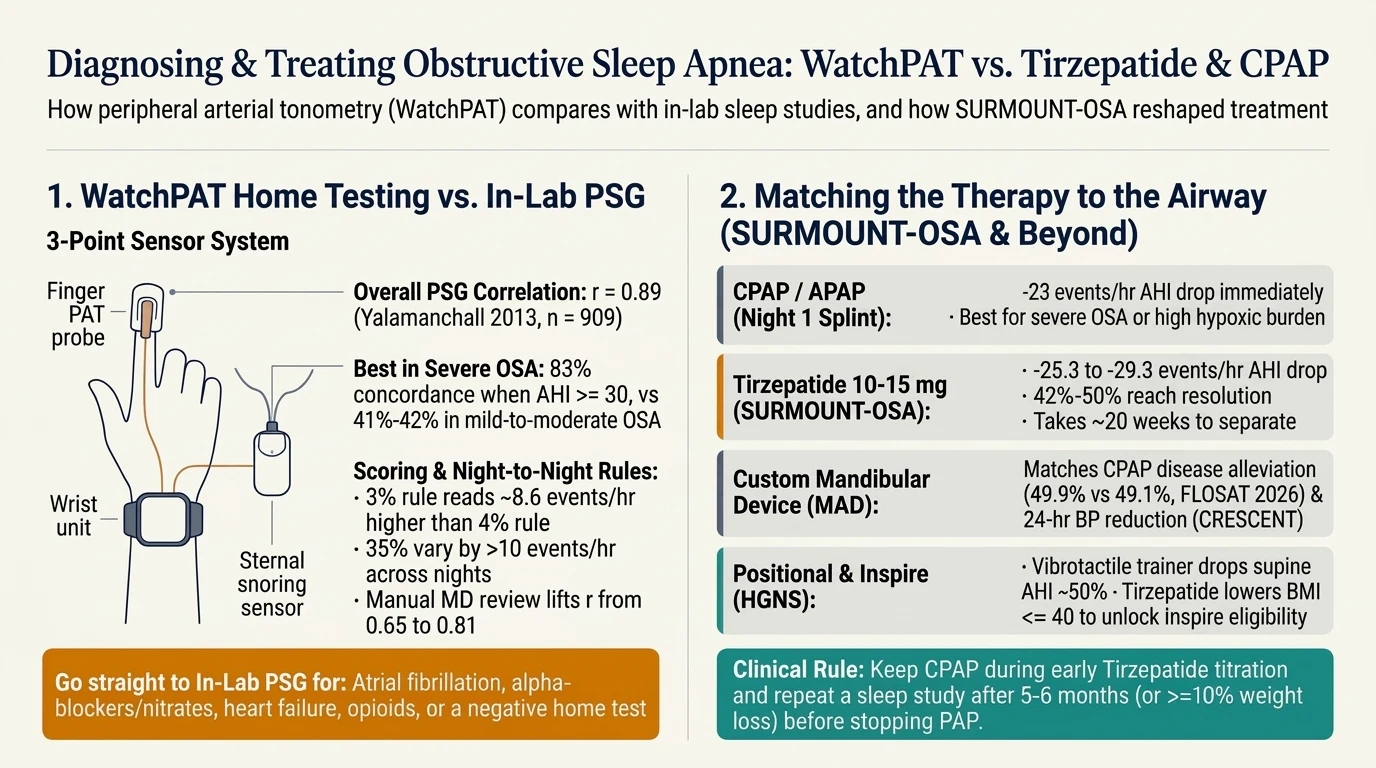
- First FDA-approved drug for moderate-to-severe sleep apnea in obesity: At 10 or 15 mg weekly over 52 weeks, tirzepatide cut breathing pauses (AHI) by 25.3 events per hour (-50.7%) without CPAP and 29.3 events per hour (-58.7%) on CPAP. It brought 42.2% to 50.2% of patients to disease resolution while lowering C-reactive protein (-29% to -45%) and systolic blood pressure (-7.6 to -9.5 mmHg).
- Proven gain in heart failure (HFpEF) and fatty liver (MASH): Tirzepatide cut heart-failure events in HFpEF and matched dulaglutide on major heart events in type 2 diabetes, while semaglutide still holds the only placebo-controlled heart-attack-and-stroke reduction in non-diabetic heart disease until ongoing tirzepatide heart trials finish.
A 48-year-old contractor from Fishtown came in with a blood pressure of 144/92 mmHg on two pills, a BMI of 36, and a CPAP machine gathering dust in his closet because the mask woke him up at 2 AM. His sleep study showed an AHI of 38 events/hour (moderate-to-severe OSA), which qualified him under the December 2024 FDA approval of Zepbound (tirzepatide 10 to 15 mg weekly) from the SURMOUNT-OSA trials (Malhotra et al., NEJM 2024). Pairing a slow step-up to 10 mg weekly with a custom dental mouthpiece (MAD), 160 grams of daily protein, and three days a week of heavy lifting brought his weight down 18%, dropped his blood pressure to 118/74 mmHg, and cut his repeat sleep-study AHI to 6 events/hour in ten months.
What is tirzepatide, and how did it compare head-to-head against semaglutide (SURMOUNT-1 & SURMOUNT-5)?
Tirzepatide is a once-weekly dual GIP / GLP-1 agonist that achieved 20.9% mean weight loss in SURMOUNT-1 (Jastreboff NEJM 2022) and beat full-dose semaglutide 2.4 mg head-to-head in SURMOUNT-5 (20.2% vs. 13.7% weight loss at 72 weeks, Aronne NEJM 2025).
- Dual Receptor Action (GIP + GLP-1): While semaglutide (Ozempic, Wegovy) activates only the GLP-1 receptor, tirzepatide stimulates both GIP and GLP-1 receptors. Together, they quiet brain hunger signals, slow stomach emptying, improve insulin sensitivity in fat and muscle, and ease central nausea pathways.
- SURMOUNT-1 (Jastreboff et al., NEJM 2022): In adults with obesity (BMI >= 30 or >= 27 with a health condition, without diabetes), 72 weeks of tirzepatide 15 mg produced 20.9% weight loss (22.5% on-treatment) vs. 3.1% on placebo.
- SURMOUNT-5 Head-to-Head (Aronne et al., NEJM 2025): Comparing top obesity doses (tirzepatide 10 or 15 mg vs. semaglutide 1.7 or 2.4 mg), tirzepatide achieved 20.2% vs. 13.7% weight loss over 72 weeks, with fewer people stopping for stomach side effects. In type 2 diabetes (SURPASS-2, Frias NEJM 2021), tirzepatide also lowered HbA1c and weight more than semaglutide 1 mg.
- The Muscle Rule: In DEXA substudies, about 75% of weight lost on tirzepatide is fat and ~25% is lean mass (~3:1 fat-to-lean ratio). Every patient in our practice pairs tirzepatide with 1.2 to 1.6 g/kg/day of protein and strength training 2 to 3 days/week (see our GLP-1 muscle protection guide).
What did SURMOUNT-OSA show for obstructive sleep apnea, hypoxic burden, and blood pressure?
In the two 52-week Phase 3 SURMOUNT-OSA trials (Malhotra et al., NEJM 2024, n = 469), tirzepatide (10 or 15 mg weekly) cut AHI by 25.3 to 29.3 events/hour (-50.7% to -58.7%), brought 42.2% to 50.2% of patients to OSA resolution, and lowered hs-CRP and systolic blood pressure (Nat Med 2026).
In December 2024, the FDA approved Zepbound (tirzepatide) as the first drug for moderate-to-severe obstructive sleep apnea (AHI >= 15) in adults with obesity (BMI >= 30), and Medicare Part D coverage for this indication began in January 2025 (Anderer JAMA 2025). The approval rested on two 52-week double-blind RCTs (NCT05412004; diabetes excluded; baseline mean AHI 51.5 in Trial 1 and 49.5 events/h in Trial 2, BMI ~39):
| SURMOUNT-OSA Week-52 Endpoint (Treatment-Regimen Estimand) | Trial 1 (No PAP, n = 234): Tirzepatide vs. Placebo (Placebo-Adjusted Diff) | Trial 2 (On PAP, n = 235, PAP held 7d before PSG): Tirzepatide vs. Placebo (Placebo-Adjusted Diff) | Clinical & Mechanistic Details (Malhotra NEJM 2024; Nat Med 2026; Sleep Med 2025) |
|---|---|---|---|
| Primary Endpoint: Change in AHI (events/hour) | -25.3 vs. -5.3 events/h (Diff: -20.0 events/h, 95% CI -25.8 to -14.2, P < 0.001) | -29.3 vs. -5.5 events/h (Diff: -23.8 events/h, 95% CI -29.6 to -17.9, P < 0.001) | On-treatment (efficacy estimand) drops were -27.4 vs. -4.8 (diff -22.5/h, Trial 1) and -30.4 vs. -6.0 (diff -24.4/h, Trial 2). |
| Percent Change in AHI (%) | -50.7% vs. -3.0% (Diff: -47.7%, P < 0.001) | -58.7% vs. -2.5% (Diff: -56.2%, P < 0.001) | 61.2% vs. 19.0% (RR 3.3, Trial 1) and 72.4% vs. 23.3% (RR 3.1, Trial 2) cut AHI by >= 50%. |
| Disease Resolution / Remission (AHI < 5, or AHI 5-14 with ESS <= 10) | 42.2% vs. 15.9% (RR 2.9, 95% CI 1.8-4.8, P < 0.001; NNT ~4) | 50.2% vs. 14.3% (RR 3.3, 95% CI 2.0-5.4, P < 0.001; NNT ~3) | Level where PAP may not be needed; 68% to 79% moved to a lower OSA tier across age, sex, and baseline AHI (Falcon JCSM 2026). |
| Body Weight Change (%) | -17.7% vs. -1.6% (Diff: -16.1%) | -19.6% vs. -2.3% (Diff: -17.3%) | Serial home WatchPAT 300 tests (Sleep Med 2025) showed pAHI edged down by week 4 and separated from placebo by week 20, tracking weight loss. |
| Hypoxic Burden (SASHB, %·min/h) | -95.2 vs. -25.1 %·min/h (Diff: -70.1, P < 0.001) | -103.0 vs. -41.7 %·min/h (Diff: -61.3, P < 0.001) | Measures total depth and length of overnight oxygen drops, the strongest sleep predictor of heart death. |
| High-Sensitivity CRP (hs-CRP, mg/L) & Week-48 Systolic BP (mmHg) | hs-CRP: -1.4 vs. -0.7 mg/L (P = 0.004; -28.9% vs. placebo) SBP: -9.5 vs. -1.8 mmHg (Diff: -7.6 mmHg, P < 0.001) | hs-CRP: -1.4 vs. -0.3 mg/L (P < 0.001; -45.1% vs. placebo) SBP: -7.6 vs. -3.9 mmHg (Diff: -3.7 mmHg, P = 0.02) | In Nature Medicine (2026) mediation analyses, drops in AHI and hypoxic burden directly explained part of the gains in hs-CRP, HOMA-IR, and triglycerides beyond weight loss, whereas BP reduction was mainly weight-driven. |
Labeled OSA Dosing, PAP Rules, and Borderline WatchPAT Gatekeeping
- FDA Labeled Dosing for OSA: Start Zepbound at 2.5 mg under the skin once weekly for 4 weeks, and step up by 2.5 mg every 4 weeks as tolerated to a maintenance dose of 10 mg or 15 mg once weekly (15 mg is the maximum; the 5 mg dose was not studied for OSA).
- Keep CPAP or MAD Running & Retest After 5-6 Months or >= 10% Weight Loss: Because AHI separation takes ~20 weeks (Malhotra Sleep Med 2025) and roughly half of patients still have residual OSA at 52 weeks (Schmickl & Malhotra Lancet 2025), keep using PAP or your dental mouthpiece during titration and repeat a sleep study after 5 to 6 months (or >= 10% weight loss) before stopping airway therapy (Harris & Kaffenberger JAMA Otolaryngol 2026). For CPAP-intolerant patients with severe obesity, tirzepatide can also lower BMI to <= 40 to qualify for hypoglossal nerve stimulation (Inspire).
- Why a Borderline Home WatchPAT (pAHI ~10 to 20) Needs In-Lab PSG (Iftikhar 2022; Ioachimescu 2020): The FDA label for Zepbound in OSA requires moderate-to-severe OSA (AHI >= 15). Home WatchPAT testing has only 41% to 42% severity match in mild-to-moderate OSA (88%-92% sensitivity and 72%-74% specificity at AHI >= 15, Ichikawa 2022 / Iftikhar 2022; plus a +4 events/h bias on the 3% rule vs. -6 events/h on the 4% rule, Ioachimescu 2020). Any patient with a negative, inconclusive, or borderline home sleep apnea test should get a confirmatory in-lab polysomnogram (PSG) (Kapur AASM 2017). Note also that Zepbound treats obesity-driven airway collapse, whereas lean jaw-driven retrognathia or low-arousal-threshold UARS calls for a custom dental appliance (MAD).
Guidance from the Clinic
"CPAP works on Night 1 by splinting your airway open with air pressure, while Zepbound works by shrinking the tongue and neck fat that crowd the airway in the first place. Because that tissue remodeling takes about 20 weeks to separate from placebo - and half of patients still have some residual apnea at one year - keep your mask or dental mouthpiece on while the weight comes off, and let a repeat sleep study tell us when it is safe to put the machine away." - Dr. Ash
How does tirzepatide perform for heart failure (SUMMIT), cardiovascular safety (SURPASS-CVOT), and fatty liver (SYNERGY-NASH)?
Tirzepatide cut worsening heart-failure events in HFpEF (SUMMIT, Packer NEJM 2025), matched dulaglutide for MACE while lowering all-cause death in type 2 diabetes (SURPASS-CVOT, Nicholls NEJM 2025), and cleared MASH in 44% to 62% of biopsy-proven fatty liver patients (SYNERGY-NASH, Loomba NEJM 2024).
- Heart Failure With Preserved Ejection Fraction (SUMMIT, Packer et al., NEJM 2025): In adults with HFpEF and obesity, tirzepatide cut the composite of cardiovascular death or worsening heart-failure events and improved symptom scores and 6-minute walk distance.
- Heart Outcomes in Diabetes (SURPASS-CVOT, Nicholls et al., NEJM 2025) vs. Non-Diabetic Heart Disease (SELECT): Against the active heart-protective drug dulaglutide in type 2 diabetes, tirzepatide met non-inferiority for 3-point MACE and cut all-cause death. Still, in patients with heart disease without diabetes, semaglutide 2.4 mg (SELECT, -20% MACE vs. placebo) holds the only placebo-controlled heart-attack-and-stroke proof while SURMOUNT-MMO continues.
- Fatty Liver (SYNERGY-NASH, Loomba et al., NEJM 2024): In Phase 2 biopsy-proven MASH with Stage F2-F3 scarring, tirzepatide cleared MASH without worsening fibrosis in 44% to 62% vs. 10% on placebo (see our fatty liver & resmetirom guide).
What are the side effects, contraindications, and safety rules?
Stomach side effects (nausea 22%-25%, diarrhea 22%-26%, vomiting 9%-18% in SURMOUNT-OSA) are mostly mild-to-moderate during dose step-ups. The boxed warning rules out tirzepatide in anyone with a personal or family history of medullary thyroid cancer (MTC) or MEN2.
- Stomach Tolerance & Drop-Out Rates: In SURMOUNT-OSA, only 3.4% to 4.4% of tirzepatide patients stopped treatment for side effects (with 2 cases of pancreatitis in Trial 2 and zero deaths, Malhotra 2024). Small low-fat meals, fluids, and holding the dose steady when mild nausea appears keep tolerance high.
- Thyroid C-Cell Boxed Warning (MTC / MEN2): Based on rodent C-cell tumors, tirzepatide is contraindicated in anyone with a personal or family history of medullary thyroid carcinoma (MTC) or Multiple Endocrine Neoplasia type 2 (MEN2).
- Surgery & Birth-Control Pill Rules: Coordinate anesthesia liquid-diet/hold rules before elective endoscopy or surgery (GLP-1 & surgery guide). Also use a barrier method or non-oral birth control for 4 weeks after starting tirzepatide and after each dose step-up, since slower stomach emptying lowers oral birth-control pill absorption.
Key Takeaways
- Top-Tier Weight Loss (SURMOUNT-1 & SURMOUNT-5): Tirzepatide achieves 20.2% to 20.9% weight loss (vs. 13.7% on full-dose semaglutide), requiring 1.2-1.6 g/kg/day protein and strength training (2-3x/week) to protect lean muscle.
- First FDA-Approved Drug for Obesity-Related Moderate-to-Severe OSA (SURMOUNT-OSA, NEJM 2024): At 10 or 15 mg weekly (Medicare Part D covered since Jan 2025), tirzepatide cuts AHI by -25.3 to -29.3 events/h (-50.7% to -58.7%), brings 42.2% (NNT ~4) to 50.2% (NNT ~3) of patients to resolution, cuts hs-CRP by 29% to 45%, and lowers systolic BP by 3.7 to 7.6 mmHg vs. placebo (Nat Med 2026).
- Retest After 5-6 Months or >= 10% Weight Loss Before Stopping PAP: Keep CPAP or MAD therapy running during the first 20+ weeks of weight loss, repeat a sleep study after 5 to 6 months (or >= 10% weight loss) before stopping PAP (Harris 2026), and use in-lab PSG whenever a home WatchPAT result is negative or borderline (Ioachimescu 2020; AASM 2017).
Related at Fishtown Medicine
- Sleep Apnea Screening: What Your Watch Knows, and Who Should Test
- What a WatchPAT Home Sleep Apnea Test Costs, and How It Compares to In-Lab PSG
- Is It Insomnia or Sleep Apnea? (COMISA & UARS)
- Muscle Loss on GLP-1 Drugs
- The New Weight-Loss Drugs, Compared
- Fatty Liver (MASLD & MASH)
Scientific References
- SURMOUNT-1 & SURMOUNT-5 Obesity Trials: Jastreboff AM, Aronne LJ, Ahmad NN, et al. N Engl J Med. 2022;387(3):205-216; and Aronne LJ, Horn DB, le Roux CW, et al. (SURMOUNT-5). N Engl J Med. 2025.
- SURMOUNT-OSA Primary & Secondary Analyses (NEJM 2024, Nat Med 2026, Sleep Med 2025, Lancet 2025, JAMA Otolaryngol 2026): Malhotra A, Grunstein RR, Fietze I, et al. "Tirzepatide for the Treatment of Obstructive Sleep Apnea and Obesity." N Engl J Med. 2024;391(13):1193-1205; Malhotra A, Grunstein R, Azarbarzin A, et al. Nat Med. 2026; Malhotra A, et al. Sleep Med. 2025; Schmickl CN, Malhotra A. Lancet. 2025; Harris C, Kaffenberger TM. JAMA Otolaryngol Head Neck Surg. 2026; Falcon B, Xie CC, Redline S, et al. J Clin Sleep Med. 2026; and Anderer S. JAMA. 2025.
- WatchPAT vs. In-Lab PSG & AASM Guidelines: Kapur VK, Auckley DH, Chowdhuri S, et al. J Clin Sleep Med. 2017;13(3):479-504; Ioachimescu OC, Allam JS, Samarghandi A, et al. J Clin Sleep Med. 2020;16(10):1663-1674; Iftikhar IH, et al. J Clin Sleep Med. 2022;18(4):1093-1102; and Ichikawa M, et al. J Sleep Res. 2022;31(6):e13682.
- Heart Failure (SUMMIT), Diabetes CVOT (SURPASS-CVOT), & MASH (SYNERGY-NASH): Packer M, Zile MR, Kramer CM, et al. N Engl J Med. 2025;392(5):427-437; Nicholls SJ, Bhatt DL, Buse JB, et al. N Engl J Med. 2025;393:2409-2420; and Loomba R, Hartman ML, Lawitz EJ, et al. N Engl J Med. 2024;391(4):299-310.

Frequently Asked Questions
Common Questions
Deep-Dive Questions
Ready when you are
The chat is our AI assistant, answering from our published guides. To talk it through with Dr. Ash himself, start with the intake.