

FishtownFish wrapped around the rod of AsclepiusMedicine
Preventive Primary Care
How Care Works
Virtual & Home Visits
Virtual care across 40 states + house calls in Philadelphia
Concierge vs. Direct Care
Zero visit copays, zero hidden fees, relationship model
Send Medical Records
Securely upload prior labs & notes before consultation
Common Questions (FAQ)
PCP scope, insurance, labs & cancellation policies
Services
Primary Care & Acute Visits
Same-day sick visits, refills & comprehensive PCP care
Chronic & Complex Care
POTS, MCAS, Long COVID, Lyme & fatigue workups
Hormones & Endocrine
TRT, thyroid, perimenopause, menopause & PCOS
Metabolic Health & Weight
Advanced lipid testing, GLP-1s & glucose monitoring
Longevity & Prevention
Medicine 3.0 baselines, VO2 max, DEXA & prevention
All Clinical Services
Comprehensive catalogue of 36+ clinical services
Membership
Membership Details
Unlimited direct access, continuous physician care
Billing & Payment FAQ
HSA/FSA eligibility, transparent cancellation policy
About
Meet Dr. Ash
Your Physician
GER·O·SPAN
Our Clinical Framework
Clinical Library & Articles
Evidence-based health guides reviewed by Dr. Ash
What People Say
124 patient reviews across 6 platforms
Contact Dr. Ash
Reach out with questions or book an intro
Patient PortalStart Intake
Weekly Semaglutide Resolves MASH in 63% of Patients and Regresses Liver Scarring in the ESSENCE Trial
Fishtown Medicine•6 min read

Weekly Semaglutide Resolves MASH in 63% of Patients and Regresses Liver Scarring in the ESSENCE Trial

Ashvin Vijayakumar MD

Medically Reviewed

Ashvin Vijayakumar MD•Updated November 7, 2026
On This Page
  • What Did the Phase 3 ESSENCE Trial Show for Liver Inflammation and Scarring?
  • How Does Semaglutide Compare With Resmetirom, Tirzepatide, and Survodutide?
  • How Do We Select Patients and Monitor Response Without a Biopsy?
  • What Are the Limits and Safety Rules to Keep in Mind?
  • Guidance from the Clinic
  • Actionable Steps in Philly
  • Common Questions
  • Is semaglutide (Wegovy) FDA-approved for fatty liver disease?
  • What were the primary results of the ESSENCE trial?
  • Do I need a liver biopsy to get prescribed semaglutide for MASH?
  • How do I choose between semaglutide (Wegovy) and resmetirom (Rezdiffra)?
  • Can I take semaglutide and resmetirom at the same time?
  • Deep Questions
  • If liver cells have no GLP-1 receptors, how does semaglutide resolve MASH?
  • Why did ESSENCE show significant fibrosis improvement when the 2021 Phase 2 trial did not?
  • Why is semaglutide not recommended for MASH cirrhosis (F4, VCTE > 20 kPa)?
  • How do dual agonists (tirzepatide and survodutide) differ from semaglutide in MASH?
  • Related at Fishtown Medicine
  • Scientific References

Get a preventive doctor that knows you.

Consult Dr. Ash
TL;DR30-second take

Semaglutide 2.4 mg (Wegovy) received FDA accelerated approval in August 2025 for adults with non-cirrhotic MASH and moderate-to-advanced liver fibrosis (stages F2 to F3). In the Phase 3 ESSENCE trial (n = 800 at 72 weeks), weekly semaglutide resolved steatohepatitis in 62.9 percent of patients versus 34.3 percent on placebo, improved liver fibrosis by at least one stage in 36.8 percent versus 22.4 percent, and achieved both endpoints together in 32.7 percent versus 16.1 percent alongside 10.5 percent weight loss. Guidelines select patients without a biopsy using FibroScan stiffness of 8 to 15 kPa (or ELF 9.2 to 10.5) and prioritize semaglutide when obesity, type 2 diabetes, or cardiovascular disease coexist.

Weekly semaglutide 2.4 mg (Wegovy) earned FDA accelerated approval in August 2025 as the first GLP-1 therapy for non-cirrhotic MASH with moderate-to-advanced (F2 to F3) liver fibrosis, after the Phase 3 ESSENCE trial (n = 800) showed 62.9 percent MASH resolution (vs. 34.3% placebo) and 36.8 percent fibrosis regression (vs. 22.4% placebo) over 72 weeks.1

TL;DR - Your Next Steps

  1. Know the Phase 3 ESSENCE numbers (NEJM 2025): At 72 weeks in 800 adults with biopsy-confirmed F2 to F3 MASH, semaglutide 2.4 mg resolved steatohepatitis in 62.9% vs 34.3% (+28.7 percentage points), improved fibrosis in 36.8% vs 22.4% (+14.4 points), and hit both endpoints together in 32.7% vs 16.1%, with -10.5% body weight loss.
  2. Qualify without a liver biopsy (AASLD 2025): You do not need a biopsy to start therapy. AASLD guidance selects F2 to F3 candidates using a FibroScan (VCTE) stiffness of 8.0 to 15.0 kPa, MRE of 3.1 to 4.4 kPa, or an ELF blood score of 9.2 to 10.5.
  3. Match the drug to your metabolic profile (EASL 2026): Semaglutide is preferred when F2-F3 MASH travels with obesity, type 2 diabetes, or cardiovascular risk (SELECT trial -20% MACE), while weight-neutral resmetirom (Rezdiffra) is preferred in lean MASH or GLP-1 intolerance.
  4. Protect muscle mass and track 1-year response: Pair semaglutide with high protein and resistance training, and verify 12-month response via ALT (>= 17 U/L or >= 20% drop), VCTE (>= 30% stiffness drop), or ELF (>= 0.5 drop).
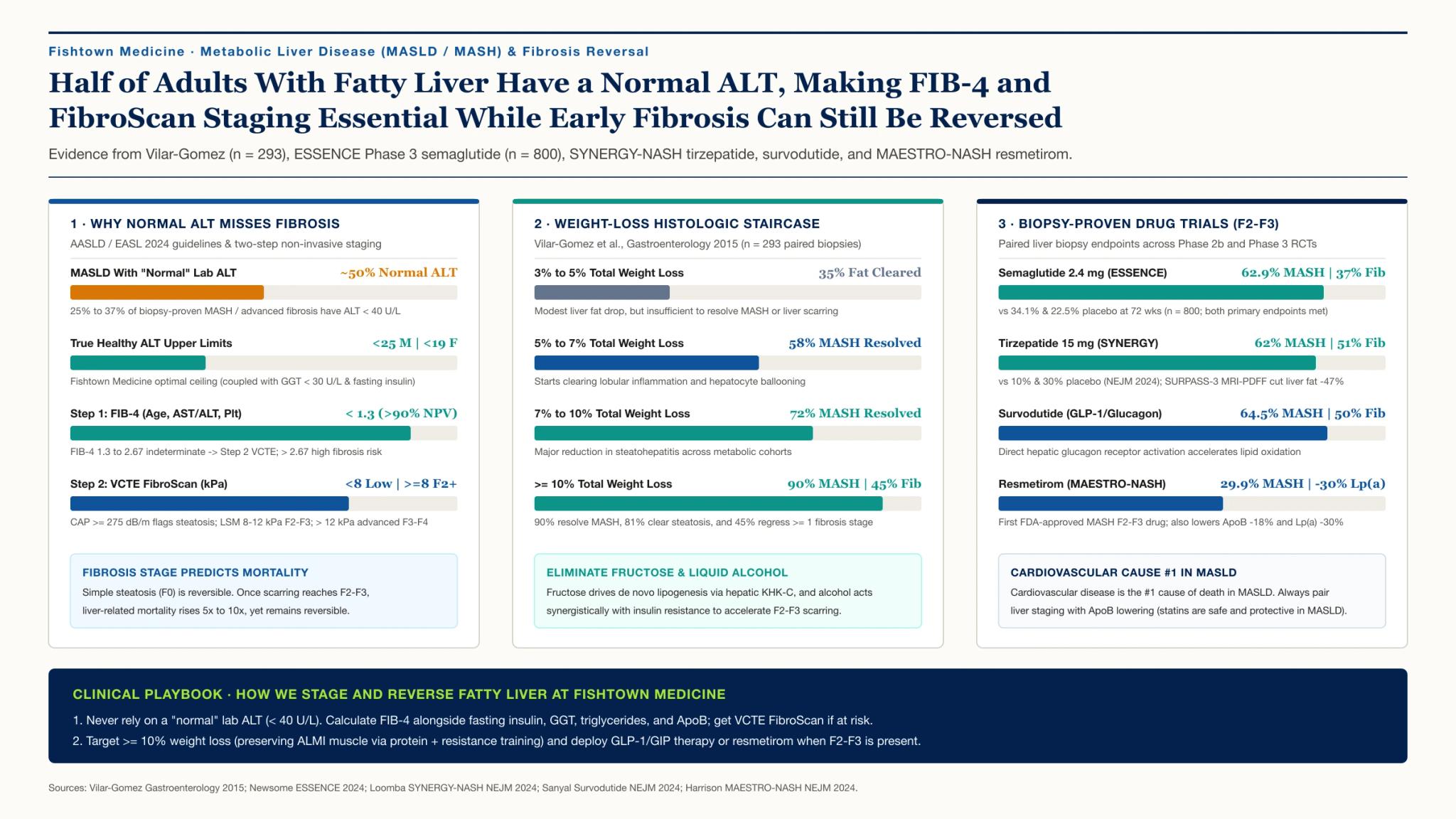
Fatty Liver (MASLD & MASH): Why Normal ALT Misses Fibrosis and How We Reverse It

What Did the Phase 3 ESSENCE Trial Show for Liver Inflammation and Scarring?

In Part 1 of the Phase 3 ESSENCE trial (Sanyal et al., NEJM 2025, n = 800 with F2-F3 fibrosis followed for 72 weeks), weekly semaglutide 2.4 mg beat placebo on both primary liver-biopsy endpoints while reducing total body weight by 10.5 percent (vs. 2.0% on placebo).1

ESSENCE Phase 3 Endpoint (72 Weeks, F2-F3 MASH)Semaglutide 2.4 mg (n = 534)Placebo (n = 266)Treatment Difference / Clinical Read
MASH Resolution (No Worsening of Fibrosis)62.9%34.3%+28.7 percentage points (p < 0.001); nearly two-thirds cleared active steatohepatitis.
Fibrosis Improvement (>= 1 Stage, No Worsening of MASH)36.8%22.4%+14.4 percentage points (p < 0.001); solved the sample-size limit of the 2021 Phase 2 trial.
Combined MASH Resolution AND Fibrosis Improvement32.7%16.1%Doubled the combined histologic recovery rate (p < 0.001).
Total Body Weight Change-10.5%-2.0%Crossed the critical >= 10% weight-loss threshold where fibrosis regression accelerates.
GI Tolerability & Discontinuation36.2% nausea (2.6% stopped for AEs)13.2% nausea (3.3% stopped for AEs)Slow 16-week titration kept treatment discontinuation lower than placebo.

Why did ESSENCE succeed on fibrosis where the earlier 2021 Phase 2 trial (Newsome et al., NEJM 2021, n = 320) missed statistical significance (43% vs 33%, p = 0.48)? Scar tissue remodels much more slowly than active inflammation cools down. By enrolling 800 F2-F3 patients and extending treatment to 72 weeks, ESSENCE captured the delayed collagen remodeling that follows sustained metabolic unloading.1,2

How Does Semaglutide Compare With Resmetirom, Tirzepatide, and Survodutide?

Semaglutide heals the liver from the outside in by reversing whole-body insulin resistance, visceral adiposity, and adipose lipolysis, whereas resmetirom acts directly on liver THR-beta receptors without changing body weight.1,3

Hepatocytes (liver cells) express almost zero GLP-1 receptors. Instead, semaglutide quiets hypothalamic appetite signaling, improves pancreatic insulin-to-glucagon balance, and stops inflamed visceral fat from flooding the portal vein with free fatty acids. Once that incoming fat supply drops and body weight falls by >= 10 percent, the liver burns through its stored fat and halts stellate-cell scarring.

Here is how the 2026 EASL-EASD-EASO and AASLD guidelines position the current landscape:

  • Semaglutide 2.4 mg (Wegovy, FDA-approved Aug 2025): First-line choice when F2-F3 MASH coexists with obesity, type 2 diabetes, or established cardiovascular disease, since semaglutide also reduces major heart events (MACE) by 20 percent (SELECT trial, Lincoff et al., NEJM 2023).4,5
  • Resmetirom 80/100 mg (Rezdiffra, FDA-approved Mar 2024): First-line choice in non-obese ("lean") F2-F3 MASH or in patients who cannot tolerate or have already plateaued on a GLP-1 therapy (MAESTRO-NASH: 25.9 to 29.9% MASH resolution vs 9.7%, 24.2 to 25.9% fibrosis improvement vs 14.2%, and -13.6 to -16.3% LDL-C reduction).3,4
  • Tirzepatide (SYNERGY-NASH Phase 2, NEJM 2024): In 190 patients with F2-F3 MASH over 52 weeks, the dual GIP/GLP-1 agonist resolved MASH in 44% / 56% / 62% (5 / 10 / 15 mg) vs 10% placebo and improved fibrosis in 51 to 55% vs 30% placebo alongside up to -15.7% weight loss.6 While FDA-approved for obesity, diabetes, and sleep apnea, it awaits Phase 3 liver biopsy trials for a formal MASH label.
  • Survodutide (GLP-1 + Glucagon dual agonist, Phase 2 NEJM 2024 & Phase 3 SYNCHRONIZE-MASLD 2026): Because liver cells carry abundant glucagon receptors, adding direct hepatic glucagon signaling to GLP-1 weight loss stimulates mitochondrial fat oxidation directly inside the liver (mediation analysis showed 63.7% of its fibrosis benefit was independent of weight loss). Its Phase 3 LIVERAGE biopsy trial is ongoing.7

How Do We Select Patients and Monitor Response Without a Biopsy?

Under the November 2025 AASLD Practice Guidance update for semaglutide (Bansal et al., Hepatology 2025), clinicians select F2 to F3 MASH candidates and track treatment response using non-invasive tests (NITs) instead of serial liver biopsies:5

  1. Non-biopsy initiation thresholds (F2 to F3 zone):
    • FibroScan (VCTE) liver stiffness: 8.0 to 15.0 kPa (or 15.0 to 20.0 kPa after carefully excluding cirrhosis via platelet count, imaging, and clinical exam).
    • MR Elastography (MRE): 3.1 to 4.4 kPa.
    • ELF blood score: 9.2 to 10.5.
    • Who should NOT start semaglutide for MASH: Patients with mild steatosis (F0-F1, < 8 kPa) who have no other indication (BMI, T2D, CV risk), and patients with established cirrhosis (F4, VCTE > 20 kPa), where a dedicated Phase 2 trial (Loomba et al., 2023) showed no fibrosis benefit (11% vs 29% placebo).8
  2. 12-Month non-invasive response targets:
    • ALT reduction: Drop of >= 17 U/L or >= 20 percent from baseline.
    • FibroScan (VCTE) improvement: Stiffness drop of >= 30 percent (keeping in mind that VCTE drops can overestimate histologic scar regression when liver fat clears rapidly).
    • ELF score improvement: Drop of >= 0.5 units.

What Are the Limits and Safety Rules to Keep in Mind?

Three clinical boundaries keep our use of semaglutide for MASH safe and durable:

  • Surrogate vs. hard clinical outcomes (ESSENCE Part 2): The August 2025 FDA approval is an accelerated approval based on 72-week biopsy histology. Part 2 of ESSENCE is following patients out to 240 weeks (~4.5 years) to confirm reductions in progression to cirrhosis, hepatic decompensation, liver transplant, and mortality.
  • Protecting skeletal muscle mass (sarcopenic obesity trap): Because skeletal muscle is the primary disposal site for blood glucose, losing lean mass during rapid GLP-1 weight loss worsens insulin resistance if you ever pause the medication. We pair every GLP-1 protocol with 1.2 to 1.6 g/kg of daily protein and structured resistance training.
  • GI titration and contraindications: Nausea (36.2% vs 13.2%), diarrhea, and constipation are minimized by gradual 4-week dose steps (0.25 -> 0.5 -> 1.0 -> 1.7 -> 2.4 mg/wk). Semaglutide is contraindicated in patients with a personal or family history of medullary thyroid carcinoma (MTC) or MEN2, and requires monitoring for gallstones and pancreatitis.

Guidance from the Clinic

Dr. Ash
"When a patient has F2 or F3 liver scarring (FibroScan 8 to 15 kPa) tangled up with visceral weight, prediabetes, or high ApoB, semaglutide 2.4 mg lets us treat the entire cardiometabolic web with one weekly injection. What makes the difference between temporary weight loss and lasting liver recovery is what we build around the prescription: heavy resistance training, protein targets, zero liquid fructose, and 12-month FibroScan tracking."

Actionable Steps in Philly

Stage your liver accurately and match the right therapy.

  1. Run a baseline FIB-4 and metabolic panel: Check AST, ALT (healthy cutoffs <= 29 to 33 U/L men, <= 19 to 25 U/L women), platelets, fasting insulin, HbA1c, triglycerides, and ApoB.
  2. Confirm F2 to F3 eligibility by FibroScan (VCTE) (8 to 15 kPa): Establish your baseline stiffness (kPa) and steatosis (CAP >= 275 dB/m) without a biopsy.
  3. Protect lean muscle while titrating over 16+ weeks: Hit 30 to 40 g of protein per meal and lift weights 2 to 3 days per week so weight loss comes from visceral and hepatic fat (>= 10% target).
  4. Re-check ALT at 3 to 6 months and repeat FibroScan or ELF at 12 months: Confirm you hit the >= 17 U/L (>= 20%) ALT drop and >= 30% VCTE stiffness reduction.

Related at Fishtown Medicine

  • Resmetirom (Rezdiffra): The First MASH Drug - the other approved MASH drug, working directly in the liver
  • Survodutide (GLP-1/Glucagon) - the investigational GLP-1/glucagon drug with strong MASH data
  • Fatty Liver (MASLD/MASH) - the disease and the metabolic work underneath it
  • Tirzepatide (Zepbound, Mounjaro) - the dual agonist with its own emerging MASH data
  • Ozempic vs Metformin - where semaglutide fits among metabolic drugs
  • Metabolic Health and Insulin Resistance - the root driver of fatty liver

Scientific References

  1. Sanyal AJ, Newsome PN, Kliers I, et al. "Phase 3 Trial of Semaglutide in Metabolic Dysfunction-Associated Steatohepatitis (ESSENCE)." The New England Journal of Medicine. 2025;392(17):1608-1618.
  2. Newsome PN, Buchholtz K, Cusi K, et al. "A Placebo-Controlled Trial of Subcutaneous Semaglutide in Nonalcoholic Steatohepatitis." The New England Journal of Medicine. 2021;384(12):1113-1124.
  3. Harrison SA, Bedossa P, Guy CD, et al. "A Phase 3, Randomized, Controlled Trial of Resmetirom in NASH with Liver Fibrosis (MAESTRO-NASH)." The New England Journal of Medicine. 2024;390(6):497-509.
  4. European Association for the Study of the Liver (EASL), EASD, EASO. "EASL-EASD-EASO Guidance on the Use of Resmetirom and Semaglutide as MASH-targeted Therapy." Journal of Hepatology. 2026.
  5. Bansal MB, Patton H, Morgan TR, et al. "Semaglutide Therapy for Metabolic Dysfunction-Associated Steatohepatitis: November 2025 Updates to AASLD Practice Guidance." Hepatology. 2025/2026.
  6. Loomba R, Hartman ML, Lawitz EJ, et al. "Tirzepatide for Metabolic Dysfunction-Associated Steatohepatitis with Liver Fibrosis (SYNERGY-NASH)." The New England Journal of Medicine. 2024;391(4):299-310.
  7. Sanyal AJ, Bedossa P, Fraessdorf M, et al. "A Phase 2 Randomized Trial of Survodutide in MASH and Fibrosis." The New England Journal of Medicine. 2024;391(4):311-319.
  8. Loomba R, Abdelmalek MF, Armstrong MJ, et al. "Semaglutide 2.4 mg once weekly in patients with non-alcoholic steatohepatitis-related cirrhosis: a randomised, placebo-controlled phase 2 trial." The Lancet Gastroenterology & Hepatology. 2023;8(6):511-522.

Medical Disclaimer: This resource provides clinical context for educational purposes and is not medical advice. Do not start, stop, or change any medication based on this article. In Precision Medicine there is no one-size-fits-all; the right plan must be matched to your history, labs, and fibrosis stage. Consult Dr. Ash or your own physician about your liver and metabolic health.
Ashvin Vijayakumar MD (Dr. Ash)

Fishtown Medicine | Metabolism

2418 E York St, Philadelphia, PA 19125·(267) 360-7927·hello@fishtownmedicine.com·HSA/FSA Eligible

Start your intake

Frequently Asked Questions

Common Questions

Yes. In August 2025, the FDA granted accelerated approval to Wegovy (semaglutide 2.4 mg once weekly) to treat adults with non-cirrhotic MASH and moderate-to-advanced liver fibrosis (stages F2 to F3), alongside nutrition and exercise.<sup>1,5</sup>
In Part 1 of the Phase 3 ESSENCE trial (n = 800, 72 weeks), semaglutide 2.4 mg resolved steatohepatitis without worsening fibrosis in 62.9 percent of patients versus 34.3 percent on placebo (+28.7 percentage points). It improved liver fibrosis by at least one stage without worsening MASH in 36.8 percent versus 22.4 percent on placebo (+14.4 percentage points), and achieved both endpoints together in 32.7 percent versus 16.1 percent.<sup>1</sup>
No. The November 2025 AASLD guidance recommends selecting patients non-invasively using a FibroScan (VCTE) liver stiffness between 8.0 and 15.0 kPa, an MR Elastography (MRE) reading of 3.1 to 4.4 kPa, or an ELF blood score of 9.2 to 10.5.<sup>5</sup>
Per the 2026 EASL-EASD-EASO drug guidance, semaglutide is prioritized when F2-F3 MASH coexists with obesity, type 2 diabetes, or high cardiovascular risk (since semaglutide drives -10.5% weight loss and lowers heart attacks and strokes). Resmetirom is prioritized in non-obese ("lean") F2-F3 MASH or in patients who cannot tolerate or are already on a GLP-1 receptor agonist.<sup>4</sup>
The 2026 Global Consensus advises against starting both drugs simultaneously upfront because no randomized trial has tested combined initiation. However, because resmetirom acts directly on liver THR-beta receptors while semaglutide acts systemically on weight and insulin resistance (and ~14% of MAESTRO-NASH participants were already taking a baseline GLP-1), sequential addition is sometimes used in specialist care when a patient on a stable GLP-1 still has persistent F2-F3 fibrosis.

Deep-Dive Questions

Hepatocytes lack canonical GLP-1 receptors. Semaglutide resolves MASH primarily by reducing hypothalamic energy intake, improving adipose-tissue insulin sensitivity (which stops unchecked lipolysis of free fatty acids into the portal vein), lowering hepatic *de novo* lipogenesis driven by hyperinsulinemia, and reducing systemic inflammatory cytokines. Once total body weight drops by >= 10 percent, intrahepatic triglyceride overload clears and stellate-cell fibrogenesis subsides.
In the 2021 Phase 2 trial (Newsome et al., NEJM 2021), semaglutide 0.4 mg/day resolved MASH in 59% vs 17% of patients, but fibrosis improvement (43% vs 33%, p = 0.48) was underpowered with only ~80 patients per arm. Collagen scar degradation lags behind the resolution of hepatocyte ballooning and inflammation. With 800 F2-F3 patients followed for 72 weeks, ESSENCE had the statistical power and duration to prove a +14.4 percentage-point gain in fibrosis regression (36.8% vs 22.4%, p < 0.001).<a href="#ref-1" class="underline decoration-1 underline-offset-2 text-brand-primary hover:text-brand-primary transition-colors"><sup>1,2</sup>
In a dedicated Phase 2 randomized trial in patients with MASH-related compensated cirrhosis (Loomba et al., Lancet Gastroenterol Hepatol 2023, n = 71), weekly semaglutide 2.4 mg for 48 weeks reduced liver fat and body weight but did not improve liver fibrosis (11% vs 29% on placebo).<sup>8</sup> Accordingly, AASLD and EASL guidelines recommend against prescribing semaglutide as a MASH-targeted antifibrotic once VCTE exceeds 20 kPa.

Ready when you are

Start your intake

The chat is our AI assistant, answering from our published guides. To talk it through with Dr. Ash himself, start with the intake.


Related Intelligence

Performance Physical Philadelphia: 4 Tests That Predict How You Age

Performance Physical Philadelphia: 4 Tests That Predict How You Age

A performance physical measures how well you are aging: VO2 max, grip strength, mobility, and body composition - the 4 tests that predict healthspan.

Read Deep Dive
Healthspan vs Lifespan: Why Living Longer Is Not Enough | Philadelphia

Healthspan vs Lifespan: Why Living Longer Is Not Enough | Philadelphia

Americans live to about 78 but spend the last 12 years sick and dependent. A Philadelphia primary care practice on why healthspan is the better metric.

Read Deep Dive
Accidental Death Prevention Philadelphia | The Missing Horseman of Medicine 3.0

Accidental Death Prevention Philadelphia | The Missing Horseman of Medicine 3.0

The number one cause of death for people under 45 is not cancer or heart disease. It is accidental injury. How to prevent the unforced error in your longevity plan.

Read Deep Dive

New patients

Talk it through with Dr. Ash.

Share where your weight and energy are now, what you have tried, and what you want the next year to look like. Dr. Ash reads every intake personally.

HSA/FSA eligible
No initiation or cancellation fees
No copays
Tell Dr. Ash what’s going on →
FishtownFish wrapped around the rod of AsclepiusMedicine
Preventive Primary Care
2418 E York St, Philadelphia, PA 19125(267) 360-7927Primary care in PhiladelphiaHome visits in Greater PhiladelphiaPricing & MembershipGER·O·SPAN: our clinical frameworkDigital Health LiteracyClinical Evidence & Research

Serving Fishtown · Northern Liberties · East Kensington · Olde Richmond · Port Richmond · Old City · Callowhill · Poplar · Center City · Center City West · Art Museum · Bella Vista · Chestnut Hill · Fairmount · Fitler Square · Graduate Hospital · Logan Square · Manayunk · Queen Village · Rittenhouse · Roxborough · Society Hill · Southwark · Bryn Mawr, PA · Gladwyne, PA · Villanova, PA · Wayne, PA · Cherry Hill, NJ · Haddonfield, NJ · Medford, NJ · Moorestown, NJ · Voorhees, NJ

Explore by topic

Women’s Health
  • Perimenopause
  • Menopause 3.0
  • PCOS
  • Fertility
Men’s Health
  • Testosterone (TRT)
  • Sleep Apnea & Low T
  • Andropause
  • Low Libido
Metabolic
  • Medical Weight Loss
  • Ozempic vs Metformin
  • Fasting Protocols
  • Visceral Fat
Cardiovascular
  • apoB & Heart Health
  • apoB vs LDL
  • Lp(a) Cholesterol
  • ED & Heart Risk
Longevity + Performance
  • Healthspan vs Lifespan
  • Biological Age
  • VO2 Max
  • Zone 2 Training
Supplements
  • Magnesium
  • Creatine
  • Omega-3
  • Foundational Stack
  • Supplement Guides

Tools, pricing & comparisons

Tools & Guides

  • Normal vs. Optimal Lab Checker
  • Curated Clinical Packets
  • Playbooks & Protocols
  • Clinical Evidence & Research
Pricing & Labs
  • Pricing & Membership
  • 90% Wholesale Quest Labs
  • Cost-Plus Meds & Labs
  • HSA & Open Enrollment Calculator
Compare
  • Primary Care Models
  • Concierge vs. DPC
  • vs. Function Health
  • vs. One Medical
  • vs. Parsley Health
  • Urgent Care Alternative
Who We Care For
  • Primary Care in Philadelphia
  • Hospitality Leadership
  • Philadelphia Dads
  • Sports Club Medicine
Care in Philadelphia +
Direct Primary Care in Philadelphia, PAConcierge Medicine in Philadelphia, PAConcierge vs DPC in Philadelphia, PALongevity Medicine in Philadelphia, PAPreventive Care in Philadelphia, PAExecutive Physical in Philadelphia, PAAnnual Physical in Philadelphia, PAHealthspan Optimization in Philadelphia, PAFunctional Medicine in Philadelphia, PASame-Day Sick Visits in Philadelphia, PATestosterone Replacement Therapy in Philadelphia, PAPerimenopause Care in Philadelphia, PAMenopause Care in Philadelphia, PAThyroid Treatment in Philadelphia, PAPCOS Care in Philadelphia, PAGLP-1 Weight Loss in Philadelphia, PAMetabolic Health in Philadelphia, PAHormone Optimization in Philadelphia, PAAdvanced Lipid Testing in Philadelphia, PAVO2 Max Testing in Philadelphia, PADEXA Scan in Philadelphia, PACGM in Philadelphia, PALong COVID Care in Philadelphia, PAChronic Fatigue Treatment in Philadelphia, PAPOTS Treatment in Philadelphia, PAMCAS Treatment in Philadelphia, PALyme Disease Care in Philadelphia, PABrain Fog Treatment in Philadelphia, PASleep Disorders Treatment in Philadelphia, PAStrep Throat Treatment in Philadelphia, PAUTI Treatment in Philadelphia, PASinus Infection Treatment in Philadelphia, PASTI Testing in Philadelphia, PATravel Medicine in Philadelphia, PAPre-Op Clearance in Philadelphia, PASports Club Medicine in Philadelphia, PA

Made it this far? You’re already most of the way there. let’s get started → Dr. Ash reads every word personally.

Content is for educational purposes only and does not constitute medical advice.

TermsPrivacyScope of PracticeClinical IndependenceCare NetworkResearch & Monographs