

Resmetirom (Rezdiffra) is a once-daily oral thyroid hormone receptor-beta (THR-beta) agonist approved by the FDA in March 2024 for adults with non-cirrhotic MASH and moderate-to-advanced liver fibrosis (stages F2 to F3). In the Phase 3 MAESTRO-NASH trial (n = 966 at 52 weeks), resmetirom (80 mg and 100 mg) resolved MASH in 25.9 to 29.9 percent of patients versus 9.7 percent on placebo, improved liver fibrosis by at least one stage in 24.2 to 25.9 percent versus 14.2 percent, and lowered LDL cholesterol by 13.6 to 16.3 percent without changing body weight. Guidelines select candidates without a biopsy using FibroScan stiffness of 8 to 15 kPa.
Resmetirom (Rezdiffra) is a once-daily oral thyroid hormone receptor-beta (THR-beta) agonist that earned FDA accelerated approval in March 2024 for non-cirrhotic MASH with moderate-to-advanced (F2 to F3) fibrosis, after the Phase 3 MAESTRO-NASH trial (n = 966) showed 25.9 to 29.9 percent MASH resolution (vs. 9.7% placebo), 24.2 to 25.9 percent fibrosis improvement (vs. 14.2% placebo), and a 13.6 to 16.3 percent drop in LDL cholesterol.1
TL;DR - Your Next Steps
- Understand the liver-direct mechanism: Resmetirom selectively switches on THR-beta receptors in liver cells to ramp up mitochondrial fat burning and lower lipotoxicity, sparing THR-alpha receptors in the heart and bone. It is weight-neutral.
- Know the MAESTRO-NASH Phase 3 numbers (NEJM 2024): Over 52 weeks in 966 biopsy-proven patients (~95% F2-F3), resmetirom 80 mg (< 100 kg body weight) and 100 mg (>= 100 kg) roughly tripled MASH resolution (25.9% / 29.9% vs 9.7%), nearly doubled 1-stage fibrosis regression (24.2% / 25.9% vs 14.2%), and lowered LDL-C by 13.6 to 16.3%.
- Qualify without a biopsy (AASLD 2024): Candidates are selected using a FibroScan (VCTE) stiffness of 8.0 to 15.0 kPa or MRE of 3.1 to 4.4 kPa (avoiding initiation above 20 kPa).
- Watch statin dose caps and expected Free T4 shifts: Resmetirom increases statin blood levels (capping rosuvastatin and simvastatin at 20 mg and atorvastatin at 40 mg) and lowers serum Free T4 by 15 to 20% without changing TSH or Free T3.
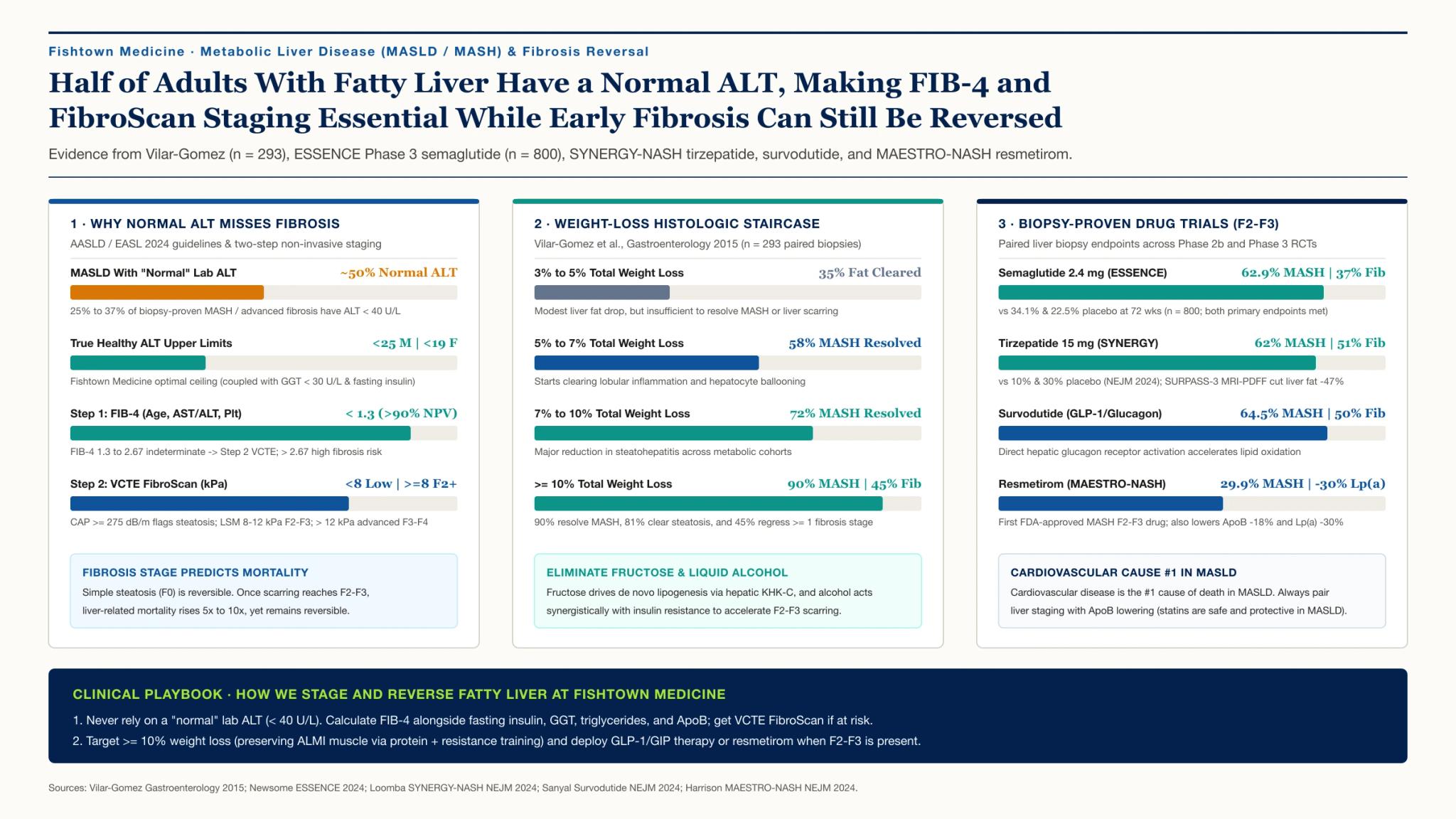
What Is Resmetirom and How Does Liver THR-Beta Activation Work?
Resmetirom is a liver-targeted thyroid hormone receptor-beta (THR-beta) agonist that restores intrahepatic thyroid signaling so liver cells oxidize stored triglycerides and clear damaged mitochondria without causing systemic hyperthyroidism.1,2
Inside a healthy liver, thyroid hormone activates THR-beta receptors to clear cholesterol and burn fatty acids. In patients with fatty liver (MASLD) and MASH, intrahepatic thyroid hormone conversion breaks down, creating a localized state of "hepatic hypothyroidism" even when blood TSH is normal. Giving regular thyroid hormone (levothyroxine or liothyronine) would overstimulate THR-alpha receptors in the heart and skeleton, causing atrial fibrillation and bone loss.
Resmetirom solves that problem in two ways:
- Receptor selectivity: It is roughly 28-fold selective for THR-beta (which accounts for ~80% of thyroid receptors in the liver) over THR-alpha.
- Hepatic transporter uptake: It is actively pulled into hepatocytes by liver organic anion transporting polypeptides (OATP1B1/1B3), concentrating the drug's fat-burning action inside the liver while leaving heart rate, blood pressure, and bone mineral density untouched.1,2
What Did the Phase 3 MAESTRO-NASH Trial Show?
In the 52-week primary readout of MAESTRO-NASH (Harrison et al., NEJM 2024, n = 966 with biopsy-confirmed MASH and fibrosis, ~95% stages F2 and F3), both weight-based doses of resmetirom (80 mg and 100 mg daily) beat placebo on both primary biopsy endpoints and lowered atherogenic lipids:1
| MAESTRO-NASH Endpoint (n = 966, 52 Weeks) | Resmetirom 80 mg (n = 322) | Resmetirom 100 mg (n = 323) | Placebo (n = 321) | Clinical Read at Fishtown Medicine |
|---|---|---|---|---|
| MASH Resolution (No Worsening of Fibrosis) | 25.9% | 29.9% | 9.7% | 2.7x to 3.1x higher resolution rate (p < 0.001 for both doses). |
| Fibrosis Improvement (>= 1 Stage, No NAS Worsening) | 24.2% | 25.9% | 14.2% | +10.0 to +11.7 percentage-point gain (p < 0.001) at 1 year without weight loss. |
| LDL Cholesterol Change (Week 24) | -13.6% | -16.3% | +0.1% | Meaningful drop in LDL-C, ApoB, and triglycerides (p < 0.001). |
| Body Weight Effect | Neutral | Neutral | Neutral | Works directly on hepatic lipid oxidation, independent of weight change. |
| Common GI Side Effects | 27% diarrhea, 22% nausea | 33% diarrhea, 19% nausea | 15% diarrhea, 12% nausea | Mostly mild, transient loose stools in the first 2 to 4 weeks. |
Read the numbers with clear clinical realism: resmetirom doubled to tripled the rate of histologic healing at 1 year, yet roughly 70 to 75 percent of treated patients still had residual MASH or unchanged fibrosis stage at week 52. That is why resmetirom is always paired with foundational metabolic care (>= 7 to 10% weight loss when overweight, resistance training, and cutting fructose and alcohol).
Who Qualifies for Resmetirom, and How Do We Choose Between Resmetirom and Semaglutide?
Under the October 2024 AASLD resmetirom guidance (Chen et al., Hepatology 2025) and the 2026 EASL-EASD-EASO drug guidance, resmetirom is indicated for adults with non-cirrhotic MASH and F2 to F3 fibrosis selected by non-invasive testing (FibroScan VCTE 8.0 to 15.0 kPa or MRE 3.1 to 4.4 kPa).3,4
How do we decide between daily oral resmetirom (approved March 2024) and weekly injectable semaglutide 2.4 mg (approved August 2025 via ESSENCE)?
- When we prioritize Resmetirom (Rezdiffra):
- Non-obese ("lean") F2-F3 MASH, where major weight loss is neither needed nor desirable.
- Patients already taking a GLP-1 or GIP/GLP-1 agonist (such as semaglutide or tirzepatide) whose weight has stabilized, but whose FibroScan still shows 8 to 15 kPa fibrosis (in MAESTRO-NASH, ~14% of participants were on stable baseline GLP-1 therapy).
- Patients who cannot tolerate GLP-1 injections due to gastrointestinal side effects or contraindications.
- When we prioritize Semaglutide 2.4 mg (Wegovy):
- F2-F3 MASH accompanied by obesity, type 2 diabetes, or high cardiovascular risk, where semaglutide delivers -10.5% weight loss, 62.9% MASH resolution (vs 34.3% placebo), 36.8% fibrosis improvement (vs 22.4% placebo), and proven cardiovascular event reduction.4,5
- Who should NOT take resmetirom: Patients with mild F0 to F1 steatosis (VCTE < 8 kPa) and patients with decompensated cirrhosis or established portal hypertension (VCTE > 20 kPa), while the dedicated MAESTRO-NASH-OUTCOMES trial in compensated cirrhosis completes.3
What Drug Interactions, Lab Nuances, and Limits Should Patients Know?
Managing resmetirom safely in internal medicine requires attention to four practical details:1,3
- Weight-based dosing: Adults weighing < 100 kg (220 lbs) take 80 mg once daily; adults weighing >= 100 kg take 100 mg once daily (reduced by 20 mg if taken with moderate CYP2C8 inhibitors like clopidogrel).
- Statin dose caps (OATP1B1/1B3 and BCRP interaction): Because resmetirom raises blood statin levels, the FDA label caps concurrent statin doses at 20 mg/day for rosuvastatin and simvastatin, and 40 mg/day for atorvastatin and pravastatin. Because resmetirom itself lowers LDL-C by 13.6 to 16.3% (and pairing a low-dose statin with ezetimibe keeps deep ApoB lowering), adjusting your lipid plan is simple.
- Expected 15 to 20% drop in Free T4 (with normal TSH and Free T3): Resmetirom routinely lowers serum Free T4 by 15 to 20 percent while keeping TSH and Free T3 normal. This is an expected effect of liver THR-beta activation and does not mean hypothyroidism. Do not start or raise levothyroxine based on an isolated Free T4 dip on resmetirom.
- Accelerated approval and 1-year non-invasive monitoring: March 2024 approval rested on 52-week biopsy endpoints, while 54-month outcome trials continue. AASLD guidance recommends re-checking at 12 months using ALT (>= 17 U/L or >= 20% drop), VCTE (>= 30% stiffness drop), or MRI-PDFF (>= 30% fat drop) to confirm response.3
Guidance from the Clinic

Actionable Steps in Philly
Confirm whether liver-directed THR-beta therapy fits your stage.
- Stage your liver with FIB-4 and FibroScan (VCTE): Check whether your liver stiffness falls in the AASLD treatment window of 8.0 to 15.0 kPa (or MRE 3.1 to 4.4 kPa).
- Review your medication list for statins or clopidogrel: If you take rosuvastatin, simvastatin, atorvastatin, or pravastatin, we adjust your statin dose (<= 20 mg or <= 40 mg) and pair it with ezetimibe if needed to keep ApoB at goal.
- Monitor liver enzymes (ALT, AST, bilirubin) at 3, 6, and 12 months: Watch for the expected ALT drop while screening for rare drug-induced transaminase rises or gallbladder symptoms.
- Re-check FibroScan (VCTE) at 12 months: Verify treatment response alongside nutrition and resistance training.
Related at Fishtown Medicine
- Fatty Liver (MASLD/MASH) - the disease resmetirom treats, and the metabolic work underneath it
- Tirzepatide (Zepbound, Mounjaro) - the GLP-1-class drugs that improve MASH through weight loss
- Semaglutide (Wegovy) for MASH - the other approved MASH drug, working through weight and metabolism
- Survodutide (GLP-1/Glucagon) - the investigational glucagon drug with a dedicated MASH program
- Metabolic Health and Insulin Resistance - the root driver of fatty liver
- ApoB and Heart Health - the cardiovascular risk that travels with a fatty liver
- Ozempic vs Metformin - where the metabolic drugs fit
- The Metabolic Thermostat: Thyroid Optimization - how we read a full thyroid panel, which is the first question most people have about a thyroid-receptor drug
Scientific References
- Harrison SA, Bedossa P, Guy CD, et al. "A Phase 3, Randomized, Controlled Trial of Resmetirom in NASH with Liver Fibrosis (MAESTRO-NASH)." The New England Journal of Medicine. 2024;390(6):497-509.
- Cusi K. "Selective Agonists of Thyroid Hormone Receptor Beta for the Treatment of NASH." The New England Journal of Medicine. 2024;390(6):559-561.
- Chen VL, Morgan TR, Rotman Y, et al. "Resmetirom Therapy for Metabolic Dysfunction-Associated Steatotic Liver Disease: October 2024 Updates to AASLD Practice Guidance." Hepatology. 2025;81(1):312-320.
- European Association for the Study of the Liver (EASL), EASD, EASO. "EASL-EASD-EASO Guidance on the Use of Resmetirom and Semaglutide as MASH-targeted Therapy." Journal of Hepatology. 2026.
- Sanyal AJ, Newsome PN, Kliers I, et al. "Phase 3 Trial of Semaglutide in Metabolic Dysfunction-Associated Steatohepatitis (ESSENCE)." The New England Journal of Medicine. 2025;392(17):1608-1618.

Frequently Asked Questions
Common Questions
Deep-Dive Questions
Ready when you are
The chat is our AI assistant, answering from our published guides. To talk it through with Dr. Ash himself, start with the intake.