

Fatty liver, now called MASLD (metabolic dysfunction-associated steatotic liver disease), means fat has built up in the liver alongside a metabolic driver like insulin resistance. Standard lab ALT cutoffs (40 to 55 U/L) miss 30 to 60 percent of inflammatory MASH and advanced scarring, which is why guidelines use a two-step non-invasive screen: the FIB-4 blood score followed by a FibroScan (VCTE). Losing 7 to 10 percent of body weight resolves MASH in 64 to 90 percent of patients, and losing 10 percent or more regresses liver scarring in 45 percent, supported when needed by FDA-approved semaglutide or resmetirom for stage F2 to F3 fibrosis.
Fatty liver (MASLD) is a reversible metabolic condition where insulin resistance drives fat into liver cells, and because standard lab ALT cutoffs (40 to 55 U/L) miss up to half of patients with liver inflammation and scarring, current guidelines stage it without a biopsy using the FIB-4 score and a FibroScan (VCTE).
TL;DR - Your Next Steps
- Do not trust a "normal" ALT (40 to 55 U/L) to rule out scarring: True healthy ALT is 29 to 33 U/L in men and 19 to 25 U/L in women (ACG 2017). Even then, 30 to 60% of biopsy-proven MASH patients have a normal ALT (AUROC 0.46 for advanced fibrosis).
- Run the 2-step non-invasive staging pathway: Calculate a free FIB-4 score from age, AST, ALT, and platelets (< 1.3 low risk, 1.3 to 2.67 indeterminate, > 2.67 high risk). Follow indeterminate or high-risk patients with a FibroScan (VCTE) (< 8 kPa rules out advanced scarring with 98.7% accuracy; 8 to 15 kPa marks the F2 to F3 treatment zone).
- Target the 7% to >= 10% weight-loss curve: In paired-biopsy studies (Vilar-Gomez 2015), losing 7 to 9.9% of body weight resolves MASH in 64% of patients, while losing >= 10% resolves MASH in 90% and regresses liver fibrosis in 45%.
- Add targeted therapy for F2 to F3 fibrosis when needed: Both weekly semaglutide 2.4 mg (ESSENCE) and daily resmetirom (MAESTRO-NASH) carry FDA accelerated approval for non-cirrhotic MASH with moderate-to-advanced scarring.
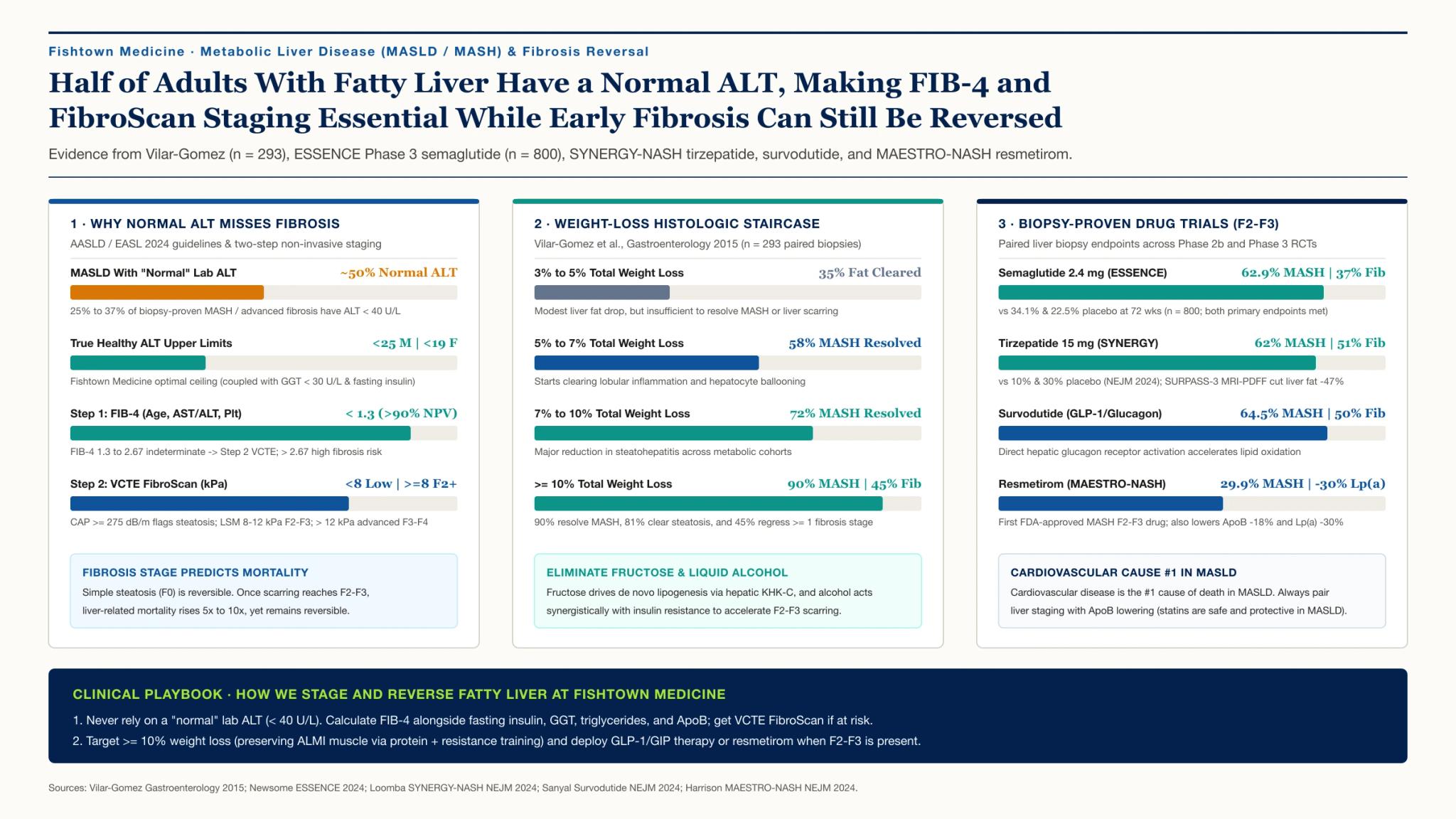
Why Do Standard "Normal" ALT Labs (40 to 55 U/L) Miss Up to Half of MASLD and Fibrosis?
Standard laboratory upper limits for ALT (40 to 55 U/L) miss 30 to 60 percent of patients with active steatohepatitis (MASH) and liver fibrosis because those reference ranges were set in the 1980s using blood donors who had undiagnosed fatty liver, obesity, and hepatitis C.1,2
When researchers excluded people with overweight (BMI > 24.9), high blood sugar, high lipids, and viral hepatitis across 6,835 blood donors in Milan (Prati et al., 2002), the healthy 95th-percentile ceiling for ALT dropped to 30 U/L in men and 19 U/L in women.2 Combining Prati, biopsy-normal living liver donors, and NHANES data, the American College of Gastroenterology (ACG) defines a true healthy ALT as 29 to 33 U/L in men and 19 to 25 U/L in women.1
Even more important, an ALT blood test cannot tell whether your liver is scarred:
- Up to half of biopsy-proven MASH has a "normal" ALT: Across systematic reviews (Rinella, JAMA 2015) and biopsy cohorts (Fracanzani et al., 2008), 30 to 60 percent of patients with inflammatory MASH had an ALT inside the standard normal range.
- ALT is no better than a coin toss for advanced fibrosis: In a biopsy cohort of 222 fatty liver patients (Verma et al., 2013), advanced fibrosis (F3-F4) was present in 26.8 percent of patients with a normal ALT (<= 35 U/L) versus 18.1 percent of those with a high ALT, yielding an AUROC of 0.46 (no better than chance).3
- Normal AST and ALT still hide F2-F4 scarring: In 534 patients with biopsy-confirmed fatty liver and both ALT and AST below 40 U/L (Gawrieh et al., 2019), 19 percent had fibrotic MASH (F2-F3) and 7 percent already had cirrhosis (F4).
- What guidelines recommend (AASLD, EASL, ADA): Because ALT cannot rule out fibrosis at any cutoff, modern guidelines screen anyone with type 2 diabetes, prediabetes, visceral obesity, or metabolic syndrome directly with non-invasive fibrosis scores (FIB-4). Never wait for liver enzymes to turn red.4,5
How Do We Stage MASLD Without a Biopsy Using FIB-4 and FibroScan (VCTE)?
Current AASLD, EASL, and ADA guidelines use a two-step non-invasive pathway that pairs the FIB-4 blood index with FibroScan (VCTE) or the ELF blood test, reserving liver biopsy for rare diagnostic puzzles.4,5
| Staging Step & Test | Low Risk (Rule Out) | Indeterminate / F2-F3 Zone | High Risk (Rule In) | Clinical Action at Fishtown Medicine |
|---|---|---|---|---|
| Step 1: FIB-4 Score (Age, AST, ALT, Platelets) | < 1.3 (NPV >= 90% for advanced fibrosis) | 1.3 to 2.67 (Note: median FIB-4 in F2-F3 MASH is 1.4) | > 2.67 (PPV 60 to 80%) | Repeat FIB-4 every 1 to 3 yrs if < 1.3. Order FibroScan if >= 1.3 or if T2D/metabolic risk is high. |
| Step 2A: FibroScan (VCTE) Liver Stiffness | < 8.0 kPa (NPV 98.7%; 1.3% false-negative rate after FIB-4) | 8.0 to 12.0 kPa (AASLD drug treatment window is 8 to 15 kPa) | > 12.0 kPa (98.9% specificity; >= 15 to 20 kPa cirrhosis range) | Treat lifestyle + consider MASH therapy at 8 to 15 kPa; co-manage with hepatology above 12 kPa. |
| Step 2B: ELF Blood Score (HA, PIIINP, TIMP-1) | < 7.7 (< 9.0 to 9.2 in 2026 global consensus) | 7.7 to 9.7 (9.2 to 10.5 semaglutide selection zone) | >= 9.8 (> 11.3 cirrhosis range) | Blood alternative when imaging elastography is unavailable. |
| Steatosis (Fat) Detection | CAP < 275 dB/m (< 5% liver fat) | CAP >= 275 dB/m (AASLD 2025 threshold for >= 5% steatosis) | MRI-PDFF (gold standard for tracking % fat change) | Standard ultrasound misses mild fat; CAP or MRI-PDFF confirms steatosis. |
Clinical pearl on the FIB-4 1.3 cutoff: In the Phase 3 MAESTRO-NASH trial, the median FIB-4 among patients with biopsy-proven F2 to F3 fibrosis was only 1.4. Relying on FIB-4 >= 1.3 alone misses roughly half of patients with treatable F2 scarring, so in patients with type 2 diabetes, high fasting insulin, or belly fat, we have a low threshold to order a FibroScan directly.
How Much Weight Loss Is Needed to Reverse Steatosis, MASH, and Fibrosis?
Histologic liver recovery follows a clear dose-response curve: losing 5 percent of body weight clears liver fat, losing 7 to 9.9 percent resolves active inflammation (MASH) in 64 percent of patients, and losing 10 percent or more resolves MASH in 90 percent and regresses liver fibrosis by at least one stage in 45 percent.6
In the landmark prospective paired-biopsy study of 293 patients over 52 weeks (Vilar-Gomez et al., Gastroenterology 2015), outcomes separated sharply by total body weight lost:6
| Total Body Weight Lost (52 Weeks) | Steatosis Improvement | MASH Resolution | Fibrosis Regression (>= 1 Stage) | Fibrosis Worsened |
|---|---|---|---|---|
| < 5% Weight Loss (n = 205) | 35% | 10% | 16% | 21% |
| 5.0% to 6.9% Weight Loss (n = 34) | 65% | 26% | 18% | 8% |
| 7.0% to 9.9% Weight Loss (n = 25) | 76% | 64% | 16% | 0% |
| >= 10.0% Weight Loss (n = 29) | 100% | 90% | 45% | 0% |
Two critical insights shape how we build your plan:
- Fibrosis regression required >= 10% weight loss: Losing 5 to 9.9 percent of body weight stopped scarring from getting worse (0% progression at 7 to 9.9%). Still, scar regression stayed flat (16 to 18%) until patients crossed the 10 percent weight-loss threshold (45% regression). Across randomized trials (Monami et al., 2026), every 1 percent of body weight lost raises the odds of MASH resolution by +7 percent and fibrosis improvement by +4 percent.
- Why we combine nutrition, muscle training, and medications when needed: In Vilar-Gomez, only 10 percent of patients reached >= 10 percent weight loss with lifestyle advice alone (30% reached >= 5%). When patients reach larger weight drops with incretin drugs or metabolic surgery (BRAVES trial, Lancet 2023: 56 to 57% MASH resolution and 70 to 80% fibrosis improvement at 1 year; SPLENDOR, JAMA 2021: 88% lower 10-year major liver events, aHR 0.12), both the liver and the heart recover together.7
How Do Resmetirom, Semaglutide, Tirzepatide, and Survodutide Compare for MASH?
Two drugs now hold FDA accelerated approval for non-cirrhotic MASH with F2 to F3 fibrosis: resmetirom (Rezdiffra) and semaglutide 2.4 mg (Wegovy). Meanwhile, tirzepatide (SYNERGY-NASH) and survodutide have strong Phase 2 biopsy results with Phase 3 trials underway.8,9,10
| Medication & Trial | Phase / N / Duration | MASH Resolution (Drug vs. Placebo) | Fibrosis Improvement >= 1 Stage (Drug vs. Placebo) | Weight & Lipid Impact | Regulatory & Guideline Status |
|---|---|---|---|---|---|
| Semaglutide 2.4 mg (ESSENCE Part 1, NEJM 2025) | Phase 3 / n = 800 (F2-F3) / 72 wk | 62.9% vs. 34.3% (+28.7 pp) | 36.8% vs. 22.4% (+14.4 pp) | -10.5% weight loss; proven CV benefit (SELECT). | FDA Approved (Aug 2025) for F2-F3 MASH. Preferred when obesity, T2D, or CV risk coexist (EASL 2026). |
| Resmetirom 80/100 mg (MAESTRO-NASH, NEJM 2024) | Phase 3 / n = 966 (F1B-F3) / 52 wk | 25.9% / 29.9% vs. 9.7% | 24.2% / 25.9% vs. 14.2% | Weight-neutral; lowers LDL-C by 13.6 to 16.3%. | FDA Approved (Mar 2024) for F2-F3 MASH. Liver THR-beta agonist; preferred in lean MASH or GLP-1 intolerance. |
| Tirzepatide 5/10/15 mg (SYNERGY-NASH, NEJM 2024) | Phase 2 / n = 190 (F2-F3) / 52 wk | 44% / 56% / 62% vs. 10% | 55% / 51% / 51% vs. 30% (secondary) | Up to -15.7% weight loss (GIP/GLP-1). | Phase 2 biopsy data; FDA-approved for obesity/T2D/OSA, pending Phase 3 MASH biopsy trial. |
| Survodutide 2.4/4.8/6.0 mg (NEJM 2024 & SYNCHRONIZE 2026) | Phase 2 / n = 293 (F1-F3) / 48 wk | 47% / 62% / 43% vs. 14% (NAS improvement; 49% vs 11% resolution at 6 mg) | 34% / 36% / 34% vs. 22% | -10% to -13% weight loss; direct hepatic glucagon action. | Investigational (LIVERAGE Phase 3 biopsy trial ongoing; 84.2% achieved >= 30% fat drop in SYNCHRONIZE-MASLD). |
How we select patients without a biopsy (AASLD 2024/2025): Guidelines support prescribing resmetirom or semaglutide when FibroScan (VCTE) liver stiffness is 8.0 to 15.0 kPa (or MRE 3.1 to 4.4 kPa, or ELF 9.2 to 10.5 for semaglutide). We individualize between 15 and 20 kPa after ruling out cirrhosis, and avoid both drugs if stiffness is above 20 kPa.
Can You Have a Fatty Liver at a "Normal" Weight (Lean MASLD)?
Yes. About 10 to 20 percent of people with MASLD have a normal BMI (lean MASLD), driven by belly organ fat, insulin resistance, or genes like PNPLA3. In lean patients, losing 3 to 5 percent of body weight is often enough to clear the liver.4
Lean MASLD is particularly common in South Asian and East Asian adults, where metabolic risk and liver fat climb once BMI crosses 23 kg/m². Because scale weight and standard ALT both look normal in lean MASLD, we check fasting insulin, triglycerides, ApoB, GGT, FIB-4, and body composition (DEXA visceral fat) directly.
Guidance from the Clinic

Actionable Steps in Philly
Move from a vague ultrasound note to a staged reversal plan.
- Calculate your FIB-4 and check true metabolic drivers: Use your age, AST, ALT, and platelet count alongside fasting insulin, HbA1c, triglycerides, ApoB, GGT, and ferritin (keeping in mind that healthy ALT is <= 29 to 33 U/L in men and <= 19 to 25 U/L in women).
- Order a FibroScan (VCTE) if FIB-4 >= 1.3 or if you have type 2 diabetes or prediabetes: Measure both CAP (>= 275 dB/m for fat) and liver stiffness in kPa (< 8 kPa low risk, 8 to 15 kPa F2-F3 treatment window, > 12 kPa hepatology co-management).
- Cut liquid fructose and alcohol, lift weights, and target >= 10% weight loss (3 to 5% if lean): Skeletal muscle disposes of blood glucose, while cutting fructose and alcohol stops direct hepatic fat synthesis (de novo lipogenesis).
- Add targeted pharmacotherapy if stiffness is 8 to 15 kPa (F2 to F3): Discuss weekly semaglutide 2.4 mg (when weight, diabetes, or heart risk coexist) or daily resmetirom (for liver-direct THR-beta activation).
Key Takeaways
- Standard lab ALT misses 30% to 60% of MASH and fibrosis: Healthy physiological ALT falls near 29 to 33 U/L in men and 19 to 25 U/L in women, well below typical 40 to 55 U/L lab reference cutoffs.
- Stage non-invasively with FIB-4 and FibroScan: Pair age, AST, ALT, and platelets (FIB-4) with vibration-controlled transient elastography (VCTE) to rule out advanced scarring (under 8 kPa) or detect F2 to F3 fibrosis (8 to 15 kPa) without a biopsy.
- Target 7% to 10%+ weight loss to reverse liver inflammation and scar: Losing 7% to 9.9% body weight resolves MASH in 64% of patients, while 10% or more weight loss resolves MASH in 90% and regresses liver fibrosis in 45%.
- Add targeted MASH therapy when F2 to F3 fibrosis is present: Weekly semaglutide 2.4 mg and daily resmetirom carry FDA approval for non-cirrhotic MASH with moderate-to-advanced scarring, tracked at 12 months with ALT and VCTE drops.
Related at Fishtown Medicine
- Metabolic Health and Insulin Resistance - the driver underneath a fatty liver
- Resmetirom (Rezdiffra): The First MASH Drug - the first approved drug for MASH with fibrosis
- Semaglutide (Wegovy) for MASH - the first GLP-1 approved for MASH, via the ESSENCE trial
- Prediabetes: The Reversal Window - catching insulin resistance before it moves
- ApoB and Heart Health - the cardiovascular risk that travels with a fatty liver
- Advanced Lipid Testing in Philadelphia - triglycerides, HDL, and the fuller metabolic picture
- Continuous Glucose Monitoring - seeing the glucose swings that drive liver fat
- High Ferritin: Iron Overload or Inflammation? - the iron marker that often flags fatty liver
- High GGT: What Your Liver Enzyme Means - the enzyme that often rises with fatty liver
Scientific References
- Kwo PY, Cohen SM, Lim JK. "ACG Clinical Guideline: Evaluation of Abnormal Liver Chemistries." The American Journal of Gastroenterology. 2017;112(1):18-35.
- Prati D, Taioli E, Zanella A, et al. "Updated Definitions of Healthy Ranges for Serum Alanine Aminotransferase Levels." Annals of Internal Medicine. 2002;137(1):1-10.
- Verma S, Jensen D, Hart J, Mohanty SR. "Predictive value of ALT levels for non-alcoholic steatohepatitis (NASH) and advanced fibrosis in non-alcoholic fatty liver disease (NAFLD)." Liver International. 2013;33(9):1398-1405.
- Rinella ME, Neuschwander-Tetri BA, Siddiqui MS, et al. "AASLD Practice Guidance on the Clinical Assessment and Management of Nonalcoholic Fatty Liver Disease." Hepatology. 2023;77(5):1797-1835.
- European Association for the Study of the Liver (EASL), EASD, EASO. "EASL-EASD-EASO Clinical Practice Guidelines on the management of metabolic dysfunction-associated steatotic liver disease (MASLD)." Journal of Hepatology / Diabetologia. 2024.
- Vilar-Gomez E, Martinez-Perez Y, Calzadilla-Bertot L, et al. "Weight Loss Through Lifestyle Modification Significantly Reduces Features of Nonalcoholic Steatohepatitis." Gastroenterology. 2015;149(2):367-378.
- Verrastro O, Panunzi S, Castagneto-Gissey L, et al. "Bariatric-Metabolic Surgery Versus Lifestyle Intervention Plus Best Medical Care in Non-Alcoholic Steatohepatitis (BRAVES): A Multicentre, Open-Label, Randomised Trial." The Lancet. 2023;401(10390):1786-1797.
- Harrison SA, Bedossa P, Guy CD, et al. "A Phase 3, Randomized, Controlled Trial of Resmetirom in NASH with Liver Fibrosis (MAESTRO-NASH)." The New England Journal of Medicine. 2024;390(6):497-509.
- Sanyal AJ, Newsome PN, Kliers I, et al. "Phase 3 Trial of Semaglutide in Metabolic Dysfunction-Associated Steatohepatitis (ESSENCE)." The New England Journal of Medicine. 2025;392(17):1608-1618.
- Loomba R, Hartman ML, Lawitz EJ, et al. "Tirzepatide for Metabolic Dysfunction-Associated Steatohepatitis with Liver Fibrosis (SYNERGY-NASH)." The New England Journal of Medicine. 2024;391(4):299-310.

Frequently Asked Questions
Common Questions
Deep-Dive Questions
Ready when you are
The chat is our AI assistant, answering from our published guides. To talk it through with Dr. Ash himself, start with the intake.