

FishtownFish wrapped around the rod of AsclepiusMedicine
Preventive Primary Care
How Care Works
Virtual & Home Visits
Virtual care across 40 states + house calls in Philadelphia
Concierge vs. Direct Care
Zero visit copays, zero hidden fees, relationship model
Send Medical Records
Securely upload prior labs & notes before consultation
Common Questions (FAQ)
PCP scope, insurance, labs & cancellation policies
Services
Primary Care & Acute Visits
Same-day sick visits, refills & comprehensive PCP care
Chronic & Complex Care
POTS, MCAS, Long COVID, Lyme & fatigue workups
Hormones & Endocrine
TRT, thyroid, perimenopause, menopause & PCOS
Metabolic Health & Weight
Advanced lipid testing, GLP-1s & glucose monitoring
Longevity & Prevention
Medicine 3.0 baselines, VO2 max, DEXA & prevention
All Clinical Services
Comprehensive catalogue of 36+ clinical services
Membership
Membership Details
Unlimited direct access, continuous physician care
Billing & Payment FAQ
HSA/FSA eligibility, transparent cancellation policy
About
Meet Dr. Ash
Your Physician
GER·O·SPAN
Our Clinical Framework
Clinical Library & Articles
Evidence-based health guides reviewed by Dr. Ash
What People Say
124 patient reviews across 6 platforms
Contact Dr. Ash
Reach out with questions or book an intro
Patient PortalStart Intake
Survodutide Pairs GLP-1 Appetite Control With Direct Liver Glucagon Signaling to Clear MASH in Over 60% of Patients
Fishtown Medicine•6 min read

Survodutide Pairs GLP-1 Appetite Control With Direct Liver Glucagon Signaling to Clear MASH in Over 60% of Patients

Ashvin Vijayakumar MD

Medically Reviewed

Ashvin Vijayakumar MD•Updated November 7, 2026
On This Page
  • How Does Survodutide's GLP-1 + Glucagon Mechanism Target the Liver Directly?
  • What Did the Phase 2 MASH Biopsy Trial and Phase 3 SYNCHRONIZE Trials Show?
  • How Does Survodutide Compare With Semaglutide, Resmetirom, Tirzepatide, and Retatrutide?
  • What Are the Trade-Offs and Safety Signals to Watch?
  • Guidance from the Clinic
  • Actionable Steps in Philly
  • Common Questions
  • Is survodutide FDA-approved or available by prescription?
  • What did the Phase 2 survodutide MASH trial show across doses?
  • What did the 2026 Phase 3 SYNCHRONIZE-MASLD trial show?
  • How is survodutide different from tirzepatide (Zepbound) and semaglutide (Wegovy)?
  • Deep Questions
  • Why was the Phase 2 primary endpoint "MASH improvement" instead of "MASH resolution"?
  • How much of survodutide's fibrosis benefit is direct vs. weight-loss driven?
  • What are the LIVERAGE and LIVERAGE-Cirrhosis Phase 3 trials testing?
  • Related at Fishtown Medicine
  • Scientific References

Get a preventive doctor that knows you.

Consult Dr. Ash
TL;DR30-second take

Survodutide is an investigational once-weekly injection from Boehringer Ingelheim and Zealand Pharma that activates both GLP-1 receptors (to lower appetite and blood sugar) and hepatic glucagon receptors (to burn liver fat directly). In its 48-week Phase 2 MASH biopsy trial (NEJM 2024, n = 293), survodutide improved MASH without worsening fibrosis in 47 percent (2.4 mg), 62 percent (4.8 mg), and 43 percent (6.0 mg) of patients versus 14 percent on placebo, and improved liver fibrosis by at least one stage in 34 to 36 percent versus 22 percent. In the 2026 Phase 3 SYNCHRONIZE-MASLD trial, 84.2 percent of treated patients achieved at least a 30 percent reduction in liver fat versus 24.1 percent on placebo, while Phase 3 LIVERAGE biopsy trials continue.

Survodutide is an investigational once-weekly GLP-1 and glucagon dual receptor agonist that improved MASH on liver biopsy in 47 percent (2.4 mg), 62 percent (4.8 mg), and 43 percent (6.0 mg) of patients versus 14 percent on placebo (Sanyal et al., NEJM 2024, n = 293), and cleared >= 30 percent of liver fat in 84.2 percent vs. 24.1 percent of patients in the 2026 Phase 3 SYNCHRONIZE-MASLD trial.1,2

TL;DR - Your Next Steps

  1. Understand the direct liver glucagon mechanism: Unlike GLP-1 drugs (semaglutide) or GIP/GLP-1 drugs (tirzepatide), which have almost no receptors on liver cells, survodutide stimulates hepatic glucagon receptors to burn liver fat directly. A 2026 mediation analysis (Noureddin et al.) showed 63.7% of its fibrosis benefit acts independently of weight loss (36.3% via weight loss).
  2. Know the Phase 2 biopsy numbers (NEJM 2024, n = 293, 48 weeks): Across 2.4 mg (n = 73), 4.8 mg (n = 72), and 6.0 mg (n = 74) vs. placebo (n = 74), MASH improvement without fibrosis worsening hit 47% / 62% / 43% vs 14%, strict MASH resolution at 6.0 mg was 49% vs 11%, and >= 1-stage fibrosis regression was 34% / 36% / 34% vs 22%.
  3. Know the 2026 Phase 3 SYNCHRONIZE readouts: In SYNCHRONIZE-1 (76 weeks), survodutide produced -16.6% body weight loss (vs -3.0% placebo), and in SYNCHRONIZE-MASLD (Nature Medicine 2026), 84.2% vs 24.1% achieved a >= 30% liver fat drop.
  4. Use FDA-approved MASH therapies today: Survodutide remains investigational while the Phase 3 LIVERAGE (F2-F3 biopsy) and LIVERAGE-Cirrhosis (F4, n = 1,590) trials run. Today, we treat F2-F3 MASH (FibroScan 8 to 15 kPa) with FDA-approved semaglutide 2.4 mg (Wegovy) or resmetirom (Rezdiffra).
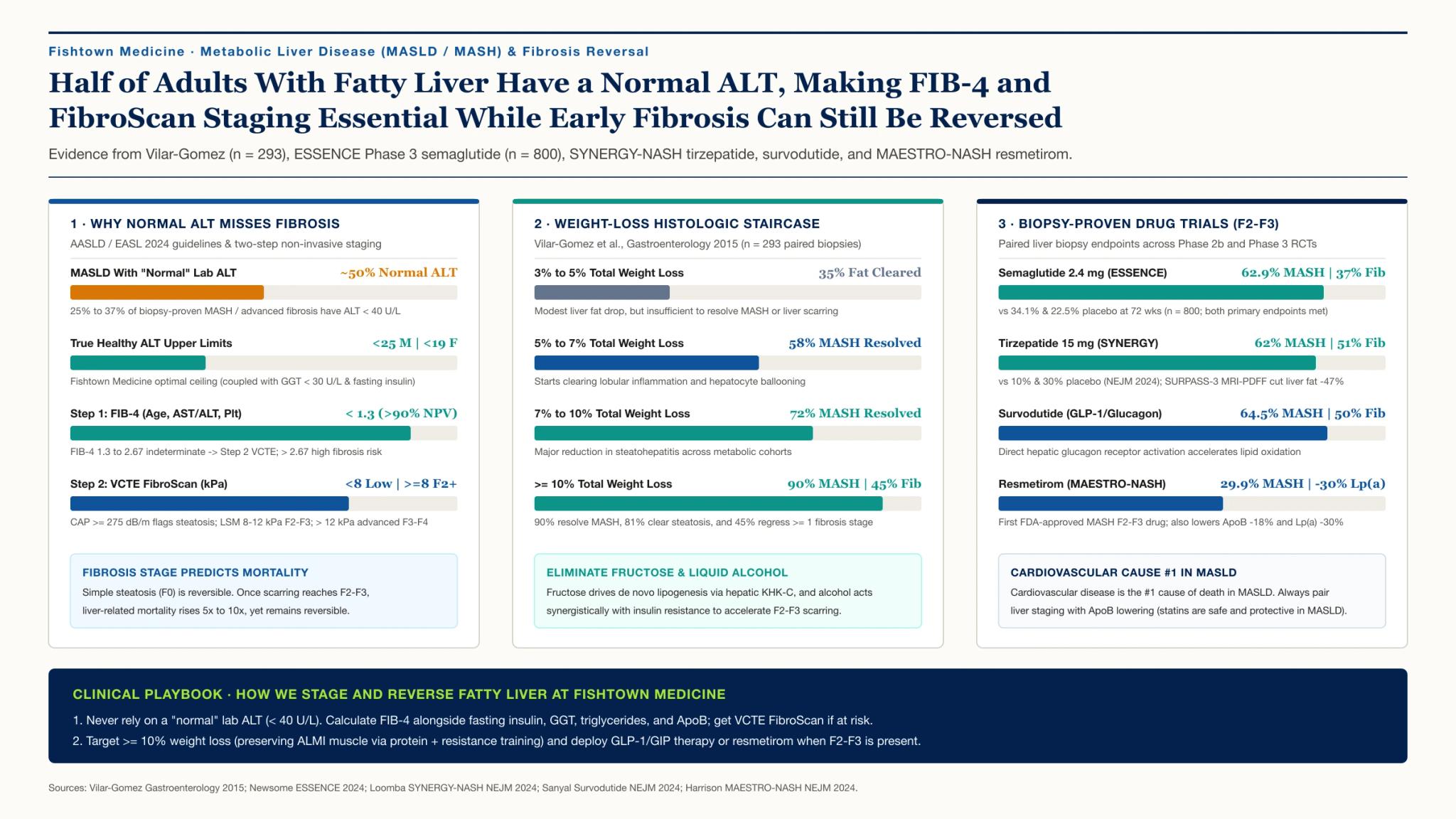
Fatty Liver (MASLD & MASH): Why Normal ALT Misses Fibrosis and How We Reverse It

How Does Survodutide's GLP-1 + Glucagon Mechanism Target the Liver Directly?

Survodutide pairs GLP-1 receptor action (which lowers appetite, slows stomach emptying, and supports insulin) with liver glucagon receptor action. That second signal tells liver cells to burn stored fatty acids directly.1,3

Why does adding glucagon matter so much for fatty liver (MASLD and MASH)?

  • Liver cells carry many glucagon receptors, but almost zero GLP-1 or GIP receptors: Semaglutide (Wegovy) and tirzepatide (Zepbound) heal the liver indirectly by shrinking belly fat and lowering whole-body insulin resistance. Survodutide does that work via GLP-1 (built at an 8:1 GLP-1-to-glucagon ratio so blood sugar stays steady) while also telling liver cells to burn fat and raise calorie burn.
  • Proof of a weight-independent liver effect (Noureddin et al., Hepatology 2026): In a mediation analysis of the Phase 2 MASH trial, 36.3 percent of survodutide's liver fibrosis gain was explained by weight loss, while 63.7 percent came from direct liver glucagon signaling.3

What Did the Phase 2 MASH Biopsy Trial and Phase 3 SYNCHRONIZE Trials Show?

Across the 48-week Phase 2 biopsy trial (Sanyal et al., NEJM 2024, n = 293 with biopsy-proven MASH and F1 to F3 fibrosis) and the 2026 Phase 3 SYNCHRONIZE trials, survodutide produced deep drops in liver fat and steatohepatitis:1,2,4

Trial & EndpointSurvodutide 2.4 mg (n = 73)Survodutide 4.8 mg (n = 72)Survodutide 6.0 mg (n = 74)Placebo (n = 74)Clinical Takeaway
Phase 2 Primary Endpoint: MASH Improvement (>= 2-pt NAS drop, no fibrosis worsening, 48 wk)47%62%43%14%p < 0.001 across all doses (up to 83% vs 18% in on-treatment completers).
Phase 2 Strict MASH Resolution (No fibrosis worsening)Active dose responseActive dose response49%11%Primary endpoint used NAS drop (>= 2 points); resolution was secondary.
Phase 2 Fibrosis Improvement (>= 1 stage, no MASH worsening)34%36%34%22%Secondary endpoint (50% to 52% vs 20% among F2-F3 completers).
Phase 2 Liver Fat Reduction >= 30% (MRI-PDFF)57%62%67%14%Fast liver fat clearance by week 48.
Phase 3 SYNCHRONIZE-MASLD (2026): Liver Fat Reduction >= 30%Pooled target dose: 84.2%Pooled target dosePooled target dose24.1%Non-biopsy Phase 3 trial in obesity + MASLD met fat and weight goals.
Phase 3 SYNCHRONIZE-1 (2026): Total Body Weight Change (76 wk)-16.6% (on-treatment) / -13% (ITT)Pooled target dosePooled target dose-3.0%~85% of patients lost >= 5% of total body weight.

Why did the 6.0 mg arm (43%) score lower than the 4.8 mg arm (62%) in the Phase 2 intent-to-treat chart? In the Phase 2 trial, doses were raised every 2 weeks (nausea 66%, vomiting 41%). That fast climb caused about 20 percent of patients to stop the drug early during titration, and early dropouts were counted as non-responders in the primary bar chart.1 Among patients who stayed on their maintenance dose (active-treatment analysis), response rose across doses (up to 83% MASH improvement). The Phase 3 LIVERAGE trials use a slower monthly dose climb.

How Does Survodutide Compare With Semaglutide, Resmetirom, Tirzepatide, and Retatrutide?

While survodutide is still in Phase 3 liver biopsy trials (LIVERAGE for F2-F3 and LIVERAGE-Cirrhosis for F4, n ≈ 1,590), we can map how its mechanism compares with FDA-approved and emerging options:1,5,6

  • vs. Semaglutide 2.4 mg (Wegovy, FDA-approved Aug 2025): Semaglutide (GLP-1 only) is already FDA-approved for F2-F3 MASH based on Phase 3 ESSENCE (62.9% vs 34.3% MASH resolution; 36.8% vs 22.4% fibrosis improvement; -10.5% weight loss) and has proven cardiovascular outcome protection (SELECT).
  • vs. Resmetirom (Rezdiffra, FDA-approved Mar 2024): Resmetirom is an oral, weight-neutral liver THR-beta agonist approved for F2-F3 MASH (MAESTRO-NASH: 25.9 to 29.9% vs 9.7% MASH resolution; 24.2 to 25.9% vs 14.2% fibrosis improvement; -13.6 to -16.3% LDL-C).
  • vs. Tirzepatide (Zepbound, Phase 2 SYNERGY-NASH): Tirzepatide (GIP + GLP-1) drives deeper weight loss (up to -15.7% at 52 weeks in SYNERGY-NASH, 44 to 62% vs 10% MASH resolution, 51 to 55% vs 30% fibrosis improvement) without direct hepatic glucagon receptors.
  • vs. Retatrutide (GIP + GLP-1 + Glucagon Triple Agonist): Retatrutide combines all three receptors, producing the largest total weight loss (~24% in Phase 2) and > 80% relative liver fat reduction on MRI-PDFF, while survodutide focuses specifically on GLP-1 + glucagon with a dedicated Phase 3 biopsy and cirrhosis program (LIVERAGE).

What Are the Trade-Offs and Safety Signals to Watch?

  1. Gastrointestinal tolerability during titration: In Phase 2, rapid 2-week dose steps caused nausea in 66%, diarrhea in 49%, and vomiting in 41% of patients, driving a 20% discontinuation rate.1 Slower 4-week titration steps are standard in Phase 3.
  2. Modest heart-rate elevation from glucagon: Because glucagon receptors are also present on sinoatrial pacemaker cells in the heart, survodutide raises resting heart rate by ~2 to 4 beats per minute in a dose-dependent manner. Long-term cardiovascular safety is being evaluated in the Phase 3 SYNCHRONIZE-CVOT trial.
  3. Investigational status (FDA Breakthrough Therapy, not yet FDA-approved): A Breakthrough Therapy Designation accelerates FDA review once Phase 3 trials finish, but survodutide cannot be prescribed outside clinical trials today.

Guidance from the Clinic

Dr. Ash
"The reason hepatologists and internists watch survodutide so closely is that 63.7% of its Phase 2 fibrosis signal came from direct liver glucagon action, independent of weight loss. While we wait for the Phase 3 LIVERAGE biopsy readouts, we do not wait to treat your liver: we stage your FIB-4 and FibroScan today, build muscle, cut liquid fructose, and use FDA-approved semaglutide 2.4 mg or resmetirom whenever F2-F3 scarring (8 to 15 kPa) is present."

Actionable Steps in Philly

Act on proven MASH staging and treatments today.

  1. Stage your liver without a biopsy: Run a FIB-4 score (Age, AST, ALT, Platelets) and a FibroScan (VCTE) (< 8 kPa rules out advanced fibrosis; 8 to 15 kPa identifies the F2 to F3 pharmacotherapy zone).
  2. Target >= 10% weight loss (3 to 5% in lean MASLD) while protecting muscle: Every 1% of body weight lost raises MASH resolution odds by +7% and fibrosis regression by +4% (Monami 2026).
  3. Use FDA-approved F2-F3 medications now when indicated: Choose weekly semaglutide 2.4 mg (Wegovy) when obesity, diabetes, or cardiovascular risk coexist, or daily resmetirom (Rezdiffra) for weight-neutral liver THR-beta activation.

Related at Fishtown Medicine

  • The New Weight-Loss Drugs, Compared - where survodutide fits in the whole field
  • Retatrutide: The Triple Agonist - the glucagon-containing drug with the highest weight loss
  • CagriSema (Cagrilintide + Semaglutide) - the amylin combination, another next-wave drug
  • Semaglutide (Wegovy) for MASH - an approved GLP-1 for fatty liver
  • Resmetirom (Rezdiffra): The First MASH Drug - the liver-direct drug already approved
  • Fatty Liver (MASLD/MASH) - the disease and the metabolic work underneath it
  • Mazdutide (GLP-1/Glucagon) - the other GLP-1/glucagon drug, approved in China

Scientific References

  1. Sanyal AJ, Bedossa P, Fraessdorf M, et al. "A Phase 2 Randomized Trial of Survodutide in MASH and Fibrosis." The New England Journal of Medicine. 2024;391(4):311-319.
  2. Kaplan LM, Startseva E, le Roux CW, et al. "Survodutide in adults with obesity and metabolic dysfunction-associated steatotic liver disease: SYNCHRONIZE-MASLD, a randomized, double-blind, placebo-controlled phase 3 trial." Nature Medicine. 2026.
  3. Noureddin M, Sanyal AJ, Bedossa P, et al. "Weight Reduction-Dependent/-Independent Effects of Survodutide on Liver Endpoints: Mediation Analysis of a Phase 2 Trial in MASH." Hepatology. 2026.
  4. le Roux CW, et al. "Survodutide Once Weekly for the Treatment of Adults with Obesity (SYNCHRONIZE-1)." The New England Journal of Medicine. 2026.
  5. Sanyal AJ, Newsome PN, Kliers I, et al. "Phase 3 Trial of Semaglutide in Metabolic Dysfunction-Associated Steatohepatitis (ESSENCE)." The New England Journal of Medicine. 2025;392(17):1608-1618.
  6. Harrison SA, Bedossa P, Guy CD, et al. "A Phase 3, Randomized, Controlled Trial of Resmetirom in NASH with Liver Fibrosis (MAESTRO-NASH)." The New England Journal of Medicine. 2024;390(6):497-509.

Medical Disclaimer: This resource provides clinical context for educational purposes and is not medical advice. Survodutide is investigational and not FDA-approved; nothing here is a recommendation to seek or use it. In Precision Medicine there is no one-size-fits-all; any treatment plan must be matched to your history, labs, and goals. Consult Dr. Ash or your own physician about your metabolic and liver health.
Ashvin Vijayakumar MD (Dr. Ash)

Fishtown Medicine | Metabolism

2418 E York St, Philadelphia, PA 19125·(267) 360-7927·hello@fishtownmedicine.com·HSA/FSA Eligible

Start your intake

Frequently Asked Questions

Common Questions

No. Survodutide is currently an investigational medication in Phase 3 clinical trials (LIVERAGE and SYNCHRONIZE). It holds an FDA Breakthrough Therapy Designation for non-cirrhotic MASH with F2-F3 fibrosis, while the two drugs currently FDA-approved for F2-F3 MASH are resmetirom (Rezdiffra) and semaglutide 2.4 mg (Wegovy).
In 293 adults with biopsy-confirmed MASH (F1-F3) treated for 48 weeks (Sanyal et al., NEJM 2024), the primary endpoint (>= 2-point NAS reduction with no worsening of fibrosis) was achieved by 47 percent (2.4 mg), 62 percent (4.8 mg), and 43 percent (6.0 mg) of patients versus 14 percent on placebo (p < 0.001). Fibrosis improved by at least one stage in <strong>34 to 36 percent across doses versus 22 percent on placebo.<sup>1</sup>
In SYNCHRONIZE-MASLD (Kaplan et al., Nature Medicine 2026), a randomized Phase 3 trial in adults with obesity and non-invasively defined MASLD, 84.2 percent of patients treated with survodutide achieved at least a 30 percent reduction in liver fat (MRI-PDFF) compared with 24.1 percent on placebo.<sup>2</sup>
Semaglutide activates GLP-1 receptors alone, and tirzepatide activates GIP and GLP-1 receptors; neither receptor is expressed at meaningful levels on human hepatocytes. Survodutide pairs GLP-1 with glucagon receptor agonism, which directly stimulates liver cells to oxidize stored fat and increases whole-body energy expenditure.

Deep-Dive Questions

The Phase 2 trial (Sanyal et al., NEJM 2024) defined its primary endpoint as a >= 2-point decrease in the NAFLD Activity Score (NAS) with at least a 1-point drop in lobular inflammation or hepatocyte ballooning and no worsening of fibrosis (47% / 62% / 43% vs 14%), which is a slightly broader endpoint than complete disappearance of ballooning (MASH resolution). On the stricter secondary endpoint of complete MASH resolution without worsening of fibrosis, survodutide 6.0 mg achieved 49 percent versus 11 percent on placebo.<sup>1</sup>
In a 2026 participant-level mediation analysis of the Phase 2 biopsy trial (Noureddin et al., Hepatology 2026), weight loss accounted for 36.3 percent of survodutide's effect on liver fibrosis improvement, whereas 63.7 percent was weight-independent, supporting a direct intrahepatic antifibrotic and lipolytic effect from glucagon-receptor signaling.<sup>3</sup>
LIVERAGE is the pivotal Phase 3 double-blind randomized trial evaluating weekly survodutide on paired liver biopsy endpoints (MASH resolution and fibrosis regression at 52 weeks) and long-term liver outcomes in adults with non-cirrhotic MASH and F2-F3 fibrosis. Its companion trial, LIVERAGE-Cirrhosis (n ≈ 1,590), tests whether survodutide delays hepatic decompensation, transplant, and all-cause mortality in patients who already have compensated MASH cirrhosis (F4).

Ready when you are

Start your intake

The chat is our AI assistant, answering from our published guides. To talk it through with Dr. Ash himself, start with the intake.


Related Intelligence

Performance Physical Philadelphia: 4 Tests That Predict How You Age

Performance Physical Philadelphia: 4 Tests That Predict How You Age

A performance physical measures how well you are aging: VO2 max, grip strength, mobility, and body composition - the 4 tests that predict healthspan.

Read Deep Dive
Healthspan vs Lifespan: Why Living Longer Is Not Enough | Philadelphia

Healthspan vs Lifespan: Why Living Longer Is Not Enough | Philadelphia

Americans live to about 78 but spend the last 12 years sick and dependent. A Philadelphia primary care practice on why healthspan is the better metric.

Read Deep Dive
Accidental Death Prevention Philadelphia | The Missing Horseman of Medicine 3.0

Accidental Death Prevention Philadelphia | The Missing Horseman of Medicine 3.0

The number one cause of death for people under 45 is not cancer or heart disease. It is accidental injury. How to prevent the unforced error in your longevity plan.

Read Deep Dive

New patients

Talk it through with Dr. Ash.

Share where your weight and energy are now, what you have tried, and what you want the next year to look like. Dr. Ash reads every intake personally.

HSA/FSA eligible
No initiation or cancellation fees
No copays
Tell Dr. Ash what’s going on →
FishtownFish wrapped around the rod of AsclepiusMedicine
Preventive Primary Care
2418 E York St, Philadelphia, PA 19125(267) 360-7927Primary care in PhiladelphiaHome visits in Greater PhiladelphiaPricing & MembershipGER·O·SPAN: our clinical frameworkDigital Health LiteracyClinical Evidence & Research

Serving Fishtown · Northern Liberties · East Kensington · Olde Richmond · Port Richmond · Old City · Callowhill · Poplar · Center City · Center City West · Art Museum · Bella Vista · Chestnut Hill · Fairmount · Fitler Square · Graduate Hospital · Logan Square · Manayunk · Queen Village · Rittenhouse · Roxborough · Society Hill · Southwark · Bryn Mawr, PA · Gladwyne, PA · Villanova, PA · Wayne, PA · Cherry Hill, NJ · Haddonfield, NJ · Medford, NJ · Moorestown, NJ · Voorhees, NJ

Explore by topic

Women’s Health
  • Perimenopause
  • Menopause 3.0
  • PCOS
  • Fertility
Men’s Health
  • Testosterone (TRT)
  • Sleep Apnea & Low T
  • Andropause
  • Low Libido
Metabolic
  • Medical Weight Loss
  • Ozempic vs Metformin
  • Fasting Protocols
  • Visceral Fat
Cardiovascular
  • apoB & Heart Health
  • apoB vs LDL
  • Lp(a) Cholesterol
  • ED & Heart Risk
Longevity + Performance
  • Healthspan vs Lifespan
  • Biological Age
  • VO2 Max
  • Zone 2 Training
Supplements
  • Magnesium
  • Creatine
  • Omega-3
  • Foundational Stack
  • Supplement Guides

Tools, pricing & comparisons

Tools & Guides

  • Normal vs. Optimal Lab Checker
  • Curated Clinical Packets
  • Playbooks & Protocols
  • Clinical Evidence & Research
Pricing & Labs
  • Pricing & Membership
  • 90% Wholesale Quest Labs
  • Cost-Plus Meds & Labs
  • HSA & Open Enrollment Calculator
Compare
  • Primary Care Models
  • Concierge vs. DPC
  • vs. Function Health
  • vs. One Medical
  • vs. Parsley Health
  • Urgent Care Alternative
Who We Care For
  • Primary Care in Philadelphia
  • Hospitality Leadership
  • Philadelphia Dads
  • Sports Club Medicine
Care in Philadelphia +
Direct Primary Care in Philadelphia, PAConcierge Medicine in Philadelphia, PAConcierge vs DPC in Philadelphia, PALongevity Medicine in Philadelphia, PAPreventive Care in Philadelphia, PAExecutive Physical in Philadelphia, PAAnnual Physical in Philadelphia, PAHealthspan Optimization in Philadelphia, PAFunctional Medicine in Philadelphia, PASame-Day Sick Visits in Philadelphia, PATestosterone Replacement Therapy in Philadelphia, PAPerimenopause Care in Philadelphia, PAMenopause Care in Philadelphia, PAThyroid Treatment in Philadelphia, PAPCOS Care in Philadelphia, PAGLP-1 Weight Loss in Philadelphia, PAMetabolic Health in Philadelphia, PAHormone Optimization in Philadelphia, PAAdvanced Lipid Testing in Philadelphia, PAVO2 Max Testing in Philadelphia, PADEXA Scan in Philadelphia, PACGM in Philadelphia, PALong COVID Care in Philadelphia, PAChronic Fatigue Treatment in Philadelphia, PAPOTS Treatment in Philadelphia, PAMCAS Treatment in Philadelphia, PALyme Disease Care in Philadelphia, PABrain Fog Treatment in Philadelphia, PASleep Disorders Treatment in Philadelphia, PAStrep Throat Treatment in Philadelphia, PAUTI Treatment in Philadelphia, PASinus Infection Treatment in Philadelphia, PASTI Testing in Philadelphia, PATravel Medicine in Philadelphia, PAPre-Op Clearance in Philadelphia, PASports Club Medicine in Philadelphia, PA

Made it this far? You’re already most of the way there. let’s get started → Dr. Ash reads every word personally.

Content is for educational purposes only and does not constitute medical advice.

TermsPrivacyScope of PracticeClinical IndependenceCare NetworkResearch & Monographs