

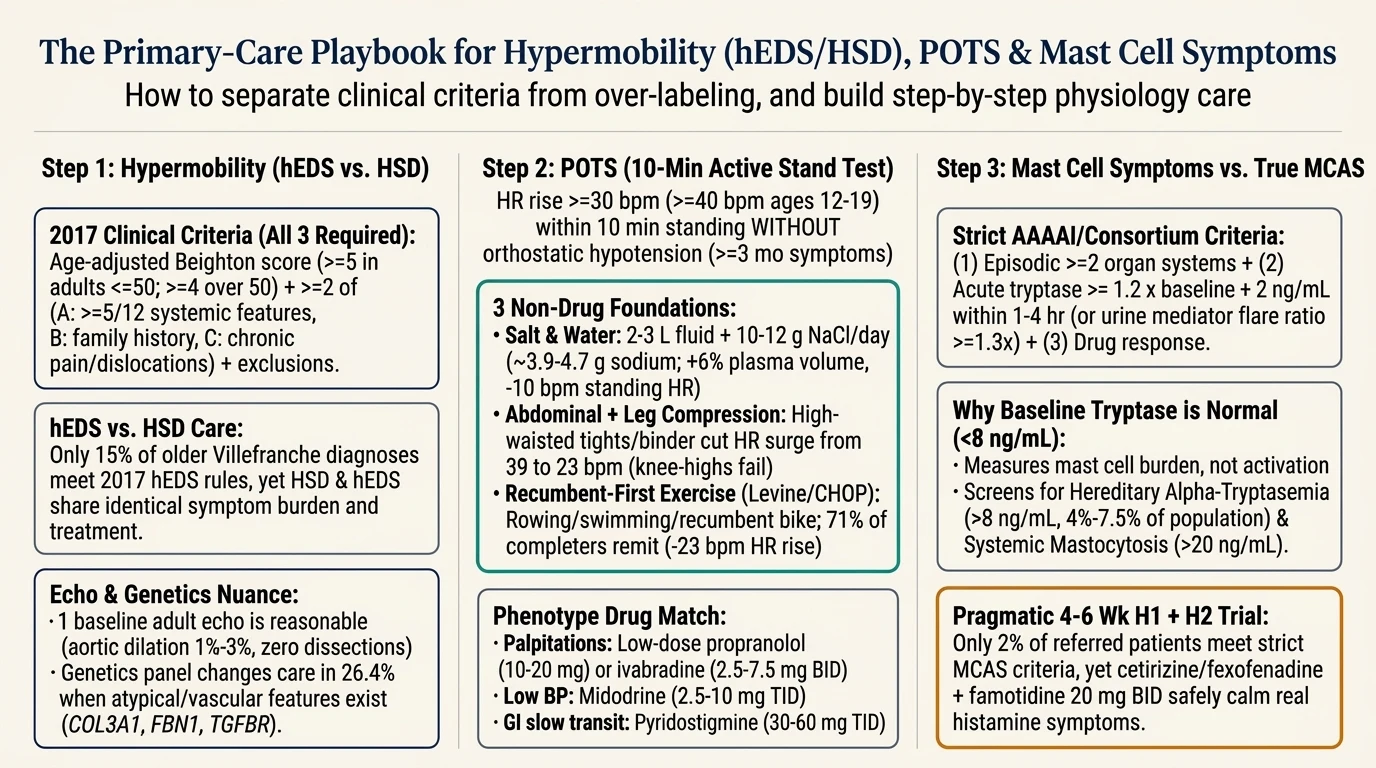
Mast Cell Activation Syndrome (MCAS) is a condition where mast cells release histamine, tryptase, leukotrienes, and prostaglandins in episodic flares across two or more organ systems. Under the strict AAAAI / Valent Consensus-1 criteria (Weiler 2019; Gulen 2024), diagnosis requires episodic >= 2-organ flares, an acute serum tryptase rise >= (1.2 x baseline) + 2 ng/mL drawn 30 to 120 minutes into a flare (or a flare-to-baseline ratio >= 1.3 on 24-hour urine N-methylhistamine, 2,3-dinor-11beta-PGF2alpha, or LTE4), and response to stepwise H1/H2 blockers (cetirizine/fexofenadine + famotidine), montelukast, oral cromolyn, ketotifen, or omalizumab.
TL;DR: Mast Cell Activation Syndrome (MCAS) causes sudden, multi-organ flares such as flushing, hives, belly cramping, wheezing, or dizziness when mast cells dump histamine, tryptase, leukotrienes, and prostaglandins.
- Use the strict 3-part diagnostic rules: Diagnosis requires sudden flares in at least 2 organ systems at the same time, a lab jump during a flare (serum tryptase drawn 30 minutes to 2 hours into a flare that rises above 1.2 times baseline plus 2 ng/mL, or a 24-hour urine mediator flare-to-baseline ratio of at least 1.3), and symptom relief on mast-cell medications.
- Understand what a normal baseline tryptase means: Baseline tryptase measures total mast cell burden, not acute firing, and is under 8 ng/mL in about 85% of idiopathic MCAS. When baseline tryptase is over 8 ng/mL, we test for Hereditary Alpha-Tryptasemia (TPSAB1) and clonal mast cell disease (KIT D816V).
- Follow the 4-step treatment ladder: Carry an Epinephrine 0.3 mg/0.3 mL Auto-Injector if at risk for anaphylaxis; start Step 1 H1 blockers (cetirizine or fexofenadine) plus an H2 blocker (famotidine 20 to 40 mg twice daily), Step 2 montelukast 10 mg plus oral cromolyn (stepped up to 200 mg four times daily), Step 3 compounded ketotifen (1 to 4 mg), and Step 4 omalizumab (150 to 300 mg every 2 to 4 weeks) for severe anaphylaxis or hives.
A 34-year-old architect from Queen Village walked into our office eating only plain white rice, roasted chicken, and water after an online checklist convinced her that every food in her kitchen triggered mast cell flares. Her prior workup had skipped the two tests that settle the question. She had never been given a standing lab slip to draw an acute serum tryptase within two hours of a two-organ flare (>= 1.2x baseline + 2 ng/mL), and her baseline tryptase of 11.2 ng/mL (> 8 ng/mL) had never been checked for hereditary alpha-tryptasemia (TPSAB1) or KIT D816V. Separating strict AAAAI mast cell rules from everyday gut triggers, starting cetirizine, famotidine, and pre-meal oral cromolyn, and adding back foods one by one got her eating twenty-five whole foods within two months.
What is the bucket theory of histamine load?
Histamine and mast cell flares behave like an overflowing bucket: symptoms appear when total triggers from food, heat, stress, hormones, and infections exceed the body's enzymatic clearance (DAO and HNMT).
Imagine a bucket with a drain at the bottom. Water pours in from many places. As long as the water stays below the rim, you feel fine. When the inflow beats the drain, the bucket spills over and you flare.
Inputs to the bucket:
- Histamine in food: Aged cheeses, cured meats, fermented foods, leftovers, alcohol, and canned fish (tuna, mackerel).
- Heat: Hot showers, humid summer days, or hard workouts.
- Stress: Sudden or ongoing stress raises CRH and cortisol, which prod mast cells.
- Infection: Recent viral illness (COVID, EBV).
- Hormone shifts: Estrogen prods mast cells; many women flare mid-cycle and in perimenopause.
- Irritants: Mold, strong fragrances, or NSAID painkillers.
Outflows from the bucket:
- DAO enzyme in the gut lining, which breaks down food histamine.
- HNMT enzyme inside cells, which clears histamine in tissues.
- Deep sleep, rest, and vagus nerve tone.
Our goal is to lower the inflow, open the drain, and calm the mast cells.
What is the diagnostic workup for MCAS (AAAAI / Valent Consensus-1 vs. Consensus-2)?
Under the Valent / ECNM-AIM and Weiler / AAAAI (2019) guidelines (Gulen 2024; AGA 2025), all three strict Consensus-1 rules are required to diagnose MCAS: episodic flares in >= 2 organ systems, an acute flare mediator rise (>= 1.2x baseline + 2 ng/mL serum tryptase or >= 1.3 urine flare-to-baseline ratio), and response to mast-cell therapy.
- Clinical Rule (Episodic >= 2-Organ Flares & REMA Score): Recurrent flares hitting at least 2 organ systems at the same time (skin flushing/hives/swelling, gut cramping/diarrhea, airway wheezing/throat tightness, or low blood pressure/near-fainting). Daily fatigue or steady pain alone points to other causes (Weiler et al., JACI 2019). For patients with anaphylaxis or syncope, we calculate the Spanish Network on Mastocytosis (REMA) score, where a score of >= 2 points predicts clonal mast cell disease with 0.92 sensitivity and 0.81 specificity (Gulen 2024; Golden et al., AAAAI 2024).
- Lab Rule (Acute Flare Jump Over Baseline):
- Acute vs. Baseline Serum Tryptase (Gold Standard, > 90% Specificity): Draw an acute blood sample 30 minutes to 2 hours (up to 4 hours) after a flare starts and compare it with a baseline blood sample drawn >= 24 hours after all symptoms stop. A positive jump is >= (1.2 x baseline tryptase) + 2 ng/mL (Valent et al., 2019).
- Paired 24-Hour Urine Mediators (Flare-to-Baseline Ratio >= 1.3): Urine N-methylhistamine, 2,3-dinor-11beta-PGF2alpha, and leukotriene E4 (LTE4) must be compared between an acute flare and baseline. A flare-to-baseline ratio of >= 1.3 supports mast cell activation, whereas a single baseline urine test alone does not diagnose MCAS (Butterfield 2023; Voelker 2024).
- Why We Skip Loose "Consensus-2" Checklists (Buttgereit 2022; Yao 2024; Farley 2025; Aziz AGA 2025): Loose "Consensus-2" checklists count single baseline lab bumps and 153 broad symptoms, causing massive overdiagnosis. In a prospective study of 100 patients referred for suspected MCAS (Buttgereit et al., Allergy 2022), only 2% met strict consortium criteria. In Yao et al. (Front Neurol 2024), MCAS prevalence among young POTS patients was 87% on symptoms alone, 37% under Consensus-2, and 2% under strict Consensus-1. A 2025 systematic review (Farley et al., 2025) found zero studies confirming an MCAS-POTS-EDS link using strict criteria and zero lab evidence of a direct cellular pathway from hEDS to mast cell degranulation. That is why the 2025 AGA Clinical Practice Update (Aziz et al.) advises against routine MCAS testing in hEDS unless episodic symptoms hit at least 2 organ systems.
- Response Rule (With Pragmatic Caveat): Clear symptom relief on mast-cell drugs (H1/H2 blockers, montelukast, or cromolyn). Note that feeling better on a 4-to-6-week H1 + H2 blocker trial can also reflect chronic hives, acid reflux, or placebo, so clinical response alone does not confirm formal MCAS without the acute flare lab jump.
Why Baseline Serum Tryptase Is Normal (< 8 ng/mL) in ~85% of Idiopathic MCAS
- Burden vs. Activation: Baseline serum tryptase measures total mast cell burden, not acute firing, and is < 8 ng/mL in ~85% of patients with idiopathic MCAS (raised in only ~15%). Its main job at baseline is screening for Hereditary Alpha-Tryptasemia (HaT, > 8 ng/mL) and Systemic Mastocytosis (> 20 ng/mL minor criterion).
- Hereditary Alpha-Tryptasemia (HaT): Extra copies of the TPSAB1 gene show up in 4% to 7.5% of the general population and push baseline tryptase > 8 ng/mL (Luskin 2021). Controlled studies (Chollet & Akin, JACI 2022; Lyons, 2025; Farley, 2025) and POTS cohorts (only 7.2% of 493 POTS patients had tryptase >= 8 ng/mL, Castells 2024) show no true excess over the general public.
- Clonal Mast Cell Disease (PROSPECTOR Study, Hartmann et al., JACI 2026): High-sensitivity blood KIT D816V testing found clonal mast cell disease in 8% of patients with anaphylaxis or mast-cell flares - and 80% of KIT D816V-positive cases had a baseline tryptase < 20 ng/mL. A positive KIT D816V test or REMA score >= 2 calls for a bone marrow evaluation for systemic mastocytosis.
What is the strategic roadmap for MCAS treatment?
We pair a brief 3-to-4-week low-histamine trial with a 4-step medication ladder (H1 + H2 blockers, montelukast + oral cromolyn, ketotifen, and omalizumab), then reintroduce foods systematically.
Phase 1: Lowering the Inflow (Diet and Environment)
A short-term low-histamine diet calms the gut enough to start treatment. We use it for a brief 3-to-4-week window, then add foods back one at a time, much like the AIP elimination protocol when immune triggers are broader than histamine alone.
- Pause for 3 to 4 weeks: aged cheeses, cured meats, fermented foods, leftovers kept over 24 hours, alcohol (above all wine), tomato, spinach, eggplant, avocado, citrus, chocolate, and vinegar.
- Eat fresh meats (chicken, lamb, turkey, fresh fish), fresh produce (zucchini, cucumber, lettuce, apple, pear, blueberry), rice, oats, and fresh herbs.
- Cook fresh and freeze right away: Histamine builds up in cooked food stored in the fridge.
- Cut air triggers: Strong perfumes, scented candles, harsh bleach cleaners, and damp moldy rooms.
Phase 2: Stabilizing the Mast Cells (The 4-Step Ladder)
This is where most patients start to feel better.
Step 1: Antihistamines (Pragmatic 4-to-6-Week H1 + H2 Trial, Weiler AAAAI 2019)
- Emergency Rescue: Every patient at risk for anaphylaxis carries two Epinephrine 0.3 mg/0.3 mL Auto-Injectors (DAW-0 generic) and lies flat (supine) during low-BP flares (Weiler 2019).
- Non-Sedating H1 Blockers: Cetirizine 10 mg or fexofenadine 180 mg (or loratadine), stepped up to 2x to 4x the standard daily dose if needed (borrowed from chronic hives guidelines; kidney rule: if CrCl is 11 to 31 mL/min, cap cetirizine at 10 mg/day).
- H2 Blockers: Famotidine 20 to 40 mg twice daily for gut flares and blood vessel histamine blockade (kidney rule: lower the famotidine dose when CrCl < 60 mL/min to prevent confusion and QT changes).
Step 2 & Step 3: Leukotriene Blockers & Mast Cell Stabilizers
- Montelukast (10 mg daily, Step 2): Works best when urine LTE4 is high or wheezing and flushing stand out (Sabato 2024).
- Oral Cromolyn Sodium (Step 2, step up weekly to 200 mg four times daily): Taken 30 minutes before meals and at bedtime (Gastrocrom); calms gut cramping, diarrhea, and bloating over 2 to 6 weeks (Weiler 2019).
- Ketotifen (Step 3, 1 to 4 mg once or twice daily, compounded in the US): Calms both H1 receptors and mast cell release; can cause drowsiness.
- Titrated Aspirin (Step 3): Saved only for patients with prostaglandin D2 flushing and high urine 2,3-dinor-11beta-PGF2alpha who tolerate NSAIDs without wheezing or hives.
- Omalizumab (Step 4, 150 to 300 mg SC every 2 to 4 weeks): Anti-IgE antibody injection for severe anaphylaxis or hives (94% response rate in HaT cohorts, Giannetti et al., 2021).
- Quercetin (500 mg twice daily) & Luteolin (100 to 200 mg twice daily): Plant flavonoids used as gentle add-ons.
Fishtown Medicine
A 90-minute conversation with Dr. Ash. A written plan you can follow.
Histamine Clearance Support
- DAO enzyme capsules (Diamine Oxidase): Taken 15 minutes before meals to break down histamine in food.
- Vitamin C: 500 to 1,000 mg twice daily as a natural DAO helper.
- Vitamin B6 (P5P form): 25 mg daily (we avoid high-dose B6 above 50 mg/day to protect nerves).
Phase 3: Treating the Drivers
We look for and treat root triggers that keep mast cells jumpy:
- Tick or viral infections: Lyme, Bartonella, or Long COVID recovery.
- Water-damaged buildings: Fixing leaks and damp air.
- Hormone swings: Perimenopause or mid-cycle estrogen surges.
- Gut health: Treating SIBO or low iron (ferritin).
Phase 4: Reintroduction and Expansion
Once flares stay quiet for 6 to 8 weeks, we add foods back one at a time. Most patients return to a wide, enjoyable diet.
Guidance from the Clinic
"A normal baseline serum tryptase under 8 ng/mL does not mean your flushing and hives are imaginary - about 85% of people with idiopathic MCAS have a baseline tryptase under 8 ng/mL because baseline tryptase measures mast cell numbers, not acute firing. At the same time, only 2% of patients referred for suspected MCAS meet strict diagnostic criteria once tested. So we do two things at once: we give you a standing order to catch an acute flare tryptase within two hours of an attack, and we start a safe 4-to-6-week cetirizine and famotidine trial so you get symptom relief without shrinking your diet to five foods." - Ashvin Vijayakumar MD (Dr. Ash)
What are your actionable steps for suspected MCAS?
Start a 4-to-6-week H1 + H2 blocker trial with your doctor, carry a standing lab order for an acute flare tryptase (1.2x baseline + 2 ng/mL), and limit any low-histamine diet trial to 3 to 4 weeks.
- Start the Step-1 trial with your doctor: cetirizine 10 mg (or fexofenadine 180 mg) plus famotidine 20 mg twice daily for 4 to 6 weeks, noting that symptom relief helps guide care even before flare labs are captured.
- Try a 3-to-4-week low-histamine trial if meals trigger flares, then add foods back one by one.
- Cut air triggers: perfumes, scented candles, and harsh cleaners.
- Get baseline and paired flare labs: baseline serum tryptase plus a standing order for an acute flare tryptase drawn 30 minutes to 2 hours into a flare (>= 1.2x baseline + 2 ng/mL, Valent 2019; or a >= 1.3 urine flare-to-baseline ratio, Butterfield 2023), and check TPSAB1 (HaT) and blood KIT D816V if baseline tryptase beats 8 ng/mL (Hartmann 2026).
- Work with a doctor who uses the strict AAAAI / Valent rules.
Key Takeaways
- Strict 3-Part AAAAI / Valent Rules (Weiler 2019; Gulen 2024): Diagnose MCAS only when episodic flares hit >= 2 organ systems, acute flare labs rise (>= 1.2x baseline + 2 ng/mL serum tryptase or >= 1.3 urine mediator flare-to-baseline ratio, Butterfield 2023 / Voelker 2024), and symptoms respond to mast-cell therapy.
- Calibrate Prevalence & Baseline Tryptase: Only 2% of referred patients (Buttgereit 2022) and 2% of POTS patients (Yao 2024) meet strict MCAS criteria. Baseline serum tryptase is < 8 ng/mL in ~85% of idiopathic MCAS; when > 8 ng/mL (or REMA >= 2), test TPSAB1 for HaT (4% to 7.5% population prevalence) and peripheral-blood KIT D816V (PROSPECTOR 2026).
- 4-Step Treatment Ladder: Start a 4-to-6-week Step-1 H1 + H2 blocker trial (cetirizine/fexofenadine + famotidine), layer Step 2 montelukast 10 mg and oral cromolyn (200 mg QID), Step 3 compounded ketotifen (1-4 mg), and Step 4 omalizumab (150-300 mg SC q2-4w), while keeping low-histamine diet trials brief (3 to 4 weeks).
Related at Fishtown Medicine
- POTS and Dysautonomia Clinical Playbook - autonomic workup and why we choose ivabradine over beta-blockers when anaphylactic flares coexist
- Low-Dose Naltrexone Clinical Guide - neuroimmune dosing and titration when chronic pain or post-viral fatigue overlaps
- Negative Allergy Tests While Still Reacting - sorting IgE-mediated allergy from mast cell activation, HaT, and histamine intolerance
- Alpha-Gal Syndrome Guide - delayed reactions after tick exposure that mimic spontaneous histamine flares
Scientific References
- AAAAI & ECNM-AIM Strict MCAS Criteria: Weiler CR, Austen KF, Akin C, et al. "AAAAI Mast Cell Disorders Committee Work Group Report: Mast Cell Activation Syndrome (MCAS) Diagnosis and Management." J Allergy Clin Immunol. 2019;144(4):883-896; Valent P, et al. Int Arch Allergy Immunol. 2019;180(1):44-55; and Gulen T. Curr Allergy Asthma Rep. 2024.
- Consensus-1 vs. Consensus-2 Specificity & AGA 2025 Update: Buttgereit T, et al. Allergy. 2022;77(9):2794-2802; Yao L, et al. Front Neurol. 2024; Solomon Y, Khatri L. JACI. 2025; Farley M, et al. Ann Allergy Asthma Immunol. 2025; and Aziz Q, Harris LA, Goodman BP, Simrén M, Shin A (AGA Clinical Practice Update). Clin Gastroenterol Hepatol. 2025.
- Clonal Mast Cell Disease (PROSPECTOR) & HaT (TPSAB1): Hartmann K, Gotlib J, Akin C, et al. "Prevalence of KIT D816V and Clonal Mast Cell Disease in Patients With Anaphylaxis and Mast Cell Activation Symptoms (PROSPECTOR)." J Allergy Clin Immunol. 2026; Luskin KT, et al. JACI Pract. 2021; Chollet MB, Akin C. JACI. 2022; and Giannetti MP, et al. (Omalizumab in HaT). JACI Pract. 2021.
- Urine Mediator Flare Ratios & Anaphylaxis Parameter: Butterfield JH, et al. JACI Pract. 2023; Voelker D, et al. JACI. 2024; and Golden DBK, Wang J, Waserman S, et al. "Anaphylaxis: A 2023 Practice Parameter Update." Ann Allergy Asthma Immunol. 2024;132(2):124-176.
Conclusion
You have been walking through this maze alone, cutting out more and more foods. We help you test the right markers, calm the mast cells, and expand your plate again.
Tell Dr. Ash what's going on. Let's empty the bucket.

Frequently Asked Questions
Common Questions
Deep-Dive Questions
Ready when you are
The chat is our AI assistant, answering from our published guides. To talk it through with Dr. Ash himself, start with the intake.