

Postural Orthostatic Tachycardia Syndrome (POTS) is a form of autonomic dysfunction where heart rate rises 30+ beats per minute on standing (40+ in ages 12 to 19) without a drop in blood pressure for at least 3 months (CCS 2020; JAMA 2026). The POTS Strategy covers diagnosis (10-minute active stand test), volume expansion (2 to 3 liters of water plus 10 to 12 grams of salt / ~4 to 5 grams of sodium), abdominal and waist-high compression, recumbent-first exercise progression (dropping average standing heart rate rise from 46 to 23 bpm), and phenotype-matched medications (low-dose propranolol, generic ivabradine, midodrine, pyridostigmine, or fludrocortisone) while avoiding routine chronic IV saline (HRS Class III - Harm).
TL;DR: Postural Orthostatic Tachycardia Syndrome (POTS) is diagnosed when a 10-minute stand test shows a sustained heart rate rise of 30 beats per minute or more (40 or more at ages 12 to 19) without a blood pressure drop, paired with at least 3 months of standing symptoms.
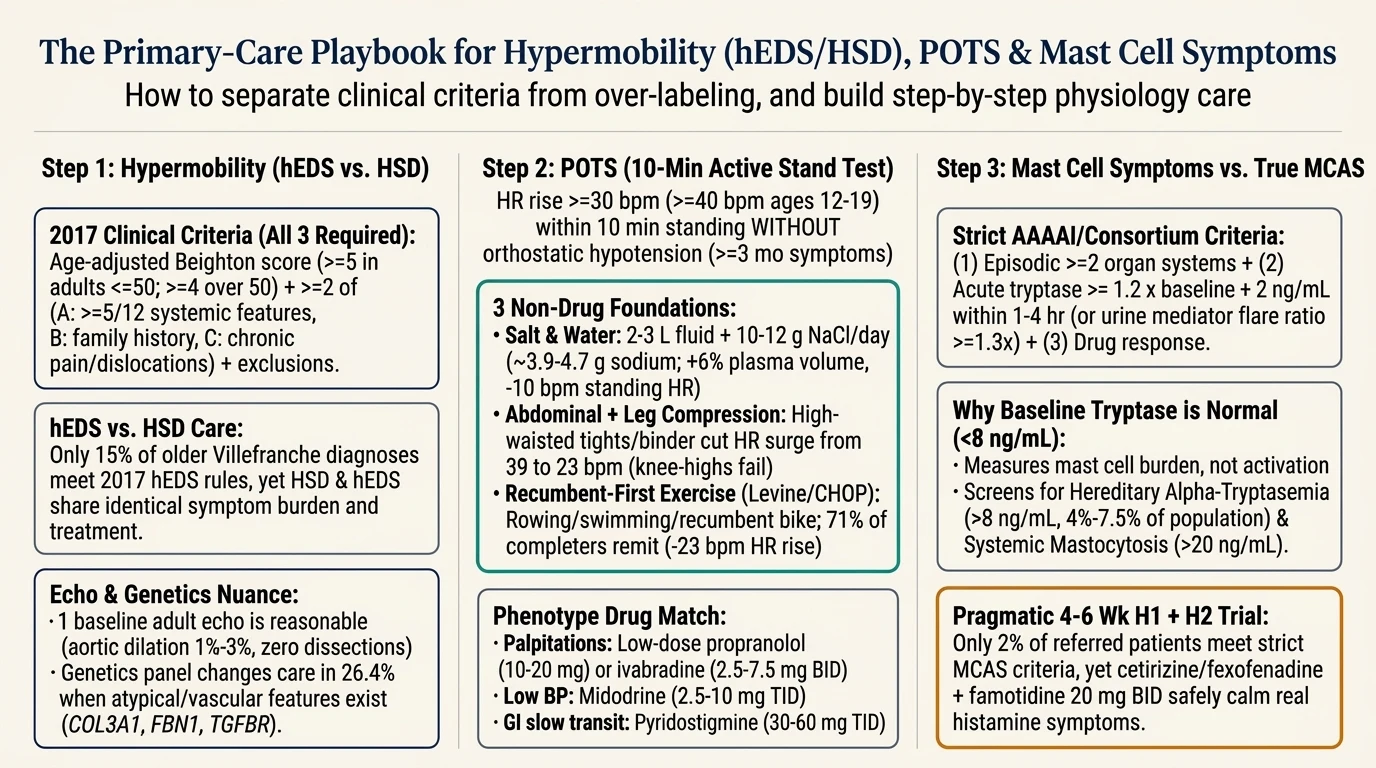
- Build the non-drug foundation first: Target 2 to 3 liters of water plus 10 to 12 grams of table salt per day (about 4 to 5 grams of sodium), abdominal compression with high-waisted tights or a belly binder, and a 3-month recumbent exercise plan on a rower, recumbent bike, or pool.
- Match medications to your main symptom: Use low-dose immediate-release propranolol (10 to 20 mg) or generic ivabradine (2.5 to 7.5 mg twice daily, preferred over beta-blockers when anaphylactic MCAS coexists) for a racing pulse, midodrine (2.5 to 10 mg three times daily) for low blood pressure, pyridostigmine (30 to 60 mg three times daily) when constipation coexists, and fludrocortisone (0.1 to 0.2 mg daily) for low blood volume.
- Skip routine chronic IV saline: Save IV saline strictly for short-term acute rescue because central venous catheters carry high infection and blood clot risks.
A 26-year-old graphic designer in Fishtown came to my office after two emergency room visits and a normal resting echocardiogram left her with a discharge label of panic disorder because her pulse hit 128 bpm every morning while brushing her teeth. When we laid her flat for ten minutes and ran a simple bedside active stand test, her pulse climbed from 72 bpm supine to 114 bpm by minute five while her blood pressure held steady at 106/70 mmHg - proving in ten minutes that gravity and venous pooling, not panic, were driving her racing heart. Starting 4.5 grams of elemental sodium (~11 grams of table salt), 3 liters of water, high-waisted abdominal compression tights, and recumbent rowing brought her standing heart rate down into the 80s within six weeks.
What is happening in POTS?
POTS is defined by a sustained heart rate rise of 30 beats per minute or more (40 or more in ages 12 to 19) within 10 minutes of standing, without orthostatic hypotension (>= 20/10 mmHg blood pressure drop), accompanied by at least 3 months of standing symptoms (CCS 2020; Chung & Raj, JAMA 2026; updated from > 6 months in HRS 2015).
Several overlapping mechanisms can produce this pattern:
1. Hypovolemia (Low Blood Volume)
Many POTS patients have a measurably lower blood volume than healthy controls. Standing causes blood to pool in the lower extremities and abdomen, leaving less blood to return to the heart and brain. The heart beats faster to keep up.
2. Neuropathic POTS
Small fiber nerve injury in the legs and pelvis weakens the reflex squeeze that normally pushes blood back up to the heart when you stand. This pattern often follows a viral illness or autoimmune trigger.
3. Hyperadrenergic POTS
The nervous system releases extra norepinephrine on standing, driving the pulse and blood pressure up and causing shakiness, sweating, and a racing heart. Standing norepinephrine levels above 600 pg/mL support this subtype.
4. Secondary & Overlapping Conditions
POTS often develops after viral infections (Long COVID, EBV) or alongside joint hypermobility (hEDS or HSD) and mast cell flares (MCAS).
What does the diagnostic workup look like?
A bedside 10-minute active stand test confirms the diagnosis in primary care, paired with an ECG and targeted blood tests (ferritin, TSH, morning cortisol, CBC, CMP, B12, and vitamin D) to rule out mimics.
Bedside Diagnostic Tests
- 10-minute active stand test (or NASA Lean Test): After 5 to 10 minutes lying flat and quiet, take two consecutive baseline readings 1 minute apart (
Supine 1 minandSupine 2 min). Then have the patient stand barefoot with heels 6 inches (15 cm) from the wall and only the shoulder blades touching the wall (buttocks clear of the wall, arms relaxed at sides) to turn off the calf-muscle pump, recording heart rate, blood pressure, and symptoms atStanding 0 minand every 1 minute throughStanding 10 min. A sustained pulse rise of >= 30 bpm (>= 40 bpm at ages 12 to 19) without a >= 20/10 mmHg blood pressure drop confirms POTS when standing symptoms have lasted >= 3 months (CCS 2020; JAMA 2026). Morning testing is most sensitive. In patients with overlapping ME/CFS and post-exertional malaise, the 10-minute lean test also screens for narrowed pulse pressure (< 25% of systolic) and delayed orthostatic hypotension. - Head-up tilt table test: Used in cardiology or autonomic clinics when the bedside stand test is borderline or syncope needs evaluation.
 Positioning photographs and 10-minute lean test instructions courtesy of the Bateman Horne Center (NASA 10-Minute Lean Test PDF).
Supportive Workup
- 12-lead ECG and patch monitor: Rules out heart rhythm blocks, pre-excitation, or supraventricular tachycardia.
- Mimic blood panel: CBC, CMP, TSH, morning cortisol, vitamin B12, vitamin D, and ferritin (replete to >= 50 ng/mL, since iron deficiency worsens tachycardia and fatigue).
- Selective comorbidity checks (AGA 2025): Score the 9-point Beighton exam and 2017 Malfait criteria when joints are hypermobile. Order a baseline serum tryptase and a standing acute flare tryptase slip only if episodic symptoms hit at least 2 organ systems (Aziz et al., AGA 2025; in Yao et al., 2024, only 2% of young POTS patients met strict Consensus-1 MCAS criteria).
- Targeted echocardiogram: Ordered for heart murmurs, chest symptoms, or hEDS Feature A scoring (modern cohorts find mild aortic dilation in 1% to 3% of hEDS/HSD patients with zero dissections; Asher 2018; Rashed 2022).
What is the strategic roadmap for POTS treatment?
We start all patients on Phase 1 volume expansion, Phase 2 abdominal compression, and Phase 3 recumbent exercise at Visit 1, then add one phenotype-matched Phase 4 medication at 4 to 6 weeks if standing symptoms remain limiting.
Phase 1: Volume Expansion (Foundation)
Volume expansion is the single most important intervention. Medications work poorly until blood volume is rebuilt.
- Sodium vs. Salt (HRS Class IIb; Garland et al., JACC 2021): Guidelines recommend 10 to 12 grams of salt (NaCl) per day, which equals ~3,900 to 4,700 mg (~3.9 to 4.7 g, or 170 to 205 mmol) of elemental sodium. In a randomized crossover trial (Garland et al., JACC 2021), high dietary sodium expanded plasma volume by ~6% and lowered standing heart rate by ~10 bpm. Always check whether an electrolyte label lists milligrams of sodium or grams of salt.
- Water: 2 to 3 liters per day minimum, starting with a 500 mL (16 oz) water bolus before getting out of bed (-15 bpm standing heart rate).
- WHO Oral Rehydration Salts (TriOral): When table salt upsets the stomach or chugging plain water triggers nausea, one unflavored TriOral packet mixed into 1 liter of water delivers 1,695 mg (about 1,700 mg) sodium, 780 mg potassium, 13.5 g glucose, and 2.9 g trisodium citrate (zero citric acid, stevia, or dyes for comorbid MCAS). The 1:1 sodium-to-glucose ratio turns on the small intestine's SGLT1 pump to expand blood volume as effectively as 1 liter of IV normal saline (Medow 2019) at roughly $0.42 per liter. Chill it or add a splash of lemonade flavoring or tart cherry juice to mask the salt taste.
- Other electrolyte mixes: LMNT (1,000 mg sodium per stick, zero sugar), Vitassium salt capsules (250 mg sodium per capsule), or homemade sodium-potassium solutions.
- Crash-day bedside bottle (spill-resistant bite valve): On POTS or ME/CFS crash days when you sleep long stretches and wake volume-depleted, keep a 1-liter spill-resistant bite-valve bottle on the mattress so you can take small sips while lying flat before sitting up.
- Salt loading at key times: 16 oz water with 1 gram sodium upon waking, before exercise, and before prolonged standing.
Phase 2: Mechanical Compression (Abdomen Coverage Beats Rigid Stockings)
External compression squeezes pooled blood in the belly and pelvis back toward the heart:
- Cover the abdomen first (Bourne et al., JACC 2021 & Can J Cardiol 2026): The splanchnic (belly and pelvic) veins hold the largest pool of blood on standing. In randomized crossover trials, full lower-body (abdomen + leg) compression cut the standing heart rate rise from 39 to 23 bpm (109 to 92 bpm standing pulse) and halved symptoms (Bourne JACC 2021), and abdomen-only compression also significantly reduced standing tachycardia (Bourne Can J Cardiol 2026), whereas leg-only or knee-high stockings helped little.
- Practical daily options: Covering the abdomen matters more than forcing on stiff 30 to 40 mmHg medical stockings. High-waisted athletic compression leggings, shapewear shorts, or an adjustable abdominal binder are much easier to wear during upright hours and exercise. Remove at bedtime.
Phase 3: Recumbent Exercise Progression (The Levine Protocol)
Deconditioning shrinks heart stroke volume and worsens POTS. In the International POTS Registry (George et al., Heart Rhythm 2016), 3 months of recumbent-first exercise cut the average standing heart rate rise from 46 to 23 bpm, and 71% of completers no longer met POTS criteria (with an RCT gain of +3.4 vs. -0.2 mL/kg/min in peak VO2, Wheatley-Guy 2023).
Fishtown Medicine
A 90-minute conversation with Dr. Ash. A written plan you can follow.
- Phase 1 (Months 1-3): Recumbent exercise only - rowing machine, recumbent bike, or swimming for 20 to 30 minutes, 3 to 4 times per week. Skip upright running or treadmill walking at first.
- Phase 2 (Months 4-6): Add semi-recumbent cardio (stationary bike with seat back, elliptical).
- Phase 3 (Months 7-8): Gradual upright exercise as tolerated.
- Lower-body strength training: Leg presses, seated rows, and glute/core strength from week 1 to strengthen the skeletal muscle pump (skip end-range passive stretching if hypermobile).
Phase 4: Symptom-Matched Medications (When Needed)
When non-drug measures leave standing symptoms after 4 to 6 weeks, we add one off-label drug matched to your main symptom (Chung & Raj, JAMA 2026):
- Low-dose propranolol (10 to 20 mg up to four times daily, CCS 2020 preferred 1st-line drug; HRS Class IIb): Immediate-release propranolol 20 mg lowered standing tachycardia and improved symptoms better than 80 mg (Raj et al., Circulation 2009). Triad safety rule (AAAAI 2023 Anaphylaxis Parameter): In patients who also have documented mast cell anaphylaxis (MCAS), beta-blockers can blunt recovery during anaphylaxis, increase mediator release, and oppose epinephrine - so we prefer ivabradine over propranolol when anaphylactic MCAS coexists (Golden et al., 2024).
- Generic ivabradine (2.5 to 7.5 mg twice daily with meals): Selectively slows the sinus node (If current) without dropping blood pressure (Taub et al., JACC 2021 RCT showing -18.5 bpm standing HR; Uppal et al., JACC Adv 2026 randomized crossover trial of ivabradine, propranolol, and placebo). Note: Brand Corlanor was discontinued in January 2026, while generic ivabradine tablets remain available. Contraindicated in pregnancy (requires effective contraception) and with strong CYP3A4 inhibitors.
- Midodrine (2.5 to 10 mg three times daily while upright, HRS Class IIb): Alpha-1 agonist that squeezes peripheral veins in neuropathic or low-BP POTS (Ross et al., 2014). Take the last dose at least 4 hours before bedtime; side effects include supine hypertension in ~8%, scalp tingling or itching, and urinary retention.
- Pyridostigmine (30 to 60 mg three times daily, HRS Class IIb): Boosts vagal tone and lowers standing HR (-11 bpm, Raj et al., Circulation 2005). Best fit when constipation or slow gut motility coexists; causes belly cramping or diarrhea in 19%.
- Fludrocortisone (0.1 to 0.2 mg daily, HRS Class IIb): Expands plasma volume via kidney sodium retention in hypovolemic POTS, though it has no randomized trial in POTS and requires monitoring for low potassium (hypokalemia) and headaches.
- IV saline (HRS Class IIa for acute rescue ONLY; Class III - Harm for chronic scheduled infusions): While 1 to 2 liters of IV normal saline works for short-term emergency rescue, the Heart Rhythm Society classifies regularly scheduled chronic IV saline infusions as Class III (Harm) due to central-line bloodstream infections and blood clots (Sheldon et al., HRS 2015).
Phase 5: Treating the Drivers
We treat overlapping contributors in parallel:
- Mast cell flares: Stepwise H1 and H2 blockers (cetirizine + famotidine) and oral cromolyn when two-organ flares are present.
- Post-viral / Long COVID: Energy-envelope pacing and sleep repair.
- Hypermobility (hEDS / HSD): Joint-stabilizing physical therapy and ferritin repletion (>= 50 ng/mL).
Guidance from the Clinic
"Two practical adjustments make the biggest difference in POTS care. First, you do not need to fight with rigid 30 to 40 mmHg leg stockings if they hurt your joints or fingers - high-waisted athletic compression tights or a simple belly binder compress the abdominal blood pool where most standing blood collects. Second, stick with recumbent rowing, cycling, or swimming for 12 full weeks before re-testing your standing pulse; in registry data, that 3-month block cuts the average standing heart rate jump in half." - Ashvin Vijayakumar MD (Dr. Ash)
What are your actionable steps for suspected POTS?
Start with a 10-minute home stand log, build up to 2 to 3 liters of water and 4 to 5 grams of sodium (~10 to 12 grams of table salt), wear abdominal compression, and switch to recumbent cardio.
- Run a 10-minute home stand log: Lie flat for 10 minutes and check your pulse and blood pressure. Stand still and record readings at 1, 3, 5, and 10 minutes. A sustained rise of >= 30 bpm (>= 40 bpm under age 19) without a BP drop points to POTS.
- Build water and sodium: Drink 2 to 3 liters of water and 3,900 to 4,700 mg of sodium (~10 to 12 g salt) per day unless you have kidney disease or high blood pressure.
- Compress the abdomen: Wear high-waisted compression leggings or an abdominal binder during upright hours.
- Switch to recumbent exercise: Use a rower, recumbent bike, or pool for 3 months before returning to upright cardio.
- Re-check at 4 to 6 weeks and 3 months: Add one symptom-matched drug at 4 to 6 weeks if needed, and repeat the 10-minute stand test at 3 months.
Key Takeaways
- Diagnose at the bedside (CCS 2020; JAMA 2026): A 10-minute stand test showing a sustained >= 30 bpm heart rate rise (>= 40 bpm at ages 12 to 19) without a >= 20/10 mmHg BP drop and >= 3 months of symptoms confirms POTS.
- Volume + Abdomen Compression + Recumbent Exercise First: Target 2 to 3 L water + 10 to 12 g salt (~3,900 to 4,700 mg sodium, Garland JACC 2021), abdominal compression via high-waisted tights or a belly binder (cutting standing HR rise from 39 to 23 bpm, Bourne 2021/2026), and 3 months of recumbent cardio (cutting standing HR rise from 46 to 23 bpm with 71% remission, George 2016).
- Symptom-Matched Medications: Low-dose propranolol (10-20 mg, CCS 2020 1st-line) or generic ivabradine (2.5-7.5 mg BID, -18.5 bpm; brand Corlanor discontinued Jan 2026; preferred if anaphylactic MCAS coexists), midodrine (~8% supine high BP), pyridostigmine (19% GI cramping), or fludrocortisone (monitor potassium).
- Protect Against Harm: Never use routine chronic IV saline infusions (HRS Class III - Harm), and test for MCAS only when episodic symptoms hit >= 2 organ systems (AGA 2025; only 2% of POTS patients meet strict Consensus-1 MCAS criteria, Yao 2024).
Related at Fishtown Medicine
- MCAS and Histamine Intolerance Clinical Playbook - when episodic multi-system flares overlap with orthostatic symptoms
- The NASA Lean Test: In-Office Orthostatic Assessment - how we run the 10-minute stand test without waiting months for a tilt table
- Racing Heart When Standing (POTS) Guide - symptom patterns, blood pooling, and post-viral onset
- Propranolol Dosage and Timing - low-dose beta-blocker pharmacology and when to time doses around posture and sleep
- Small-Fiber Neuropathy Evaluation - neuropathic mechanisms that overlap with autonomic dysfunction
Scientific References
- HRS, CCS, & JAMA POTS Reviews: Sheldon RS, Grubb BP, Olshansky B, et al. Heart Rhythm. 2015;12(6):e41-e63; Raj SR, et al. (CCS Position Statement). Can J Cardiol. 2020;36(3):357-372; Chung TH, Raj SR. "Postural Orthostatic Tachycardia Syndrome (POTS): A Review." JAMA. 2026; and Vernino S, et al. Auton Neurosci. 2021;235:102828.
- Sodium, Abdominal Compression, & Exercise Trials: Garland EM, et al. JACC. 2021;77(17):2174-2184; Bourne KM, et al. JACC. 2021;77(3):285-296 & Can J Cardiol. 2026; George SA, Bivens TB, Howden EJ, et al. "The International POTS Registry: Evaluating the Efficacy of an Exercise Training Intervention in a Community Setting." Heart Rhythm. 2016;13(4):943-950; and Wheatley-Guy CM, et al. J Cardiopulm Rehabil Prev. 2023.
- Pharmacotherapy Trials (Propranolol, Ivabradine, Pyridostigmine, Midodrine): Raj SR, et al. Circulation. 2009;120(9):725-734 & Circulation. 2005;111(21):2734-2740; Taub PR, et al. JACC. 2021;77(7):861-871; Uppal J, et al. JACC Adv. 2026; Ross AJ, et al. Clin Auton Res. 2014; and Golden DBK, et al. (AAAAI Anaphylaxis Parameter). Ann Allergy Asthma Immunol. 2024.
- Triad Calibration (AGA 2025 & MCAS Prevalence): Aziz Q, et al. Clin Gastroenterol Hepatol. 2025; Yao L, et al. Front Neurol. 2024; and Farley M, et al. Ann Allergy Asthma Immunol. 2025.
Conclusion
Gravity is your enemy right now. We turn it back into your friend.
Tell Dr. Ash what's going on. Let's get you standing.

Frequently Asked Questions
Common Questions
Deep-Dive Questions
Ready when you are
The chat is our AI assistant, answering from our published guides. To talk it through with Dr. Ash himself, start with the intake.