

A prescribed heart monitor records your heart's electrical rhythm during daily life. With Zio, press the patch button when symptoms happen and record their time and description in MyZio or the paper log. Fishtown Medicine uses that pairing to understand symptoms. Wear it for the prescribed duration and follow your model's instructions.
TL;DR: A heart monitor helps match what you feel with what your heart is doing at that moment. When a symptom happens, press the Zio button and write down the time, sensation, and activity in MyZio or the paper log. Follow the prescribed wear period and your device's skin instructions. If adhesives have caused trouble before, make a plan before applying it.
A flutter may last a few seconds and disappear before you get to an appointment. A patch records continuously during its wear period, including during sleep.11 Your description helps make sense of it: a thump after a pause, a sudden run of fast beats, or feeling lightheaded when you stand can lead to different questions.
Call 911 for possible emergency symptoms, including new or persistent chest pain or pressure, severe trouble breathing, or fainting with palpitations. Do not wait for an app response or a monitor report. A monitor cannot summon emergency help for you.12
What does a heart monitor help us find?
An ambulatory ECG is a recording of your heart's electrical activity while you go about daily life. It can document a fast or irregular rhythm and help connect it with a symptom. An office ECG is a brief sample; the choice of a Holter, longer patch, or another monitor depends on your symptoms and clinical risk. A 24- to 48-hour Holter can be appropriate when episodes happen frequently enough to capture in that window.3
A rhythm recording answers a different question from an echocardiogram or coronary artery scan. It does not show whether a coronary artery is blocked. A normal recording also cannot exclude an episode that happened outside the recording period. Persistent symptoms still deserve a plan.
What should I record when I feel something?
Press the top of the Zio patch when you notice a symptom, then describe it in the supplied paper log or MyZio. iRhythm's patient instructions demonstrate the process.11
Useful details are:
- The time it began and roughly how long it lasted.
- What you felt: fluttering, pounding, skipped beats, dizziness, or breathlessness.
- What you were doing, such as seated, walking, lying down, or standing up.
- Anything else that happened at the same time, including chest discomfort or nearly fainting.
For example: “2:15 PM, fluttering for about 30 seconds while seated at my desk; felt a little lightheaded.” You do not need to decide which rhythm it was. Use your own words.
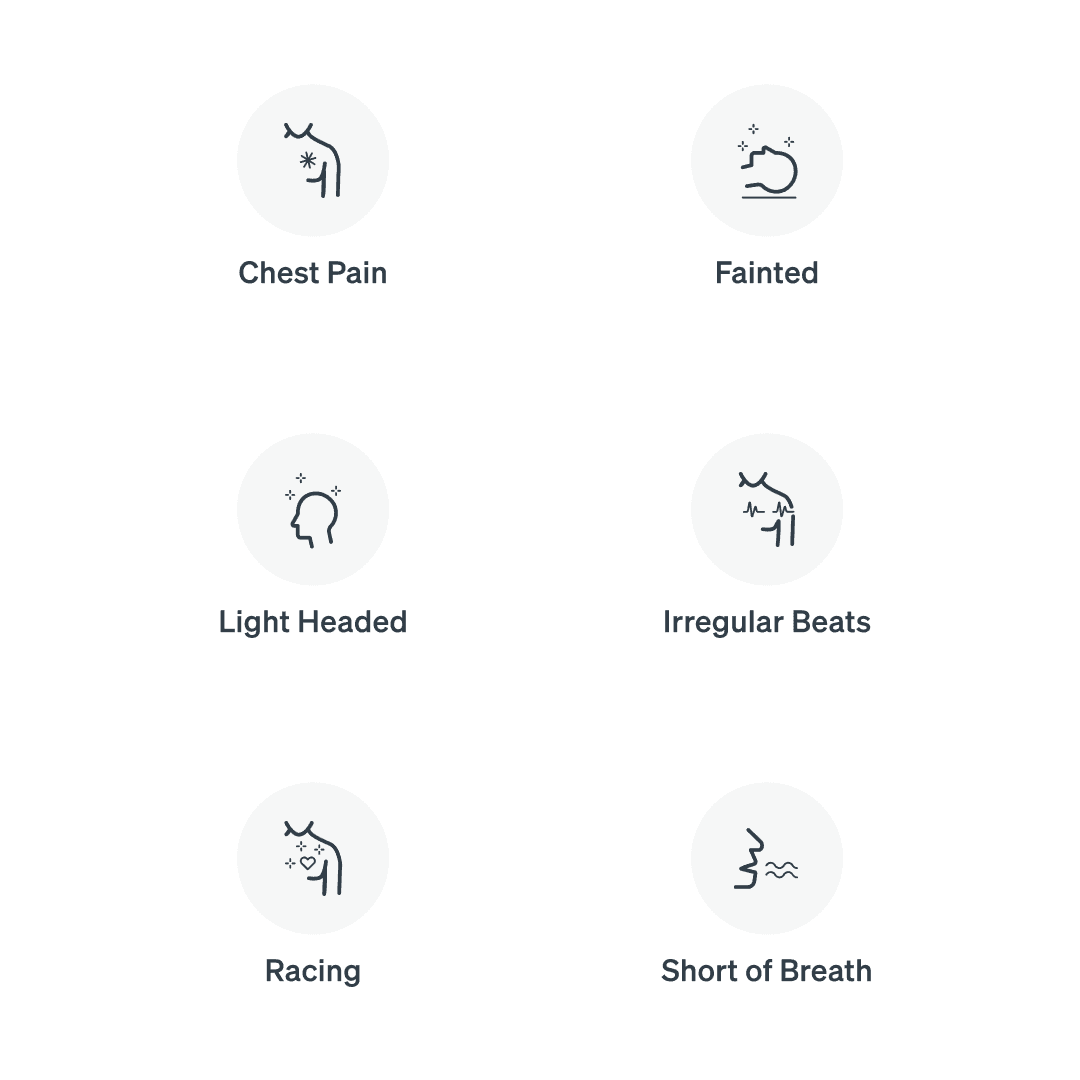
Symptom illustration supplied from iRhythm patient materials. These are examples for a symptom diary; chest pain, fainting, and severe breathlessness may need emergency care as described above.
How does MyZio help?
MyZio gives you a place to log and review symptoms and find instructions for wearing and returning the monitor. It is available for iPhone and Android. A paper log is also an option.45
Keep the log available wherever you usually notice episodes. If you use paper, include it when you return the monitor. Logging a symptom does not request an urgent clinical response.
Why might I need more than a day or two of recording?
Some rhythms appear only after several days, even when a person feels symptoms daily. A retrospective study published in Heart Rhythm examined 1,100,337 patch recordings. Among recordings with an actionable arrhythmia, most first detections occurred after 48 hours in both the daily-symptom and less-frequent-symptom groups. The study also found limited overall agreement between reported symptoms and detected rhythms.6
This was an observational study of people already selected for monitoring, with manufacturer-affiliated authors. It supports considering a longer recording when appropriate; it does not establish that everyone needs 14 days or that every palpitation is an arrhythmia. Wear your monitor for the time your clinician prescribed.
Fishtown Medicine
A 90-minute conversation with Dr. Ash. A written plan you can follow.
Can I use Cavilon if the adhesive makes me itch?
Possibly, and one of our own patients has done it. If adhesive has bothered your skin before, tell me before the patch goes on so we can plan the skin prep together. If another clinician ordered your monitor, the same conversation belongs with them.
That patient used 3M Cavilon No Sting Barrier Film, a thin clear coating painted onto the skin before an adhesive goes on. They applied 2 layers, let each one dry fully for about 2 minutes, and then wore the Zio for the full 14 days with only minimal itching. Two weeks is a long time to wear something on your chest, and staying comfortable is what let that recording run the full length it was ordered for.
What I can't tell you yet is how reliably that works for other people. The Zio instructions walk through shaving, exfoliating, and drying the skin, and a barrier film is not one of their steps.7 3M's own Cavilon instructions say to let the coating dry before an adhesive device goes on top.8 That drying time is the part I would hold onto, because the patch needs a dry, firm seal against your skin to record a clear tracing. If we decide together that it fits your situation, this is the Cavilon barrier film, and I'm happy to go through the steps with you before you put it on.
A true allergy is a different conversation. If you have a known allergy to adhesives or hydrogel, or one runs in your family, the Zio instructions warn against wearing it, so let's talk before the box is opened about another way to monitor your heart.7 Please skip lotions, creams, and other sprays under the patch, since leftover residue can keep it from sticking. If your skin blisters, weeps, spreads well past the patch, or looks infected, follow the removal instructions and message me and iRhythm. You do not need to push through a bad reaction to finish the days. Our guide to adhesive reactions goes further into why different devices need different skin plans.
How do I handle daily wear and returning it?
Follow the instructions for the model on your box. iRhythm's Zio monitor education page has application, wear, and removal videos. Check its water and activity restrictions before showering or exercising. For a loose patch or device problem, iRhythm Customer Care is available at 888-693-2401.9
At the end of the prescribed wear, return the monitor and paper log in the supplied packaging, using the carrier on the prepaid label. The recording is analyzed and sent to the ordering clinician for interpretation. Returning the patch is part of completing the test.2
What will we look at together when the result comes back?
I want to understand whether your usual symptom happened during the recording, what rhythm was present then, and whether anything else was recorded that needs attention. If your familiar symptoms occurred during normal rhythm, that is useful information for deciding what to investigate next. If the symptom never happened, we need to account for that when interpreting the result.
The next step depends on the finding and your history. Skipped beats, a racing heart on standing, and a wearable AFib alert each have their own evaluation. Monitoring is one part of cardiovascular care.
Key Takeaways
- A symptom diary helps connect your experience with the recorded rhythm.
- The prescribed duration and the instructions for your device model guide wear.
- If adhesive has bothered your skin before, talk it through before application; a barrier film like Cavilon helped one of our patients finish all 14 days.
- Return the patch and review the result with the clinician who ordered it.
- Urgent symptoms need urgent care, even while a monitor is recording.
Related at Fishtown Medicine
- Heart monitor adhesive reactions
- Skipped beats and PVCs
- Lightheadedness and dizziness
- Racing heart when standing
- Wearable AFib alerts
- Heart imaging
- Cardiovascular health
Scientific References
-
American Heart Association. Warning Signs of a Heart Attack.
-
iRhythm. How Zio Works.
-
Steinberg JS, Varma N, Cygankiewicz I, et al. 2017 ISHNE-HRS expert consensus statement on ambulatory ECG and external cardiac monitoring/telemetry. Full text.
-
iRhythm. MyZio for iPhone.
-
iRhythm. MyZio for Android.
-
Battisti AJ, Pinkerton R, Fokin V, et al. Relationship of symptom frequency and symptom-rhythm correlation to arrhythmia type and time to detection: Insights from ambulatory electrocardiogram monitoring in over 1 million patients. Heart Rhythm. 2026;23(2):e200-e208. PubMed.
-
iRhythm. Zio monitor Instructions for Use, LB10117.06, May 2026.
-
iRhythm. Zio Monitor Education.

Frequently Asked Questions
Common Questions
Ready when you are
The chat is our AI assistant, answering from our published guides. To talk it through with Dr. Ash himself, start with the intake.