

A skipped heartbeat is usually a premature beat, either a PVC from the lower chambers or a PAC from the upper ones: the early beat is faint, the reset pause lets the heart fill with extra blood, and the next beat thumps forcefully. On a 14-day Zio patch (which catches ~47% more >10%-burden cases than a 24-hour Holter, Shoureshi JACC 2024), we read PVC burden on a sliding scale: <1% is normal background (Marcus Circulation 2020), 1%-10% warrants a baseline echocardiogram if symptomatic (and predicts long-term heart failure risk above ~0.7%-1% in adults >=65, Dukes JACC 2015), >=10% (~7% cardiomyopathy prevalence) needs an immediate echo and 6-12 month follow-up, and >15%-24% (Hasdemir >16%; Baman >24% AUC 0.89) warrants electrophysiology referral. Most low-burden cases respond to fixing drivers: coffee cuts (CRAVE NEJM 2023 showed coffee raised PVCs 51% without raising PACs), sleep/OSA (PVCs rise 85% the day after disrupted sleep, Miner 2016), RBC magnesium/potassium (MAGICA RCT -17.4%), ferritin, and TSH, while beta-blockers work best when PVCs rise with daytime heart rate instead of slow nighttime rates (Hamon 2019).
TL;DR: That feeling where your heart seems to pause for a second and then thump is almost always an extra beat (PVC or PAC) that fired early; the early beat is quiet, the reset pause fills the chamber with extra blood, and the next beat hits hard.
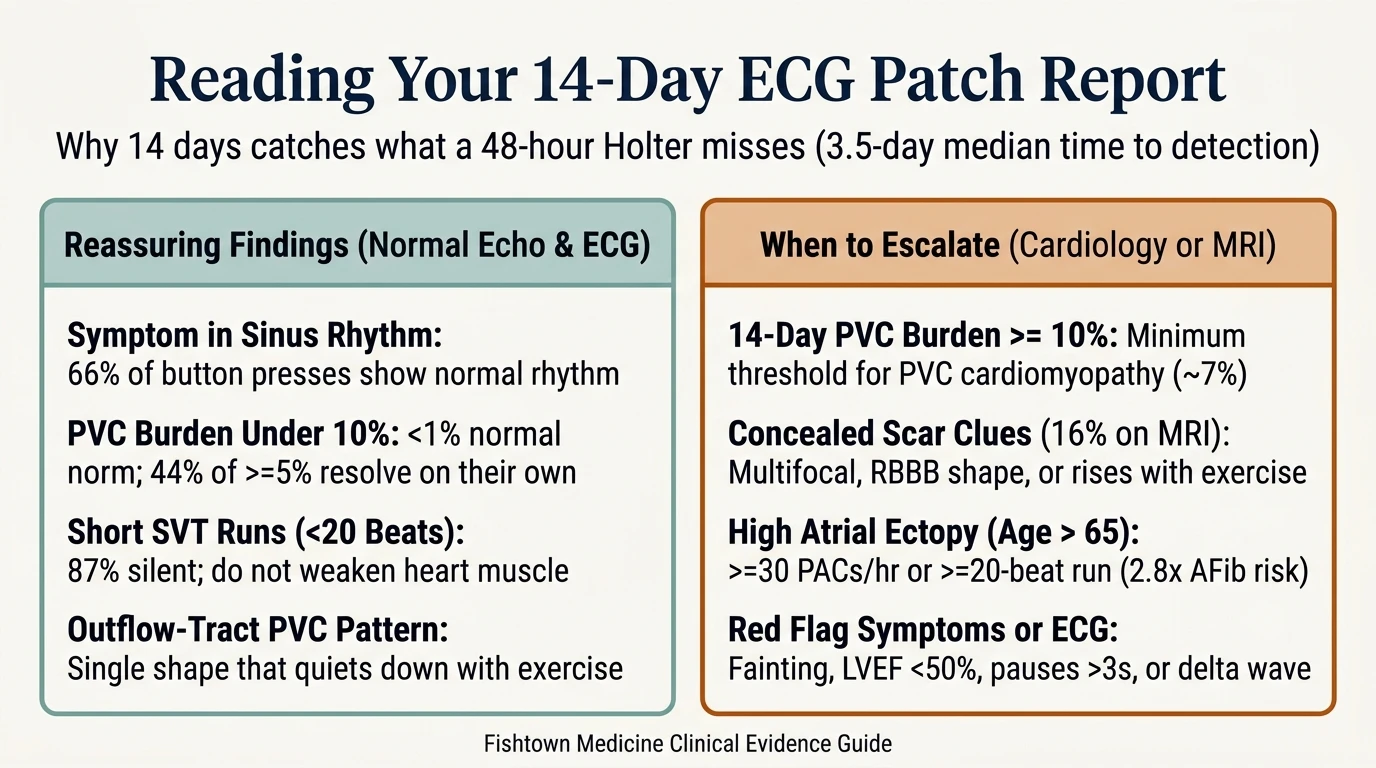
- Measure your PVC percentage over 14 days, not 24 hours: A 24-hour Holter misses nearly half of people whose single-day PVC load crosses 10%. On a 14-day Zio patch, under 1% is normal background, 1% to 10% calls for a baseline heart ultrasound (echocardiogram) when you feel symptoms, 10% or higher requires an echocardiogram and 6- to 12-month follow-up, and above 15% to 24% calls for a rhythm specialist.
- Fix the triggers that make extra beats fire: In a randomized trial, caffeinated coffee raised daily PVCs by 51% and cut sleep by 36 minutes (while not changing PACs). Poor sleep, untreated sleep apnea, low magnesium or potassium, low ferritin, and thyroid shifts drive most PVC flares and can be fixed without a daily heart pill.
- Use a 6-lead home ECG ($129) and match treatment to when your beats fire: Keep a 6-lead KardiaMobile 6L ($129, no subscription needed) at home so your doctor can see which part of your heart the beat comes from. When medicine is needed, beta-blockers cut daytime stress-driven PVCs in half but can worsen slow nighttime PVCs.
A 38-year-old architect in Fishtown came in convinced his heart muscle was failing after an urgent-care ECG caught premature ventricular contractions (PVCs) every evening on his couch. We placed a 14-day Zio XT patch that showed a 3.8% 14-day average PVC burden (7.2% on his heaviest cold-brew and deadline day). Those beats vanished whenever he went for a run (a classic benign outflow-tract sign), and only 31% of his button presses lined up with an extra beat. Swapping his afternoon cold brew (CRAVE trial), repleting his RBC magnesium (4.4 mg/dL) and ferritin (29 ng/mL), and confirming a normal echo quieted his chest within three weeks without a daily pill.
Why does a skipped beat feel like a pause and then a thump?
What feels like a skipped beat is an early, quiet heartbeat (PVC from the lower chambers or PAC from the upper chambers) followed by a reset pause and a heavy recovery beat (Ng Heart 2006; Marcus Circulation 2020).
The early beat fires before your heart chamber has finished filling with blood. Because the chamber is only partly full, that early squeeze pushes out very little blood and you rarely feel it. A brief reset pause follows, giving the chamber extra time to fill with more blood than usual. The next regular heartbeat then squeezes out that larger volume with extra force (the Frank-Starling effect). That strong beat is the heavy thump you feel in your chest or throat, most noticeably when lying on your left side in a quiet room at night.
In studies of patients with frequent PVCs, felt palpitations match PVCs on the rhythm strip only 34% of the time (Gao 2025; and 18.3% across all patch symptoms, Battisti 2026). Even better, in trials of outflow-tract PVCs (Krittayaphong Am Heart J 2002) and conservative-care cohorts (Tang 2021; Shoureshi JACC 2024), 35% to 44% of patients see their PVC burden drop below < 1% on its own without medication.
Are PVCs dangerous, and what PVC burden percentage matters on a 14-day patch?
In a structurally normal heart, occasional PVCs are benign. Risk rises on a sliding scale based on your 24-hour PVC burden percentage (< 1%, 1%-10%, >= 10%, and > 15%-24%), whether PVCs suppress or multiply during exercise, and electrical features on your ECG (Dukes JACC 2015; Baman 2010; Shoureshi JACC 2024; Muser 2020).
Because a 24-hour Holter catches only ~53% of people whose true peak burden exceeds 10% (Shoureshi JACC 2024) - and in Amara et al. (JCE 2026), about half of monitored days fell below 10,000 PVCs even in patients who had at least one day above 10,000 - we anchor clinical decisions on your 14-day average PVC percentage (while noting peak-day variability) on a 14-day Zio patch. In untreated patients with >= 5% burden and a normal echocardiogram (Lee Heart 2019), 44% resolved spontaneously to < 1%, only 4.3% developed LV dysfunction, and a normal echo plus normal exercise test carried zero excess 5.2-year mortality (Scorza Europace 2023):
| PVC Burden Tier (14-Day Average & Peak Day) | Clinical Meaning & Landmark Evidence | Recommended Workup & Next Steps |
|---|---|---|
| < 1% (< ~1,000 PVCs/day) | Normal background in healthy adults (Cardiovascular Health Study median 0.011%, Marcus Circulation 2020). | Reassurance and trigger optimization (RBC magnesium, ferritin, TSH, sleep, coffee) when 12-lead ECG, exam, and history are normal. |
| 1% to 10% | Short-term PVC-induced heart muscle weakness is unlikely. However, in 1,139 adults >= 65 years followed for 13.7 years (Dukes et al., JACC 2015), burdens above ~0.7% to 1% (> 90% specificity) predicted 3.10x odds of 5-year LVEF decline, 48% higher incident heart failure (HFrEF, aHR 1.48), and 31% higher mortality (aHR 1.31). | Order a baseline echocardiogram (TTE) if symptomatic or several thousand PVCs/day; treat symptoms and cardiovascular risk factors. |
| >= 10% (> 10,000 PVCs/day) | Usual minimum threshold for reversible PVC-induced cardiomyopathy (prevalence ~7% among those > 10%, Huizar JACC 2019; Shoureshi JACC 2024; EHRA/HRS 2020). | Order TTE (including global longitudinal strain, GLS) now, address triggers/therapy, and repeat TTE + patch every 6 to 12 months. |
| > 15% to 24%+ | Highest-risk range (Hasdemir 2011 cutoff > 16%, 100% sens / 87% spec; Baman Heart Rhythm 2010 cutoff > 24%, AUC 0.89, mean burden 33% with reduced LVEF vs. 13% preserved; Niwano 2009 > 20,000/day). | Cardiology / Electrophysiology (EP) referral (2022 ESC Class IIb supports catheter ablation at > 20% even without symptoms). |
Modifiers Beyond Burden & When We Order a Cardiac MRI (CMR)
Burden percentage alone does not tell the whole story (Slaven JACC EP 2025). Features that raise cardiomyopathy risk at any burden include wider PVC QRS > 150 ms, epicardial origin, complete lack of symptoms (aOR 13.1, because high burdens go unnoticed for years), interpolated PVCs, variable coupling intervals, non-sustained VT (NSVT), and male sex (Huizar 2019; Shoureshi 2024).
In patients with frequent PVCs and a normal echo, a cardiac MRI (CMR) with late gadolinium enhancement (LGE) finds hidden heart muscle scar (from past myocarditis or cardiac sarcoidosis) in 14% to 16% (Muser et al., JACC EP 2020; Hosseini 2022; Basile 2024). In the Muser (2020) registry, a normal CMR carried a 0.2% arrest rate, while an abnormal CMR carried a 4% sudden death and 21% resuscitated arrest rate. We order CMR when any red flag is present (2022 ESC; Muser 2020):
- Multiple PVC shapes (multifocal) or right bundle branch block (RBBB) shape (above all with a superior axis).
- PVCs that increase during exercise (benign outflow-tract PVCs calm down as heart rate climbs during exercise, 2020 ESC Sports Guidelines).
- NSVT, age >= 60, or AV conduction block (a classic clue to cardiac sarcoidosis, Trivieri JACC 2020).
- LBBB-pattern PVCs with V1-V3 T-wave inversion (screen for ARVC) or a family history of sudden cardiac death or cardiomyopathy.
What everyday triggers drive PVCs and PACs according to clinical trials?
Randomized trials show that coffee (CRAVE NEJM 2023), sleep disruption and sleep apnea (Miner 2016), alcohol (MunichBREW II 2024; HOLIDAY), intracellular magnesium and potassium (MAGICA RCT), low ferritin, and thyroid shifts each drive distinct patterns of extra beats.
Get Real Answers
Tired of being told your labs are 'normal'? Dr. Ash digs deeper.
- Coffee Increases PVCs (+51%) and Cuts Sleep (-36 min), Without Increasing PACs (CRAVE Crossover RCT, Marcus et al., NEJM 2023; Kim JAMA Intern Med 2021): In the CRAVE trial, caffeinated coffee days did NOT increase PACs (58 vs. 53/day, RR 1.09), and in the UK Biobank (Kim 2021) each daily cup tracked with a 3% lower overall arrhythmia risk. Blanket caffeine bans for PACs are not backed by evidence. However, coffee days in CRAVE increased daily PVCs by 51% (154 vs. 102/day, RR 1.51) and shortened sleep by 36 minutes/night. A 2-week N-of-1 trial of cutting caffeine (or keeping coffee to the morning) is worthwhile when PVCs bother you.
- Sleep Disruption & Hidden Sleep Apnea (Miner Sleep 2016; Somers JACC 2008): A single night of disrupted sleep increases PVCs/hour by 23% that night and 85% the next day (Miner 2016). PVCs also occur in up to 66% of adults with obstructive sleep apnea. If you wake at 3 AM, grind your teeth, wake groggy, or have high hemoglobin, a 1-night WatchPAT One home sleep apnea test (read with AASM 3%A scoring) is one of the best tests we run.
- Intracellular RBC Magnesium & Potassium (MAGICA RCT, Zehender JACC 1997; Klevay AJCN 2002; POTCAST NEJM 2025): In the double-blind MAGICA trial (n = 232 patients with > 720 PVCs/day), daily magnesium (6 mmol) plus potassium (12 mmol) aspartate for 3 weeks lowered PVCs by a median 17.4%. A feeding study (Klevay 2002) also showed low dietary magnesium triggers PACs. Because < 1% of body magnesium is in serum (Workinger 2018), we test intracellular RBC magnesium (aiming for the upper half of the range with evening magnesium glycinate) and serum potassium (in high-risk ICD patients, the 2025 NEJM POTCAST trial showed targeting potassium 4.5-5.0 mmol/L cut ventricular arrhythmias, while in general care risk rises at < 3.0 or >= 5.0 mmol/L).
- Alcohol (MunichBREW II, Brunner Eur Heart J 2024; HOLIDAY, Voskoboinik NEJM 2020): Heavy drinking raises atrial tachycardia and ectopy during the post-drinking recovery window (MunichBREW II), and alcohol abstinence cuts atrial fibrillation return in regular drinkers (HOLIDAY).
- Thyroid (TSH), Iron Stores (Ferritin), Dehydration, & Stimulants: An overactive thyroid, low ferritin, dehydration, nicotine/vapes, cannabis, decongestants (pseudoephedrine), and stimulants raise adrenaline tone and make every post-pause beat thump harder.
Why do we recommend a 6-lead personal EKG (KardiaMobile 6L) alongside a Zio patch?
A 14-day Zio patch counts your 24-hour PVC burden (including the 87% of events that happen silently), while a pocket-sized KardiaMobile 6L ($129, no subscription needed) records 6 limb leads (I, II, III, aVR, aVL, aVF) in 30 seconds for home spot checks (Kleiman 2021).
Smartwatches only record a single lead between your wrist and finger, and smart mattresses only estimate pulse from movement. Cardiologists often discount 1-lead watch strips because one view cannot show PVC QRS width, axis, or P-wave shape (Ip JAMA 2019; Steinberg ISHNE-HRS 2017). By resting two thumbs on top of the KardiaMobile 6L and placing the bottom sensor on your left knee or ankle for 30 seconds, you give us 6 camera angles of your heart's wave:
- Buy the standard KardiaMobile 6L ($129, HSA/FSA eligible) without the paid KardiaCare subscription: Record unlimited 30-second 6-lead EKGs, export the PDF strip for free, and upload it to your portal so I can read the waveform myself.
- Keep it in your drawer for years: After your 14-day Zio patch goes back in the mail, your KardiaMobile 6L lets you check in 30 seconds whether a flare months later is PVC bigeminy, sinus tachycardia, or paroxysmal AFib (including before taking any "pill-in-the-pocket" flecainide). It does not replace 911 for chest pain or fainting and is not intended for patients with pacemakers or ICDs.
How do beta-blockers (Hamon diurnal profiles), antiarrhythmics, and catheter ablation compare?
When PVCs stay bothersome or high-burden after fixing triggers, treatment is guided by your hourly heart-rate pattern (Hamon 2019): beta-blockers work well for fast-rate daytime PVCs (18.8% to 9.3%) yet worsen slow-rate nighttime PVCs (14.6% to 20.8%), while catheter ablation cures 80.6% of RVOT PVCs at 1 year vs. 11.4% on drugs (Ling RCT 2014).
| Treatment Option | Clinical Evidence & Efficacy | When It Works Best (and When It Fails) | Guideline Class (AHA/ACC/HRS 2017; ESC 2022) |
|---|---|---|---|
| Active Surveillance & Trigger Correction | 35% to 44% of patients fall to < 1% PVC burden spontaneously (Tang 2021; Shoureshi 2024); placebo cut symptom frequency (P = 0.002, Krittayaphong 2002). | First-line for preserved LVEF with < 10% burden and no red flags. | First-line standard of care (Marcus Circulation 2020; EHRA/HRS 2020). |
| Low-Dose Beta-Blocker (bisoprolol 2.5 mg, metoprolol succinate median 50 mg [IQR 25-75 mg], atenolol 25-50 mg) or Diltiazem 120-210 mg | Overall PVC count response is modest (24% formal response on atenolol while placebo also cut symptoms, Krittayaphong 2002; median -30.5% vs. -32.7% conservative, Tang 2021), but softens the forceful post-pause thump. In Hamon et al. (JCE 2019), response was 62% when PVCs rose with heart rate: - Fast-HR (daytime/adrenergic) PVCs: fell 18.8% -> 9.3% - HR-independent PVCs: no change - Slow-HR (nighttime/rest) PVCs: worsened 14.6% -> 20.8% | Best when the Zio hourly trend shows PVCs rising with daytime heart rate (or when softening the post-pause thump is the main goal). Avoid or use caution if PVCs cluster only during slow nighttime heart rates. | Class I (B-R) for symptomatic PVCs in a structurally normal heart (2017 AHA/ACC/HRS); Class IIa for focal AT (2015 SVT Guideline). |
| Class IC Antiarrhythmic (Flecainide) | Achieved > 99% PVC suppression in 56% of patients (Kojic Clin Cardiol 2023) and outperforms metoprolol/carvedilol for PVC count suppression (ECTOPIC RCT, Bertels 2025). | Specialist-initiated second-line drug when beta-blockers fail or PVCs are bradycardia-clustered. Strictly contraindicated after heart attack (MI) or in structural heart disease (CAST trial). | Class IIa in structurally normal hearts refractory to beta-blockers/ablation (2017 AHA/ACC/HRS; 2022 ESC). |
| Catheter Ablation (Radiofrequency) | - Ling et al. RCT (2014) (n = 330 RVOT PVCs): 1-year recurrence 19.4% with ablation vs. 88.6% with drugs (80.6% vs. 11.4% drug-free cure). - PVC Cardiomyopathy (Zhong 2014; Awais 2026): Normalizes LVEF in 47% to 65% (vs. 21% on drugs), gaining ~+11 LVEF points. - Success / Risk: 75%-90% success (> 90%-95% in focal AT); 2.4%-5% major complication rate. | Drug-refractory symptoms, patient preference to avoid daily pills, PVC burden >= 15% to 20%, or falling LVEF / PVC-induced cardiomyopathy. | 2022 ESC: Class I (first-line) for symptomatic RVOT/fascicular PVCs or PVC cardiomyopathy; Class IIb for asymptomatic burden > 20%. 2017 AHA/ACC/HRS: Class I when drugs fail, are not tolerated, or are not preferred. |
Guidance from the Clinic

Key Takeaways
- Mechanics: A skipped beat is a premature beat (PVC or PAC) followed by a reset pause and a forceful post-pause beat (which is the thump you feel). Only 34% of felt palpitations in PVC patients match an extra beat on the strip (Gao 2025), and 35% to 44% resolve to < 1% spontaneously (Shoureshi 2024).
- Sliding-Scale PVC Burden (14-Day Average + Peak Day): < 1% is normal background; 1%-10% calls for a baseline echo (TTE) if symptomatic (and long-term HF risk care in adults >= 65, Dukes 2015); >= 10% (~7% cardiomyopathy prevalence) requires a TTE now plus 6-12 month surveillance; > 15%-24% (Hasdemir 2011; Baman 2010) warrants EP referral.
- Evidence-Based Triggers: Coffee raises PVCs +51% (and cuts 36 min of sleep) without raising PACs (CRAVE NEJM 2023); disrupted sleep raises PVCs +85% the next day (Miner 2016); sleep apnea is present in up to 66%; and repletion of intracellular RBC magnesium + potassium (MAGICA -17.4%), ferritin, and TSH calms most cases.
- Matched Therapy: Match beta-blockers to the Hamon (2019) diurnal heart-rate profile (fast-HR daytime PVCs improve; slow-HR nighttime PVCs worsen), keep a $129 KardiaMobile 6L at home without a subscription, and use catheter ablation (80.6% vs. 11.4% 1-year drug-free success, Ling RCT 2014) for drug-refractory or high-burden cases.
Related at Fishtown Medicine
- Getting Answers from a Zio XT 14-Day Heart Monitor
- Metoprolol: Tartrate vs Succinate
- Magnesium Glycinate Clinical Guide (RBC Magnesium)
- Potassium Clinical Guide
- What a WatchPAT Home Sleep Apnea Test Costs, and How It Compares to In-Lab PSG
- Your Apple Watch Flagged AFib: What to Do Next
- Racing Heart When Standing (POTS)
Scientific References
- PVC Burden Thresholds, Natural History & Cardiomyopathy: Baman TS, Lange DC, Ilg KJ, et al. Heart Rhythm. 2010;7(7):865-869; Dukes JW, Dewland TA, Vittinghoff E, et al. J Am Coll Cardiol. 2015;66(2):101-109; Marcus GM. Circulation. 2020;141(17):1404-1418; Hasdemir C, et al. J Cardiovasc Electrophysiol. 2011;22(6):663-668; Huizar JF, et al. J Am Coll Cardiol. 2019;73(18):2328-2344; Shoureshi P, et al. J Am Coll Cardiol. 2024;83(22):2214-2232; and Slaven S, et al. JACC Clin Electrophysiol. 2025.
- Cardiac MRI (CMR) Risk Stratification & Guidelines: Al-Khatib SM, Stevenson WG, Ackerman MJ, et al. (2017 AHA/ACC/HRS). J Am Coll Cardiol. 2018;72(14):e91-e220; Zeppenfeld K, et al. (2022 ESC). Eur Heart J. 2022;43(40):3997-4126; Muser D, Santangeli P, Castro SA, et al. JACC Clin Electrophysiol. 2020;6(8):922-933; Hosseini F, et al. JACC Clin Electrophysiol. 2022;8(10):1255-1266; and Basile P, et al. Int J Cardiol. 2024;409:132195.
- Trigger Trials (CRAVE, MunichBREW II, MAGICA, POTCAST, & Sleep): Marcus GM, Rosenthal DG, Nah G, et al. (CRAVE). N Engl J Med. 2023;388(12):1092-1100; Marcus GM, et al. (AHA Caffeine Statement). Circulation. 2026; Brunner S, et al. (MunichBREW II). Eur Heart J. 2024;45(46):4938-4949; Miner SE, et al. Sleep. 2016;39(4):795-802; Zehender M, et al. (MAGICA). J Am Coll Cardiol. 1997;29(5):1028-1034; Klevay LM, Milne DB. Am J Clin Nutr. 2002;75(3):550-554; and Jøns C, et al. (POTCAST). N Engl J Med. 2025.
- Diurnal Beta-Blocker Response, Antiarrhythmics & Catheter Ablation: Hamon D, Swid MA, Rajendran PS, et al. J Cardiovasc Electrophysiol. 2019;30(6):836-843; Krittayaphong R, et al. Am Heart J. 2002;144(6):e10; Tang JKK, et al. J Cardiovasc Electrophysiol. 2021;32(8):2246-2253; Bertels RA, et al. (ECTOPIC). Heart Rhythm. 2025; Ling Z, Liu Z, Su L, et al. Circ Arrhythm Electrophysiol. 2014;7(2):236-243; Zhong L, et al. Heart Rhythm. 2014;11(2):187-193; and Awais M, et al. Medicine. 2026.

Frequently Asked Questions
Common Questions
Ready when you are
The chat is our AI assistant, answering from our published guides. To talk it through with Dr. Ash himself, start with the intake.