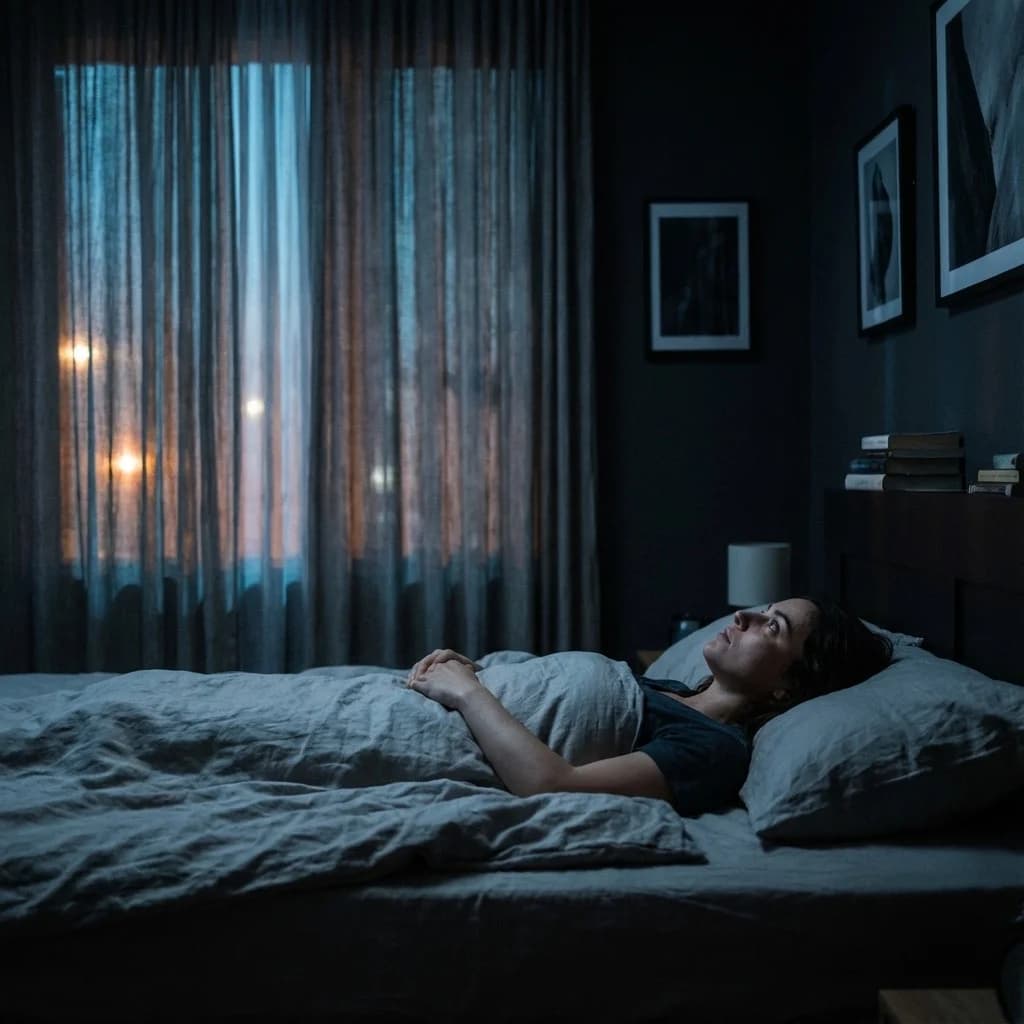

Insomnia in healthy adults is often a biology problem rather than a hygiene problem. The 3 AM wake-up is usually driven by a blood sugar dip, a cortisol spike, low progesterone, or a histamine surge. When you fix the underlying biology instead of reworking sleep habits alone, you start to stay asleep through the night.
Falling asleep was never the hard part for you. You go down fine, and then it's 3:15 AM, your eyes are open, your heart is going, and your head is already on the inbox and the leak in the roof. You're not groggy and drifting back off. You're awake, in a way that feels like your body made the decision without you.
So you do the sensible thing and see a sleep doctor at one of the big health systems, and you come home with a home sleep test.
- Result: "No sleep apnea."
- Solution: "Try CBT-I, or I can give you something like Ambien."
A home sleep test is worth having, and CBT-I helps plenty of people, so neither of those is a bad answer. But when your airway checks out and your thinking wasn't what pulled you awake, something else did, and that something is usually findable.

Why Do I Wake Up at 3 AM Even Though I'm Tired?
When a healthy adult wakes at 3 AM, the cause is usually something happening in the body rather than something wrong with the bedtime routine. Your brain has read an internal emergency and is doing the job it evolved to do, which is get you conscious and moving. Here are the 3 patterns I run into most often with my Philly patients.
1. The Metabolic Wake-Up: Nocturnal Hypoglycemia
Nocturnal hypoglycemia means your blood sugar falls too low while you're asleep, and it turns up most after a heavy carb dinner or a few drinks. Your brain treats a falling glucose level the way it would treat a fire alarm, so it sends out adrenaline and cortisol, your stress hormones, and those are what pull you out of sleep and send you looking for food. The pounding heart you notice at 3 AM is that adrenaline arriving.
- My Fix: I want a Continuous Glucose Monitor (CGM) on you for a couple of weeks, which is a small sensor you wear on the back of your arm that reads blood sugar around the clock. Then we sit down together and see whether the nights you woke are the same nights your glucose fell. If they are, I'll give you what I call a Bedtime Anchor, a small snack of protein and fat that holds you steady until morning.
2. The Hormonal Wake-Up: Low Progesterone or High Cortisol
In women the usual driver is progesterone, the calming hormone that holds you down in deep sleep. Through perimenopause, the years leading up to menopause that often begin in the late 30s or the mid 40s, progesterone drops fast, and broken sleep is frequently the first symptom a woman notices. In men the pattern looks different: evening cortisol that stays high when it should be falling, or testosterone low enough to break the night into pieces.
- My Fix: For women I draw Day 21 hormones, which is the point in the cycle where progesterone ought to be at its highest, and if that number comes back low we talk about bio-identical progesterone to rebuild sleep architecture. For men I want the cortisol curve mapped across the whole day and a full sex-hormone panel in front of me before I change anything.
3. The Histamine Wake-Up: Histamine Intolerance and MCAS
Histamine is the messenger your body uses for allergies and for digestion, and it doubles as an excitatory signal that keeps the brain switched on. Mast Cell Activation Syndrome, or MCAS, is the condition where mast cells, a kind of immune cell, release more histamine than the moment calls for. Add aged cheese, wine, and last night's leftovers, or a damp Philly basement with mold in the walls, and your histamine bucket fills up until it overflows in the middle of the night. That shows up as itching, a racing heart, and the wide-awake feeling that arrives with no story attached to it.
- Our Fix: We try eating low-histamine for 2 to 4 weeks and see what your nights do with that, and if the sleep comes back we add mast cell stabilizers, which are medications that settle those cells down so you can widen the diet again.
How Do I Know If My Insomnia Is Behavioral or Biological?
The timing tells you most of it. If your mind starts racing the moment you get into bed and you lie there unable to drop off, that pattern is usually behavioral, and CBT-I (Cognitive Behavioral Therapy for Insomnia) is the gold standard for treating it, because by then you have learned to dread your own bed. If you fall asleep without trouble and then can't stay asleep, the cause is usually biological.
You can't behavior your way out of a hypoglycemia crash, so I clear the biology first. If the biology is handled and you still can't sleep, I'll send you to a CBT-I therapist I trust to retrain the brain, and I stay in it with you while that work happens.
Why does short sleep flare skin and inflammatory conditions?
Short sleep flares skin and inflammatory conditions because a night or 2 under about 6 hours raises cortisol and tilts your immune signaling toward a more inflamed state, and that tilt happens body-wide rather than only in the brain that's keeping you awake. If you live with eczema, psoriasis, or another inflammatory or autoimmune condition, you have probably noticed your skin or your joints getting louder during the same stretch your sleep came apart. It runs in both directions too, since a flare will wake you up on its own.
You can see this on ordinary blood work. A rising neutrophil-to-lymphocyte ratio on a standard blood count is a stress fingerprint, and it tends to move during the same weeks a patient tells me were their worst for sleep; our guide to what your blood count reveals goes through how to read one. One cause of itching that wakes people is worth excluding before you treat it as a skin condition, because the fix is completely different: if the itching arrives overnight and you are finding marks in the morning, our guide to telling whether it is bedbugs covers what settles the question. If you live with a flare-prone condition, write your sleep hours down next to your symptoms for a few weeks. The pattern is usually obvious once you have both columns in front of you, and our guide to eczema that won't settle walks through the fuller mechanism for one common example.
What if I cannot sleep without an over-the-counter sleep aid?
This comes up more than almost anything else in this conversation, and it usually arrives with some embarrassment attached. Someone has been taking diphenhydramine, the antihistamine sold as a nighttime sleep aid, every night for years. It works. They tried stopping once, had a miserable night, concluded the pill is the only thing holding their sleep together, and went back to it.
Two things are usually true at the same time here.
Get Real Answers
Tired of being told your labs are 'normal'? Dr. Ash digs deeper.
The first is that the pill has become the cue rather than the cause. Sleep runs partly on association, and when the same tablet has preceded sleep every night for a decade, the body files it as the signal that sleep is now permitted. Stopping removes the signal, the first few nights are worse, and that bad stretch gets read as proof of dependence when much of it is the association coming apart.
The second is that the drug is a poor long-term choice on its own merits. Diphenhydramine is an anticholinergic, which means it blocks acetylcholine, the same messenger that memory and attention run on. Its sedating effect fades within days of nightly use, so people often end up taking it for years for a benefit that stopped being pharmacologic early on. The cumulative exposure carries its own weight: in a study following more than 3,400 older adults across a decade, taking a strong anticholinergic daily for 3 years or more came with a 54% higher rate of dementia than 3 months or less of use.
None of that is an argument for stopping tonight. It is an argument for planning the exit rather than attempting it cold.
The order that works: find out what the pill has been covering before you take it away. Loud snoring, waking unrefreshed, or a partner who has noticed pauses in breathing earns a home sleep test first, because untreated sleep apnea is a common reason nothing else helps. Then rebuild the cue deliberately, with a fixed wake time, morning light, and a wind-down that starts outside the bedroom. Then taper rather than stop, so the difficult nights stay small enough to sit through.
When Should I See a Doctor for Insomnia?
Come see someone when the bad nights are running 3 or more a week and have been going for more than 3 months, or sooner than that if your work, your mood, or your driving is taking the hit. Insomnia predicts heart disease and Alzheimer's more strongly than smoking does, so it earns a full workup in my practice. Get evaluated if any of this sounds like you:
- You lie there more than 30 minutes before you fall asleep, which we call sleep latency.
- You wake in the night and stay awake more than 30 minutes, which we call WASO, or wake after sleep onset.
- You have come to need alcohol or THC to get to sleep, and both of those suppress REM, the dreaming stage your brain uses to reset emotion and memory.
Actionable Steps in Philly
Where I'd start with stubborn insomnia.
- Steady the blood sugar. Have a small snack of protein and fat about 60 minutes before you go to bed, every night for 2 weeks, and keep a note on your phone of the nights you woke up so we have something to read later.
- Get light in your eyes early. Within an hour of waking, step outside and stay out there 10 minutes. The Delaware River trail is a few blocks away for a lot of you, and the walk to your coffee in Fishtown does the same job.
- Cool the room down. Put the thermostat at 65 to 67 degrees Fahrenheit, since your core temperature has to fall for deep sleep to happen and a warm bedroom stops it before it starts.
- Look hard at the nightcap. Go 2 weeks without alcohol and watch what your tracker tells you. Most of my patients are seeing deeper sleep by day 5.
- Get tested if it holds. If 2 weeks of the basics change nothing, ask for a CGM trial, a 4-point cortisol panel, and Day 21 hormones.
Key Takeaways
- Glucose matters. Stable blood sugar usually means stable sleep.
- Alcohol is the enemy. It helps you pass out, but it almost guarantees a 3 AM cortisol spike.
- Temperature matters. Deep sleep needs a drop in core body temperature. 65 to 67°F is non-negotiable.
- Light is medicine. Morning sunlight sets the timer for tonights melatonin release.
Scientific References
- Riemann D, et al. "European guideline for the diagnosis and treatment of insomnia." Journal of Sleep Research. 2017.
- Morin CM, et al. "Cognitive behavioral therapy, singly and combined with medication, for persistent insomnia." JAMA. 2009.
- Walker MP. "Why We Sleep." Scribner, 2017.
- Sofer S, et al. "Greater weight loss and hormonal changes after 6 months diet with carbohydrates eaten mostly at dinner." Obesity (Silver Spring). 2011.
- Prather AA, et al. "Behaviorally Assessed Sleep and Susceptibility to the Common Cold." Sleep. 2015.
Related at Fishtown Medicine
- Is it insomnia or sleep apnea? - the question that has to be answered before any sleep prescription
- CBT-I for insomnia - the first-line treatment, and the one whose benefit outlasts it
- Trazodone for sleep - the most-prescribed sleep drug, and what the guideline says about it
- Z-drugs for insomnia - Ambien, Lunesta, Sonata, and the boxed warning
- Restless Legs: A Brain Running Low on Iron - a common, overlooked reason the legs will not let you sleep
- Anxiety vs Physiology - the medical causes of anxiety-like symptoms
- Memory Loss - the workup for memory concerns at any age
- Low Libido - the biology, relationship, and mood factors in low desire
- Eczema That Won't Settle - when short sleep is the biggest flare trigger
- What Your Blood Count Reveals - reading the cortisol and stress fingerprint off a standard CBC
Related Articles:
- The Importance of Sleep
- Chronic Fatigue & HPA Axis
- Metabolic Health
- Where Online Mental Health Care Stops Short - the overlap between sleep, mood, and medication decisions
- Brain Fog and Its 4 Common Drivers - what short sleep does to attention and word finding
- Valerian: A Calm-Down Aid for Racing Minds - what the evidence supports, and what it does not
Dr. Ash is a board-certified internal medicine physician at Fishtown Medicine in Philadelphia. He helps patients move from sedation to true restoration by fixing the biology of sleep.

Frequently Asked Questions
Common Questions
Deep-Dive Questions
Ready when you are
The chat is our AI assistant, answering from our published guides. To talk it through with Dr. Ash himself, start with the intake.