
Advanced cancer screening goes beyond mammograms and colonoscopies. Liquid biopsy (Galleri) checks blood for tumor DNA across more than 50 cancers. Whole body MRI (MRI-DWI) scans your organs without radiation. Together, they catch cancers that standard screening misses, often early enough to cure.
Almost everyone fears the C-word, and that fear is understandable. What changes the outcome, though, is catching cancer early. A cancer found at Stage 1 is often curable with simple surgery, while the same cancer at Stage 4 becomes a full-body crisis. Our goal is to move that timeline to the left and find these cancers while they are still small, slow, and treatable.
What does standard cancer screening miss?
Standard cancer screening misses most cancer deaths because it only covers five cancers and only at certain ages. Your insurance covers screening for breast, cervical, colorectal, prostate, and lung (scans only for heavy smokers).
Those five account for less than 30% of cancer deaths in the United States. The other 70%, including pancreatic, stomach, liver, and ovarian cancer, have no standard screening guidelines until you have symptoms. By the time symptoms appear, the cancer has often spread.
Which advanced cancer screening tools work?
The advanced screening tools we use are liquid biopsy, whole body MRI, and genetic risk mapping. We use all three together so each one covers the gaps the others leave.
1. Liquid biopsy (Galleri)
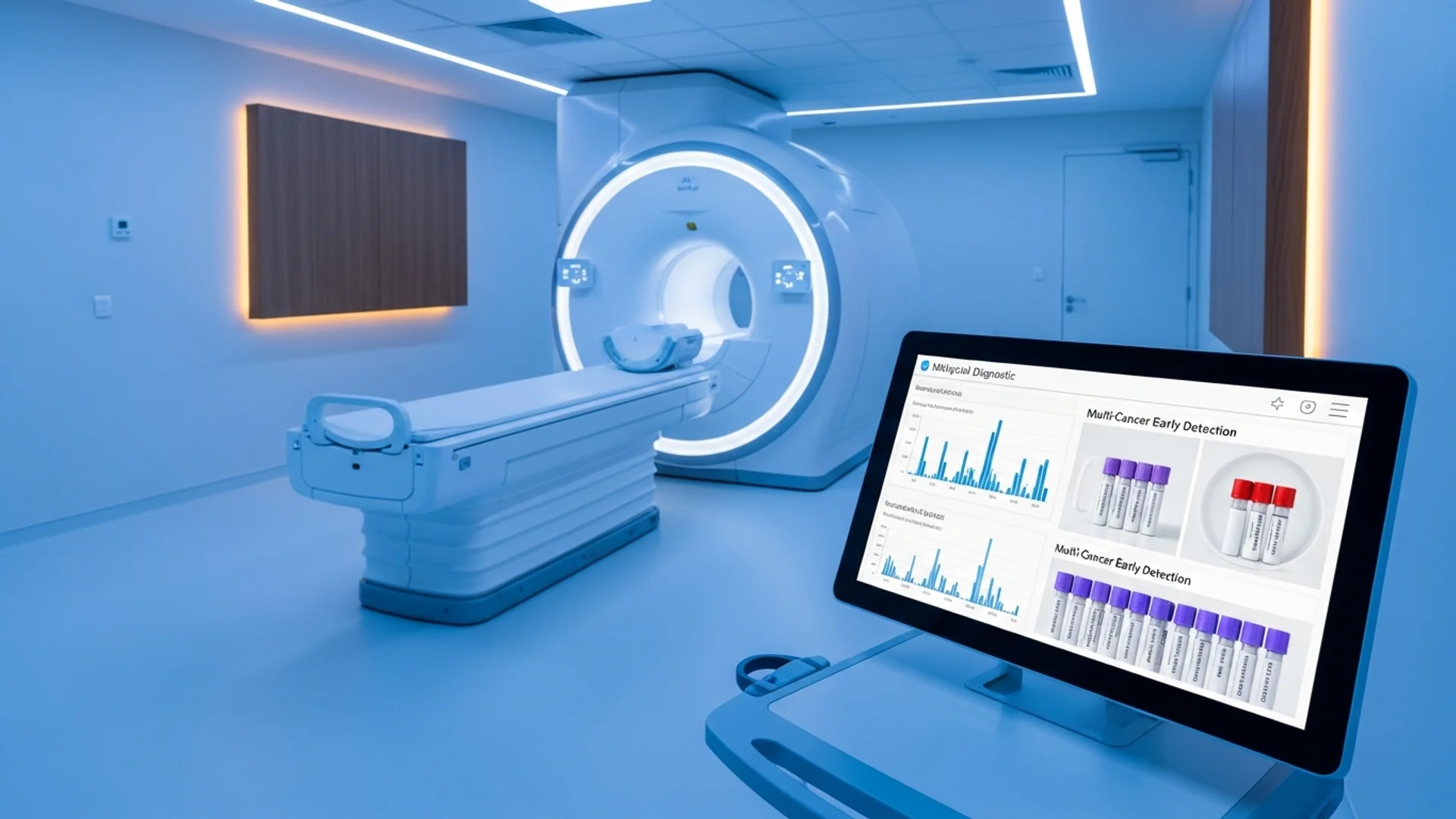
We use the Galleri multi-cancer early detection test. Galleri is a blood draw that looks for cell-free DNA (cfDNA), which are genetic fragments shed by tumors into the bloodstream. The full trial results from the 142,000-patient NHS-Galleri trial were presented at ASCO 2026 - read our deeper take on the results in What the NHS-Galleri Trial Showed (And What It Means For Your Screening).
- The reach: Detects specific signals shared by more than 50 types of cancer.
- The precision: A very low false-positive rate (under 0.5%), so we are not chasing ghosts.
2. Whole body MRI (MRI-DWI)
Whole body MRI with diffusion-weighted sequences (MRI-DWI) is radiation-free imaging that looks at organs like your liver, pancreas, kidneys, and brain.
- Why MRI: CT scans expose you to ionizing radiation. MRI does not. That makes MRI safe for repeated screening in healthy people.
- The insight: MRI can detect tumors as small as a dime, often years before they would cause pain or systemic symptoms.
3. Genetic risk mapping
Genetic risk mapping tests your DNA for inherited vulnerabilities. If you carry a BRCA or Lynch syndrome variant, your whole screening schedule changes. Someone who carries Lynch might start colonoscopies at 25 instead of 45.
Where can I get advanced cancer screening in Philadelphia?
You can get advanced cancer screening in Philadelphia through Fishtown Medicine, which coordinates scans and tests so you do not have to face the system alone.
- Galleri: We perform the blood draw right here in Philadelphia (or via mobile phlebotomy at your home).
- Whole body MRI: We coordinate scans based on your location.
- Dedicated screening MRI centers: locations in Wayne, PA, Newtown, PA, and Cherry Hill, NJ. We coordinate the referral and help you pick.
Dr. Ash reviews the images from both providers to make sure nothing falls through the cracks.
Longevity Medicine
A personalized longevity strategy starts with knowing your real baselines.
Actionable Steps in Philly
Build a layered cancer defense.
- Confirm standard screening is current: Check that your colonoscopy, mammogram, Pap smear, and (if applicable) lung CT are all up to date before adding anything new.
- Review family history: Pull together a one-page family cancer history (relatives, cancer type, age at diagnosis). This drives whether genetic testing is worth doing.
- Layer in advanced testing: Once standard screening is current, consider Galleri annually and a whole body MRI every 1 to 3 years based on your risk profile.
Key Takeaways
- How they fit in: Galleri and MRI do not replace your colonoscopy or mammogram. They add another layer of defense on top of them.
- About false positives: Critics worry about them, and that risk is highest on a first scan, then drops sharply with repeat screening over the years. We verify any finding before we act on it.
- Collaborative decisions: We weigh your family history, genetic risk, and how you feel about uncertainty, then choose the plan with you rather than for you.
- Metabolic defense matters: The best way to prevent cancer is to make your body inhospitable to it. Lowering insulin and inflammation is step one.
Scientific References
- Klein EA, et al. "Clinical validation of a targeted methylation-based multi-cancer early detection test using an independent validation set." Annals of Oncology. 2021.
- Lennon AM, et al. "Feasibility of blood testing combined with PET-CT to screen for cancer and guide intervention." Science. 2020.
- Zugazagoitia J, et al. "Current Challenges in Cancer Treatment." Clin Ther. 2016.
- Liu MC, et al. "Sensitive and specific multi-cancer detection and localization using methylation signatures in cell-free DNA." Annals of Oncology. 2020.
- Saslow D, et al. "American Cancer Society guideline for the early detection of cervical neoplasia and cancer." CA Cancer J Clin. 2002.
Related Articles:
Dr. Ash is a board-certified internal medicine physician at Fishtown Medicine in Philadelphia. He partners with patients to build a proactive cancer defense strategy using the latest diagnostic technology.
Related at Fishtown Medicine
- What the NHS-Galleri Trial Showed - the clinical read on the 142,000-patient ASCO 2026 results
- Why We Choose a CT of the Chest - the lung screening with the strongest mortality data behind it
- Your PSA Came Back High - the workup a positive prostate screen sets off
- Getting Through an MRI When the Scanner Makes You Panic - what to do if the tube is the reason you have put off a whole-body scan

Frequently Asked Questions
Common Questions
Deep-Dive Questions
Ready when you are
The chat is our AI assistant, answering from our published guides. To talk it through with Dr. Ash himself, start with the intake.