
Consumer wearables (Oura Ring, Whoop, Apple Watch, Garmin, Fitbit) are highly accurate for overnight resting heart rate (r = 0.996 vs. ECG, bias -0.63 bpm), full-night average HRV (RMSSD r = 0.98), and breathing rate, yet they match hospital sleep-lab brainwave staging only 50% to 65% of the time and overestimate total sleep by about 17 minutes. Proprietary morning "Readiness" and "Recovery" scores have zero independent clinical validation and can trigger orthosomnia - where a fake bad sleep score causes daytime fatigue and brain fog in randomized trials. Use 7- to 30-day rolling baselines of your raw overnight RHR and HRV, and confirm any irregular heart rhythm alert with a physician-read ECG and a 14-day patch.
TL;DR: Your ring or watch is great at counting overnight heartbeats and poor at reading brainwaves. Optical sensors measure overnight resting heart rate (RHR) within 1 beat per minute of a hospital ECG and track full-night heart rate variability (HRV) reliably when averaged across your whole sleep window. By contrast, they guess Light, Deep, and REM sleep stages right only 50% to 65% of the time. Their single morning "Readiness" or "Recovery" scores have not been proven in independent medical studies. Follow your own 7- to 30-day rolling average for RHR and HRV instead of reacting to one morning score. If checking your sleep score makes you anxious or tired during the day, hide the stage breakdown. If your watch flags an irregular pulse, get a doctor-read ECG and a two-week heart patch to see whether it caught atrial fibrillation or harmless extra beats.
Two weeks ago, a 37-year-old software engineer in Fishtown walked into my office ready to cancel his Saturday long run. His Oura Ring had given him a "Readiness Score of 58" and claimed he only got 24 minutes of deep sleep. When I asked how he felt when his alarm went off, he paused and said he felt wide awake until he opened the app on his phone. His ring had pulled him into orthosomnia - letting an app that guesses brainwaves from finger pulse waves talk him out of how his body felt.
Which wearable numbers match hospital tests, and which ones are software guesses?
Consumer rings and wrist straps use photoplethysmography (PPG) - shining light into your skin to time blood pulses - paired with a motion sensor. That hardware is accurate when measuring your pulse while you lie still in bed. It is far less reliable when it tries to guess brainwaves, single-morning readiness, or peak oxygen uptake.123
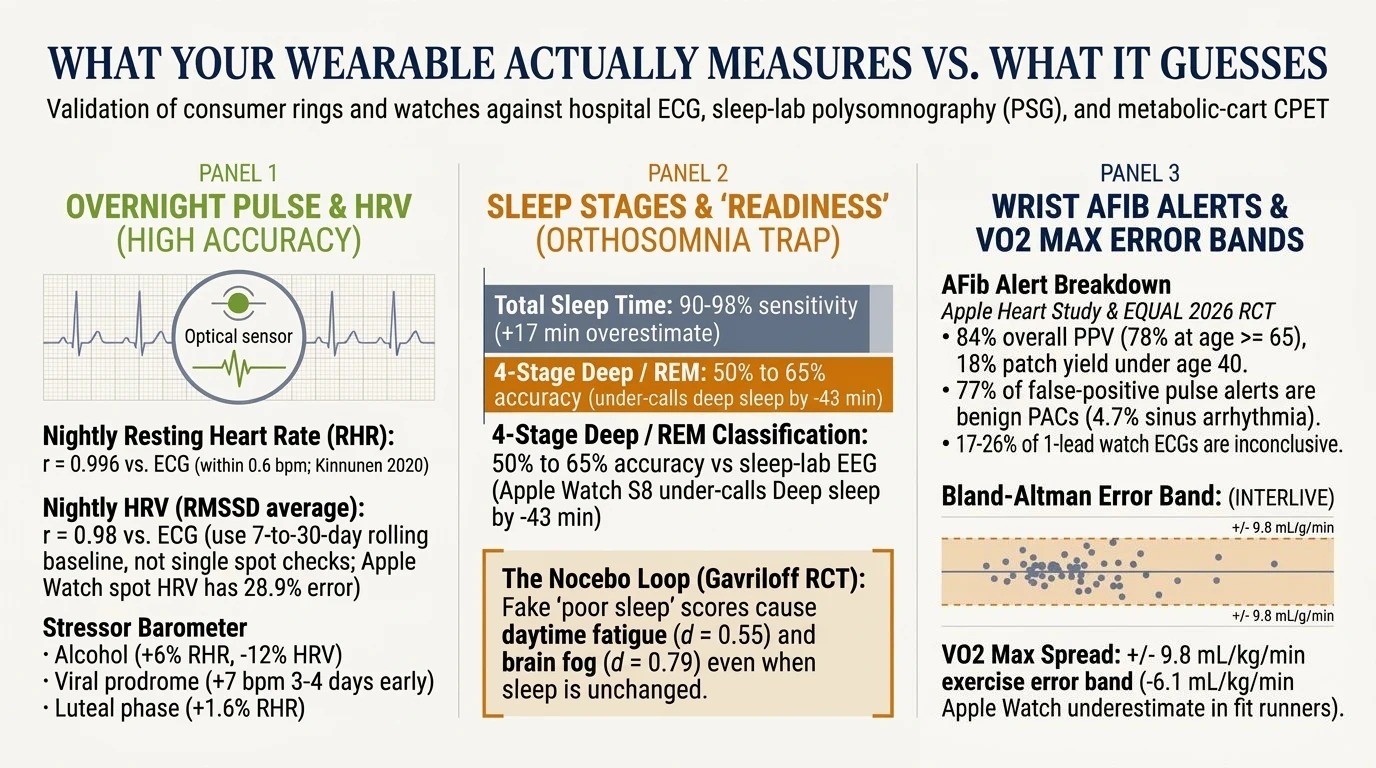
Independent validation studies against hospital electrocardiography (ECG), sleep-lab polysomnography (PSG), and metabolic-cart exercise testing (CPET) draw a sharp line between direct sensor measurements and software estimates:12622
| Wearable Metric | Accuracy vs. Hospital Gold Standard (ECG / PSG / CPET) | Key Clinical Caveat & How We Use It |
|---|---|---|
| Overnight Resting Heart Rate (RHR) | Very High: Oura r = 0.996 vs. ECG (bias -0.63 bpm); Fitbit ICC 0.998 (+/- 2.67 bpm); Whoop bias <= 0.39%.145 | Our #1 recovery barometer. Error is ~3% at rest and worsens by ~30% during exercise motion.6 |
| Overnight HRV (Full-Night RMSSD) | High as a full-night average: Oura r = 0.98 (bias -1.2 ms); Whoop lnRMSSD limits +/- 5.93%.15 | Reliable within one person on one device. Apple Watch spot HRV underestimates RMSSD by ~8 ms (28.9% error), and Garmin shows wide limits (-43% to +52%).78 |
| Overnight Breathing Rate | High in normal sleep: Fitbit r = 0.95 vs. nasal cannula (bias -0.24 breaths/min, 3% error); Samsung RMSE 1.13 breaths/min.910 | Helps spot viral prodromes, though accuracy drops to 79.5% in severe sleep apnea.10 |
| Total Sleep Time (TST) & Wake Time | Moderate: Overestimates sleep by ~17 min across 24 studies (95% CI 7-26 min); sleep sensitivity 90%-98%, wake specificity only 18%-60%.311 | Lying still awake in bed is routinely mislabeled as light sleep. Individual Oura errors span -54 to +98 min in clinical patients.11 |
| 4-Stage Sleep (Light, Deep, REM, Wake) | Low to Fair (50% to 65% in independent tests): Oura 61% (κ 0.43), Whoop 60%-64% (κ 0.44-0.47), Apple Watch 53% (κ 0.20), Garmin 50% (κ 0.25).23 | Apple Watch S8 underestimated deep sleep by 43 min and overestimated light sleep by 45 min.12 Accuracy drops further in insomnia (39.4% match with perceived sleep).11 |
| Composite "Readiness" / "Recovery" / "Body Battery" | Unvalidated: Zero independent peer-reviewed studies link these scores to clinical or performance outcomes.1314 | Built on unpublished formulas. Can trigger anxiety and orthosomnia; follow raw 7-day RHR and HRV instead.614 |
| Wearable VO2 Max Estimate | Wide Individual Error: Exercise bias -0.09 mL/kg/min, but 95% limits of agreement span +/- 9.83 mL/kg/min (+/- 15.24 at rest).22 | Apple Watch underestimates VO2 max by 6.07 mL/kg/min (13.3% error), under-reading fit runners and over-reading unfit adults.23 |
| Apple Watch Sleep Apnea Alert (SANF) | High Specificity, Modest Sensitivity: 66.3% sensitivity and 98.5% specificity for moderate-to-severe OSA (AHI >= 15).24 | An alert calls for a home sleep apnea test, while a silent watch misses 1 in 3 cases and never rules out OSA.24 |
How should you read your 7- to 30-day rolling baseline for RHR and HRV?
A single morning HRV or heart rate reading is noisy. A 7-day rolling average compared against your own 28- to 30-day baseline acts as a reliable barometer.131516
Heart rate variability (RMSSD) measures the millisecond changes between heartbeats driven by your vagus nerve (recovery brake). Healthy full-night HRV ranges from 25 ms in one fit adult to over 100 ms in another. In adults aged 45 and older, short sampling windows exceed 10% error more than half the time unless averaged across at least 30 minutes of quiet sleep.7 Sports studies by Plews and colleagues proved that a 7-day rolling average of lnRMSSD (using at least 3 valid nights per week) tracks training load far better than single mornings.13 Stanford's wearable infection studies (Mishra et al., 2020 and NightSignal, Alavi et al., 2022) use the same rule. They compare overnight RHR against a 28-day sliding baseline and only flag a shift when it holds across consecutive nights.1516
Across large wearable cohorts and sleep-lab trials, six common stressors move your overnight RHR and HRV by predictable amounts:15171819
| Physiological Stressor | Overnight RHR Shift | Overnight HRV (RMSSD) Shift | Clinical Evidence & Practical Nuance |
|---|---|---|---|
| Evening Alcohol Intake | +6% rise (effect size d = 0.97) | -12% drop (d = 0.55) | Measured across 28,175 Oura users and 9 million nights (Altini & Plews 2021); PSG trials confirm dose-dependent vagal suppression across all sleep stages.17 |
| Late Dinner vs. Sleep-Aligned Fasting | Higher nocturnal pulse | Lower HRV (reversed by earlier meal) | In a 2026 RCT (Grimaldi et al., ATVB 2026), finishing food >= 3 hours before bed (extending the overnight fast) significantly raised nighttime HRV and lowered heart rate.18 |
| Viral Infection Prodrome (COVID-19 / Flu) | Median +7 bpm jump | Drops before fever | Detected a median of 3 to 4 days before symptoms (80% presymptomatic sensitivity in NightSignal).1516 RHR alone cannot tell a virus from alcohol (+6% each; AUC 0.52 alone vs. 0.80 with sleep and steps).1617 |
| Short-Term Training Overload | +4.5 bpm rise | Can drop OR paradoxically rise | In ECSS/ACSM consensus and meta-analyses (Bellenger 2016), heavy overreaching can cause either a drop or a deceptive parasympathetic spike in HRV - always pair HRV with RHR and mood.19 |
| Starting CPAP for Sleep Apnea | -3.3 to -4.1 bpm drop | Vagal HRV rebounds | RCTs show CPAP lowers 24-hour heart rate by 3.3 bpm at 1 month and daytime RHR by 4.1 bpm at 2 weeks in prediabetes (Craig 2009; Pamidi 2020).19 |
| Menstrual Cycle (Follicular to Luteal Phase) | +1.6% rise (d = 1.41) | -3.2% drop (d = 0.80) | Progesterone after ovulation naturally warms body temperature and lifts RHR for 10 to 14 days - a normal hormone wave, not lost fitness.17 |
What is orthosomnia, and how do fake sleep scores cause daytime fatigue?
Orthosomnia - named by sleep researchers Kelly Baron and colleagues (JCSM 2017) - is insomnia and daytime worry driven by chasing ideal sleep-tracker numbers.20
Why does staring at a morning sleep score hurt your day? Two reasons work together:
- The device's stage breakdown is often wrong, above all if you have insomnia: Across 24 studies (Lee et al., JCSM 2025), wearables overestimate total sleep by ~17 minutes because they mistake lying still awake for light sleep (wake specificity is only 18% to 60%).311 Even human sleep-lab techs reading full scalp brainwaves (PSG) agree only 75% to 83% of the time on sleep stages (deep sleep κ ~0.57).12 In patients with insomnia, wearable accuracy drops to 83%. Agreement between the tracker and how the patient slept falls from 82.4% in good sleepers down to 39.4% in insomnia (Srivali 2026).11
- A bad morning score triggers a proven nocebo effect: In a randomized trial of 63 adults with insomnia (Gavriloff et al., 2018, building on Semler & Harvey 2005), researchers gave patients fake negative sleep-tracker feedback in the morning.21 Objective sleep and reaction-time tests were unchanged. Even so, being told they slept poorly caused worse daytime brain fog and lower alert thinking (d = 0.79) plus higher fatigue and sleepiness (d = 0.55) than positive feedback.21 In a national survey (Dion JMIR 2025), wearable use also steepened the link between anxiety and shorter sleep (P < 0.001).20
When we treat insomnia with cognitive behavioral therapy for insomnia (CBT-I), unguided smart-ring tracking often misses sleep-diary gains (Moon 2025). By contrast, clinician-guided wearable coaching lowered Insomnia Severity Index scores in the NITE trial (d = 0.51, Spina Sleep 2023).20 If your morning score causes dread, wait 30 minutes after waking to check your phone, hide stage breakdowns, or take a two-week break from wearing the device at night.
Performance Medicine
Stop guessing at recovery and energy. Get the data behind your performance.
What do irregular-rhythm alerts and wrist VO2 max estimates really mean?
When a watch flashes an atrial fibrillation (AFib) alert or prints a VO2 max number, base rates and sensor limits decide what you should do next.1922
1. Smartwatch Irregular-Rhythm Alerts & Single-Lead ECGs
Two numbers are often misquoted about watch AFib alerts:
- Age drives both alert rates and patch yield (Apple Heart Study, Perez NEJM 2019, n = 419,297; Fitbit Heart Study, Lubitz Circulation 2022, n = 455,699): In the Apple Heart Study, the oft-cited 84% positive predictive value (PPV) was the overall simultaneous patch value. In adults aged 65 and older, simultaneous PPV was 78% (tachogram PPV 60%).19 Because AFib is far more common with age, 3.2% of adults >= 65 received an alert and 35% had AFib confirmed on a follow-up ECG patch (41% in ages 55 to 64). In adults under age 40, only 0.16% were notified and only 18% had AFib on the patch.19 (Fitbit required at least 30 minutes of irregular pulse before alerting, reaching a 98.2% simultaneous PPV and 32.2% patch yield.)19
- Most false-positive pulse alerts come from benign extra beats (PACs), not sinus arrhythmia: Among irregular watch tachograms where AFib was not present in the Apple Heart Study, premature atrial contractions (PACs) were present in 77%. Brief atrial tachycardia appeared in 38% and PVCs in 16%, while sinus arrhythmia alone accounted for only 4.7%.19
- Single-lead watch ECGs need a doctor's eyes and a 2-week patch: While readable Apple Watch single-lead ECGs show ~95% sensitivity and specificity, 17% to 26% of automated readings are "Inconclusive" (and the watch cannot classify rhythms below 50 bpm or above 150 bpm).20 When inconclusive readings are counted in an intention-to-diagnose analysis (Doggart Heart Rhythm 2026), sensitivity and specificity drop to 78.1% and 81.0%.20 In the 2026 EQUAL trial (van Steijn et al., JACC 2026, adults >= 65), Apple Watch screening quadrupled AFib diagnosis (9.6% vs. 2.3%, HR 4.40). Yet the watch's automated AFib PPV was only 54% before cardiologist review.20 Because paroxysmal AFib comes and goes, Fitbit follow-up data (Lubitz 2025) showed that a single 10-second ECG caught only 7.6% of cases. A 1-week monitor caught 32.2% and a 4-week monitor caught 60.8% - which is why we order a 14-day Zio ECG patch instead of relying on one office ECG.19
2. Wrist-Estimated VO2 Max vs. Clinical CPET
In the INTERLIVE meta-analysis (Molina-Garcia et al., Sports Medicine 2022, 14 studies, n = 403), exercise-based wearable VO2 max estimates had a near-zero average bias (-0.09 mL/kg/min). Even so, the 95% limits of agreement spanned +/- 9.83 mL/kg/min (and resting estimates overestimated VO2 max by +2.17 mL/kg/min with limits of +/- 15.24 mL/kg/min).22 A gain of just 1.75 to 3.5 mL/kg/min (0.5 to 1.0 MET) lowers mortality (HR 0.83 per MET, Qiu 2021), so a watch's error band is wider than a meaningful clinical change.22 In validation testing of Apple Watch Series 9 and Ultra 2 (Lambe PLoS One 2025), the watch underestimated lab VO2 max by 6.07 mL/kg/min (13.3% error). It also underestimated fit runners while overestimating deconditioned adults - meaning an unfit patient can be falsely reassured until tested on a breath-by-breath CPET cart.23
Guidance from the Clinic

Key Takeaways
- Trust overnight RHR and full-night HRV trends: Nocturnal RHR (Oura r = 0.996, bias -0.63 bpm; Fitbit ICC 0.998; Whoop bias <= 0.39%) and full-night RMSSD (Oura r = 0.98) are the best-validated consumer wearable signals when tracked as 7- to 30-day rolling baselines.14513
- Doubt single-night sleep stages and composite readiness scores: Independent four-stage sleep accuracy is only 50% to 65% (with wake specificity of 18% to 60% and a +17-minute sleep overestimate), and sham-feedback RCTs (Gavriloff 2018) prove that negative morning sleep scores cause daytime fatigue (d = 0.55) and brain fog (d = 0.79).21121
- Use N-of-1 experiments on modifiable stressors: Alcohol (+6% RHR, -12% HRV), eating within 3 hours of bed (Grimaldi 2026 RCT), viral prodromes (+7 bpm 3 to 4 days early), CPAP therapy (-3.3 to -4.1 bpm), and the luteal phase (+1.6% RHR) produce clear, measurable shifts on your rolling baseline.151718
- Confirm watch AFib alerts and VO2 max estimates with clinical tests: In the Apple Heart Study, PPV was 84% overall (78% at age >= 65), patch yield was 18% under age 40, and 77% of false-positive pulse alerts came from benign PACs (4.7% sinus arrhythmia) - always confirm with a 14-day Zio patch and verify wrist VO2 max (+/- 9.8 mL/kg/min error band) with a clinical CPET test.192223
Related at Fishtown Medicine
- VO2 Max: The Fitness Metric That Predicts Lifespan - why a clinical CPET cart beats wrist VO2 max estimates and how Norwegian 4x4 intervals work
- Your Watch Flagged AFib: What to Do Next - how we verify wrist irregular-rhythm alerts with a 14-day patch
- 14-Day Heart Monitor (Zio Patch) - why a 2-week patch catches 30% to 64% more arrhythmias than a 24-hour Holter
- Skipped Heartbeats & PVCs - why harmless extra beats trigger 77% of false-positive watch pulse alerts
- Home Sleep Apnea Testing (WatchPAT) - ruling out nighttime oxygen drops when your wearable shows unrefreshing sleep
- CBT-I for Chronic Insomnia - breaking the orthosomnia loop and restoring natural sleep drive
Scientific References
- Kinnunen H, Rantanen A, Kenttä T, Koskimäki H. "Feasible Assessment of Recovery and Cardiovascular Health: Accuracy of Nocturnal HR and HRV Assessed via Ring PPG in Comparison to Medical Grade ECG." Physiological Measurement. 2020;41(4):04NT01.
- Miller DJ, Sargent C, Roach GD. "A Validation of Six Wearable Devices for Estimating Sleep, Heart Rate and Heart Rate Variability in Healthy Adults." Sensors. 2022;22(16):6317.
- Schyvens AM, Peters B, Van Oost NC, et al. "A Performance Validation of Six Commercial Wrist-Worn Wearable Sleep-Tracking Devices for Sleep Stage Scoring Compared to Polysomnography." Sleep Advances. 2025;6(1):zpaf021; and Chinoy ED, Cuellar JA, Huwa KE, et al. "Performance of Seven Consumer Sleep-Tracking Devices Compared With Polysomnography." Sleep. 2021;44(5):zsaa291.
- Haghayegh S, Khoshnevis S, Smolensky MH, Diller KR. "Accuracy of PurePulse Photoplethysmography Technology of Fitbit Charge 2 for Assessment of Heart Rate During Sleep." Chronobiology International. 2019;36(7):927-933.
- Bellenger CR, Miller DJ, Halson SL, Roach GD, Sargent C. "Wrist-Based Photoplethysmography Assessment of Heart Rate and Heart Rate Variability: Validation of WHOOP." Sensors. 2021;21(10):3571.
- Petek BJ, Al-Alusi MA, Moulson N, et al. "Consumer Wearable Health and Fitness Technology in Cardiovascular Medicine: JACC State-of-the-Art Review." Journal of the American College of Cardiology. 2023;82(3):245-264.
- Liang T, Yilmaz G, Soon CS. "Deriving Accurate Nocturnal Heart Rate, rMSSD and Frequency HRV From the Oura Ring." Sensors. 2024;24(23):7475.
- O'Grady B, Lambe R, Baldwin M, Acheson T, Doherty C. "The Validity of Apple Watch Series 9 and Ultra 2 for Serial Measurements of Heart Rate Variability and Resting Heart Rate." Sensors. 2024;24(19):6220; and Casanova-Lizón A, Sarabia JM, Aracil-Marco A, et al. "Pulse vs. R-R Interval: Validity and Reliability of the Garmin Elevate V4 Sensor for Ultra-Short HR and HRV Monitoring in Healthy Adults." Sensors. 2026;26(2):512.
- Natarajan A, Su HW, Heneghan C, et al. "Measurement of respiratory rate using wearable devices and applications to COVID-19 detection." npj Digital Medicine. 2021;4(1):136.
- Jung H, Kim D, Choi J, Joo EY. "Validating a Consumer Smartwatch for Nocturnal Respiratory Rate Measurements in Sleep Monitoring." Sensors. 2023;23(18):7976.
- Lee YJ, Lee JY, Cho JH, Kang YJ, Choi JH. "Performance of Consumer Wrist-Worn Sleep Tracking Devices Compared to Polysomnography: A Meta-Analysis." Journal of Clinical Sleep Medicine. 2025;21(1):115-126; Herberger S, Aurnhammer C, Bauerfeind S, et al. Scientific Reports. 2025;15:8912; Guo J, Luo J, Xiao Y, Huang R. PLoS One. 2024;19(10):e0311201; and Srivali N, Cheungpasitporn W. Sleep Medicine. 2026;138:45-53.
- Robbins R, Weaver MD, Sullivan JP, et al. "Accuracy of Three Commercial Wearable Devices for Sleep Tracking in Healthy Adults." Sensors. 2024;24(20):6532; and Birrer V, Elgendi M, Lambercy O, Menon C. npj Digital Medicine. 2024;7(1):74.
- Plews DJ, Laursen PB, Stanley J, Kilding AE, Buchheit M. "Training Adaptation and Heart Rate Variability in Elite Endurance Athletes: Opening the Door to Effective Monitoring." Sports Medicine. 2013;43(9):773-781; and Plews DJ, Laursen PB, Le Meur Y, et al. Int J Sports Physiol Perform. 2014;9(5):783-790.
- Rosenbach H, Itzkovitch A, Gidron Y, Schonberg T. "Assessing Stress Level Scores Against Wearables-Driven Physiological Measurements." Stress and Health. 2025;41(1):e70125; and Hughes AM, Taylor DJ, Morris PD, Brittain EL. "Wearable devices and cardiovascular health: revolutionizing remote monitoring and disease prevention." European Heart Journal. 2026;47(8):812-828.
- Mishra T, Wang M, Metwally AA, et al. "Pre-symptomatic detection of COVID-19 from smartwatch data." Nature Biomedical Engineering. 2020;4(12):1208-1220.
- Alavi A, Bogu GK, Wang M, et al. "Real-time alerting system for COVID-19 and other stress events using wearable data." Nature Medicine. 2022;28(1):175-184; and Quer G, Radin JM, Gadaleta M, et al. Nature Medicine. 2021;27(1):73-77.
- Altini M, Plews D. "What Is Behind Changes in Resting Heart Rate and Heart Rate Variability? A Large-Scale Analysis of Longitudinal Measurements Acquired in Free-Living." Sensors. 2021;21(23):7932; de Zambotti M, Forouzanfar M, Javitz H, et al. Sleep. 2021;44(1):zsaa136; and Greenlund IM, Bigalke JA, Tikkanen AL, et al. Sleep. 2021;44(9):zsab130.
- Grimaldi D, Reid KJ, Abbott SM, Knutson KL, Zee PC. "Sleep-Aligned Extended Overnight Fasting Improves Nighttime and Daytime Cardiometabolic Function." Arteriosclerosis, Thrombosis, and Vascular Biology. 2026;46(4):612-623.
- Perez MV, Mahaffey KW, Hedlin H, et al. "Large-Scale Assessment of a Smartwatch to Identify Atrial Fibrillation." New England Journal of Medicine. 2019;381(20):1909-1917; Lubitz SA, Faranesh AZ, Selvaggi C, et al. Circulation. 2022;146(19):1415-1424; Lubitz SA, McConnell MV, Selvaggi C, et al. Circ Arrhythm Electrophysiol. 2025;18(7):e013412; Bellenger CR, Fuller JT, Thomson RL, et al. Sports Medicine. 2016;46(10):1461-1486; and Pamidi S, Chapotot F, Wroblewski K, et al. J Am Heart Assoc. 2020;9(19):e016871.
- Baron KG, Abbott S, Jao N, Manalo N, Mullen R. "Orthosomnia: Are Some Patients Taking the Quantified Self Too Far?" Journal of Clinical Sleep Medicine. 2017;13(2):351-354; Spina MA, Andrillon T, Quin N, et al. Sleep. 2023;46(9):zsad138; Doggart P, Fisher C, Biglarbeigi P, et al. Heart Rhythm. 2026;23(1):88-96; van Steijn NJ, Blommestijn IS, Blok S, et al. (EQUAL Trial). Journal of the American College of Cardiology. 2026;87(15):1612-1625; and McIntyre WF, Benz AP, Becher N, et al. (NOAH-AFNET 6 & ARTESiA Meta-Analysis). Circulation. 2024;149(13):981-992.
- Gavriloff D, Sheaves B, Juss A, et al. "Sham Sleep Feedback Delivered via Actigraphy Biases Daytime Symptom Reports in People With Insomnia: Implications for Insomnia Disorder and Wearable Devices." Journal of Sleep Research. 2018;27(6):e12726; and Semler CN, Harvey AG. Behaviour Research and Therapy. 2005;43(7):843-856.
- Molina-Garcia P, Notbohm HL, Schumann M, et al. "Validity of Estimating the Maximal Oxygen Consumption by Consumer Wearables: A Systematic Review with Meta-analysis and Expert Statement of the INTERLIVE Network." Sports Medicine. 2022;52(7):1577-1597; and Qiu S, Cai X, Sun Z, Wu T, Schumann U. Atherosclerosis. 2021;330:22-32.
- Lambe R, O'Grady B, Baldwin M, Doherty C. "Investigating the accuracy of Apple Watch VO2 max measurements: A validation study." PLoS One. 2025;20(5):e0318842.
- U.S. Food and Drug Administration. "Apple Watch Sleep Apnea Notification Feature (SANF) 510(k) Clearance K240929." 2024.

Frequently Asked Questions
Common Questions
Deep-Dive Questions
Ready when you are
The chat is our AI assistant, answering from our published guides. To talk it through with Dr. Ash himself, start with the intake.